
Reduce irritation risk at the lash line—and market your glue honestly, with evidence that stands up to audits. Learn more about eyelash materials and adhesives.
Introduction
Lash adhesives sit inches from one of the most sensitive surfaces on the body. Most problems we see in the field trace back to two things: placement/technique (glue too close to the lid margin, skin contact, fumes trapped under pads) and overconfident claims (e.g., “hypoallergenic,” “safe for everyone,” or medical-ish wording that triggers regulatory scrutiny).
We’ll share practical, factory-informed guidance on safe positioning and a clear framework for compliant claims—so your artists and your brand team can stay on the same page.
Safety note (non-medical): We can share general, evidence-informed guidance, but if you have persistent irritation, swelling, pain, or vision changes, please stop use and consult an eye-care professional.
Quick Answer (Safe placement + claim-safe marketing)
One-sentence answer (for snippets):
Place lash adhesive on the natural lash shaft only—never on skin or the waterline—and reduce stinging by preventing vapor trapping (pads/tape/occlusion) and controlling humidity/temperature. For marketing, avoid absolute safety claims and keep every claim tied to documented evidence.
Do this first (most common causes of stinging)
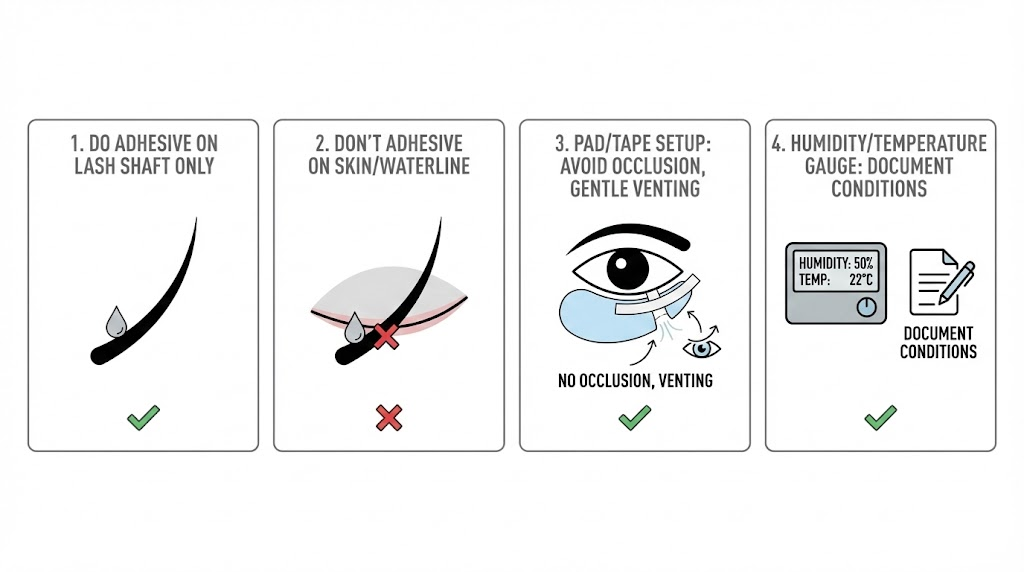
- Keep glue off skin and off the waterline.
- Bond to the natural lash shaft (not the lid margin / follicle opening).
- Use minimal volume (avoid pooling at the base).
- Confirm eyes fully closed + pads/tape not touching the waterline.
- Control room humidity + temperature and use fresh drops on schedule.
- If symptoms persist, treat as sensitivity/allergy risk and follow stop rules.
Citable takeaway: Most “burning during application” complaints are technique or vapor-trapping problems first (pads/tape/eye closure/distance), not a “mystery allergy.”
Irritation vs allergy (don’t train them as the same thing)
- Irritation (often immediate): burning/stinging during service; commonly tied to placement, fumes, or occlusion.
- Allergic contact dermatitis (often delayed): itching, swelling, redness that may worsen hours later; acrylates/cyanoacrylates can be allergens for some people.
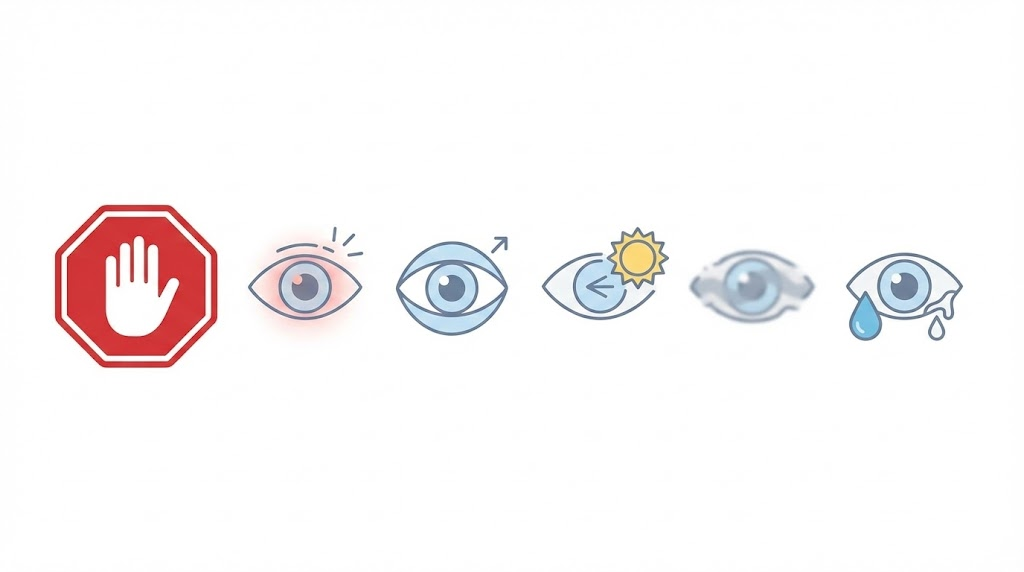
“Stop rules” (put this on every aftercare card)
Stop use and seek eye-care advice urgently if any of these occur:
- Pain, worsening redness or swelling
- Light sensitivity
- Blurred vision or vision changes
- Persistent tearing or discharge
Claim-safe language (what you can usually say if true and documented)
- “For professional use only” (with clear directions + precautions)
- “Fast-setting (X sec) when used as directed” (state test conditions)
- “Low-odor / reduced odor” (only with a defined test method)
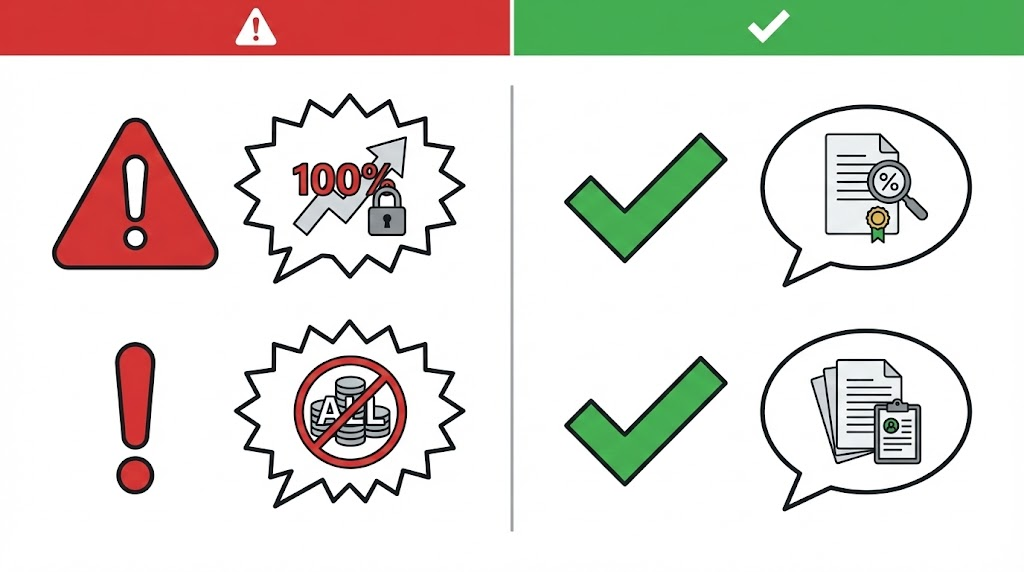
Avoid (high-risk phrases unless you can prove them in a robust file)
- “Hypoallergenic,” “safe for everyone,” “non-irritating”
- Medical-ish wording like “treats, prevents, heals, repairs”
- “Stimulates lash growth” / structure–function type promises
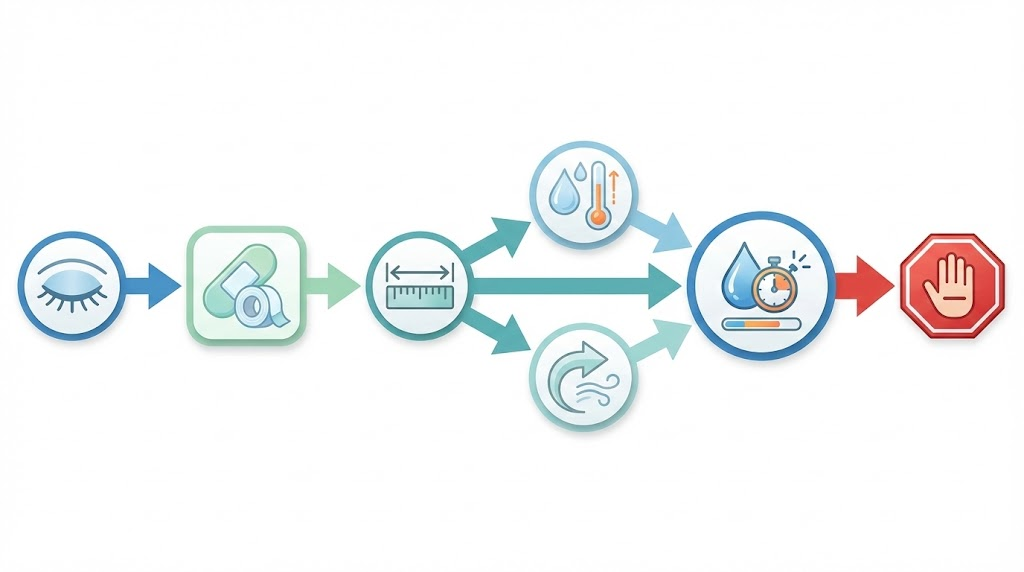
Burning During Application? Fix Technique First (60-Second Troubleshooting Flow)
Troubleshooting flow (during the appointment)
Start: Client reports immediate burning/stinging/watering while you’re working.
- Check eye closure + pad/tape first
- Is the eye fully closed?
- Are under-eye pads touching the waterline?
- Is tape/pad creating a “seal” that traps vapors and funnels them upward?
If yes → reset pads/tape, ensure full closure, add micro-venting (no occlusion).
- Check placement distance + skin contact
- Is adhesive wicking onto lid margin / skin?
- Are you bonding at the follicle opening instead of the lash shaft?
- Do you see whitening/blooming right at the base?
If yes → increase clearance, reduce adhesive volume, re-isolate and rebond to lash shaft.
- Check adhesive drop behavior + environment
- Is the drop old/thick/stringy?
- Is humidity/temperature outside your target band?
- Is airflow blowing toward the face?
If yes → refresh drop, stabilize room conditions, redirect airflow away from the face.
- If symptoms persist after technique fixes
- Stop the service and follow your stop rules (pain, swelling, vision changes, intense redness).
- Document product lot + environment + what was tried.
- Consider sensitivity/allergy evaluation only after technique causes are ruled out.
Key distinction to teach staff:
- Immediate burning is more often fumes/occlusion/placement.
- Allergic contact dermatitis more often shows delayed patterns and may require clinical evaluation.
If it burns immediately, assume technique/environment first—then escalate to sensitivity/allergy only after you’ve ruled out exposure mechanics.
Why Lash Adhesives Are “High-Sensitivity” Products
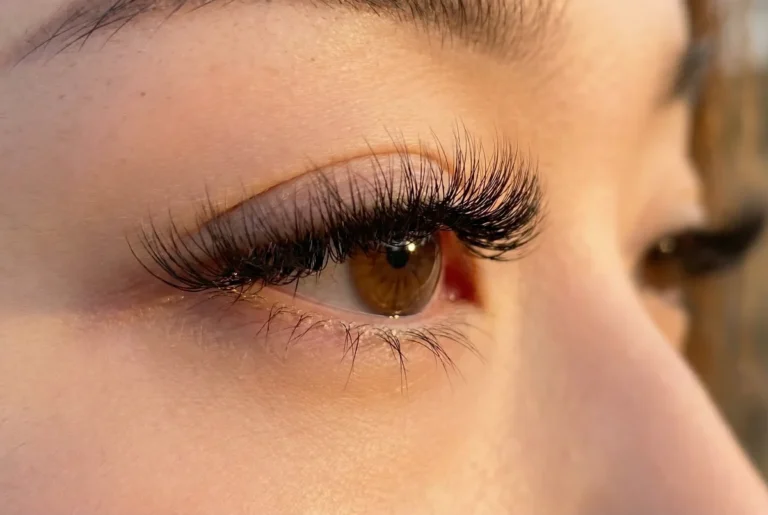
Even when used correctly, eyelash extension procedures can cause ocular surface symptoms (foreign body sensation, dryness, transient irritation), and misapplication can increase risk. Explore cluster lashes vs volume lashes for safety insights.
Two reasons lash adhesives demand extra care:
- Proximity to the ocular surface (tears spread ingredients/vapors fast).
- Chemistry + curing: most extension glues are cyanoacrylate-based, which can irritate via vapors and can also trigger allergy in a minority of users.
Safe Positioning: Where Adhesive Should (and Shouldn’t) Go
The non-negotiables we teach
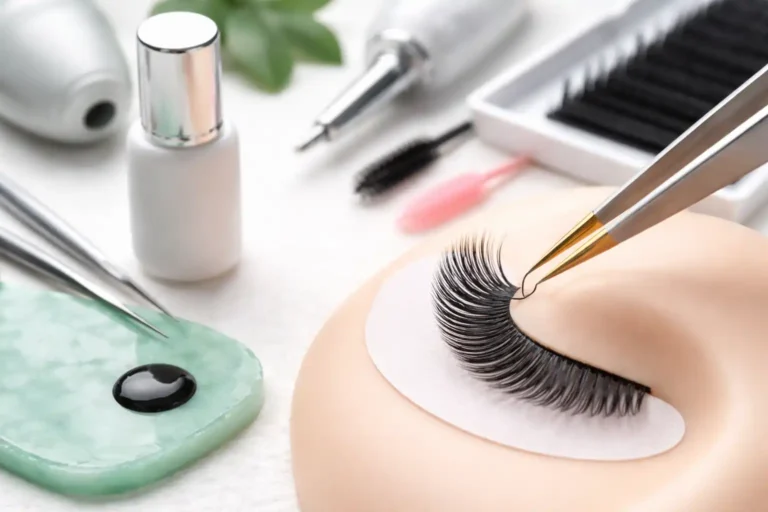
- Never place adhesive on the waterline (wet mucosa) or allow it to wick onto the eyelid margin.
- Avoid skin contact entirely. Adhesive belongs on the extension base + natural lash, not on the lid.
- Bond on the natural lash shaft (not at the follicle opening, not on the inner lid margin).
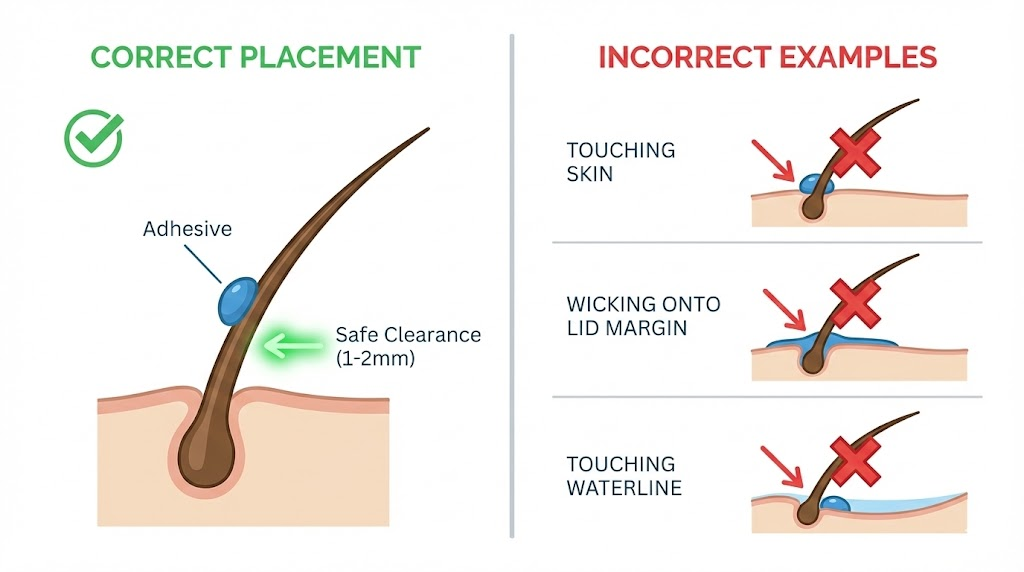
How Far From the Lid? Use “Clearance” Rules (Not a Magic Number)
The goal is consistent clearance from skin and the waterline while bonding to the lash shaft. Different training systems use different distances, but the intent is the same: retention without mucosal/skin exposure.
Use these clearance rules in training and audits:
- Rule 1 (Non-negotiable): Adhesive must never touch skin or the waterline.
- Rule 2 (Placement target): Bond to the natural lash shaft, not the follicle opening or lid margin.
- Rule 3 (Consistency): Pick a brand-standard clearance guideline and treat it as a controlled instruction: teach it, observe it, and document it.
Practical checks (what to look for):
- If you see whitening/blooming at the lid edge → assume too close / too much adhesive / occlusion.
- If the client feels a sharp poke at the base → assume placement/angle before blaming product sensitivity.
- If lashes feel “stuck to the lid” → you’ve crossed into skin contact (fix immediately).
If you publish a numeric distance:
Only do so if you can support it operationally (training + audit photos + consistency checks). Otherwise, publish clearance rules + do-not-cross boundaries.
Tape/pad placement matters more than people think
Poorly placed under-eye pads can cause:
- Micro-gaps that funnel vapor upward
- Contact with the lower waterline
- Chemical sting that looks like “allergy” but isn’t
The American Academy of Ophthalmology emphasizes the importance of experienced application and safe chemicals in a sanitary setting.
Environment + Workflow: Reducing Fumes Without Weakening Retention
Cyanoacrylate cure speed and vapor behavior change with humidity, temperature, and drop age. Small process controls make a big difference:
- Fresh drops on a schedule (old drops thicken and behave inconsistently)
- No “pooling” at the base (more mass = more vapor + more chance of wicking)
- Gentle airflow that doesn’t blow adhesive into the eye (avoid fans aimed directly at the face)
- Consistent humidity/temperature in your lash room; document your target band and train to it
This matters because ocular surface symptoms and corneal staining changes have been documented after extensions in clinical studies—even with skilled application—so reducing avoidable exposure is worth it.
Client Screening + Aftercare: The “Stop Rules” You Should Put on Every Insert
This is where eye safety and compliant claims overlap: the clearer your instructions, the safer your real-world use looks.
Screen for higher risk
Consider extra caution (or referral) for clients with:
- Current eye infection, active inflammation, or recent eye surgery
- Significant dry eye symptoms
- Known acrylate/cyanoacrylate allergy history (nail products, medical skin glues)
(Allergy to cyanoacrylates is documented in dermatology literature and case reports.)
Aftercare “stop use and seek care” triggers
Include plain-language stop rules such as:
- Pain, worsening redness, swelling
- Light sensitivity
- Blurred vision
- Persistent tearing or discharge
These align with ophthalmology safety messaging: don’t “push through” eye symptoms.
Reaction Protocol (SOP): What to Do, What to Record, What to Change Next Time
Step 1 — Stop rules (immediate)
Stop service and advise evaluation if any of the following occur: pain, swelling, light sensitivity, blurred vision, worsening redness, discharge.
Step 2 — Separate “exposure mechanics” vs “suspected allergy” (same-day)
- Immediate burning during service → treat as placement/pads/occlusion/fume control until proven otherwise.
- Delayed dermatitis pattern → treat as possible allergy and document for follow-up.
Step 3 — Log these 10 fields (this is your investigation power)
For each incident, record:
- Product name + lot/batch code
- Date/time + service duration
- Room humidity + temperature (actual reading)
- Adhesive drop age (fresh / how many minutes open)
- Pad/tape type + placement notes (waterline contact? occlusion?)
- Placement style (clearance rule used; volume notes)
- Symptoms + timing (immediate vs delayed)
- What troubleshooting changes were attempted (and result)
- Aftercare instructions given
- Outcome follow-up (resolved / referred / unknown)
Step 4 — Corrective action (next appointment / next batch)
- Technique fix: clearance + volume + pad placement + airflow
- Process fix: drop schedule + humidity control + training refresh
- Product fix: if clustered by lot → trigger retain sample checks + viscosity/cure verification
Step 5 — What NOT to say (reduces legal/compliance risk)
Avoid diagnosing (“allergy”, “chemical burn”). Use: “possible irritation; discontinue; seek professional care if severe.”
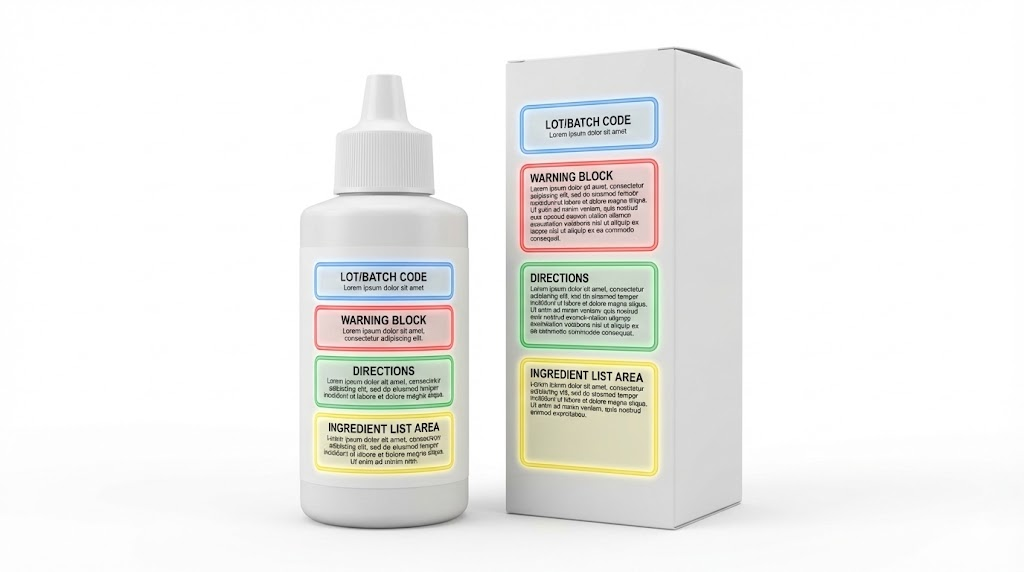
Ingredients, Labeling, and Warnings: What Private Label Brands Commonly Miss
Ingredient naming and lists
If you sell a consumer-facing adhesive, you’ll typically need an ingredient declaration approach that matches your market:
- US: FDA provides cosmetic labeling resources and expects non-misleading labeling; warning statements are required when needed to prevent a health hazard.
- Canada: Health Canada’s industry guide describes INCI ingredient labeling requirements.
- EU: Cosmetic Regulation 1223/2009 sets labeling and safety expectations, plus requirements like a Product Information File (PIF) under the Responsible Person system.
“For professional use only” isn’t a magic shield
It helps communicate intended use, but it doesn’t erase the need to:
- Provide clear directions and precautions
- Maintain traceability (lot/batch)
- Avoid misleading safety claims
Warning statements (don’t bury them)
In the US, 21 CFR Part 740 lays out warning statement principles (“whenever necessary or appropriate to prevent a health hazard”).
In the EU, precautions for use are a standard labeling element when relevant.
Operational best practice (manufacturing/QC): A two-layer traceability system—(1) bottle-level lot code and (2) carton/shipper lot + date—reduces investigation time when complaints cluster.
Claims Compliance 101: What You Can Say (and What Triggers Trouble)
EU: Common Criteria = your claim checklist
In the EU, cosmetic claims must follow common criteria (truthfulness, evidential support, honesty, etc.), and claims must be supported by adequate and verifiable evidence.
Practical takeaway: If you can’t show your proof file fast, soften the claim.
US: FTC + FDA “division of labor”
- FTC: advertising must be truthful; you need a “reasonable basis,” and health/safety-style claims generally need competent and reliable scientific evidence.
- FDA: oversees cosmetic labeling and takes issue with misleading labels and drug claims. FDA warning letters show how “drug-like” claims (e.g., “stimulates eyelash growth”) can reclassify risk.
Citable snippet: If your copy implies you “treat,” “prevent,” or “repair” a medical condition—or “affect the structure/function” (like “stimulates lash growth”)—you may be stepping into drug-claim territory, even if the product looks cosmetic.
Claims Evidence Ladder (Match the Claim to the Proof You Need)
Use this ladder to prevent overclaiming: the stronger the claim, the stronger (and more specific) your evidence file must be.
Level 1 — Descriptive / intended use (lowest risk)
Examples: “For professional use only,” “Fast-setting when used as directed,” “Works best in X–Y humidity band.”
Proof: internal SOPs + repeatable bench checks + documented conditions.
Level 2 — Performance claims (medium risk, high SEO value)
Examples: “Dry time: X seconds (at defined RH/temp),” “Retention up to X weeks (under defined routine),” “Low-odor vs our previous formula.”
Proof: standardized test protocol, sample size, acceptance criteria, date-stamped results.
Level 3 — Sensory / comfort-adjacent (higher scrutiny near eyes)
Examples: “Minimal fumes when used as directed,” “Designed to reduce sting via workflow controls.”
Proof: controlled-use evaluations, clearly defined outcomes, adverse event logging.
Level 4 — Health/safety-adjacent (highest scrutiny)
Examples: “Safe for sensitive eyes,” “Non-irritating,” “Hypoallergenic,” “Ophthalmologist tested.”
Proof: robust, relevant human-use testing under professional oversight + documented methodology.
Rule: If you can’t produce the protocol/results quickly, soften the claim.
A copy rule that keeps you compliant:
Tie comfort claims to conditions: “when used as directed,” “in a controlled environment,” “for professional application,” and keep absolutes out.
“Hypoallergenic,” “Non-Irritating,” “Safe for Sensitive Eyes”: Safer Alternatives That Stay Honest
These are the phrases that most often create compliance headaches.
1) “Hypoallergenic”
Risk: consumers interpret it as “won’t cause allergy.” But allergy to cyanoacrylates/acrylates is documented.
Better:
- “Formulated to minimize common irritants*” (only if you define the asterisk and have evidence)
- “Dermatologist-tested” / “Ophthalmologist-tested” only if you have the test protocol and results
2) “Non-irritating”
Risk: “non-irritating” reads like a universal guarantee—hard to substantiate for eye-adjacent products.
Better:
- “Assessed for eye-area compatibility in a supervised use test” (then specify what that means in your substantiation file)
- “Designed for professional application with minimal fumes when used as directed” (ties performance to directions)
3) “Free-From” Claims: The 6 Things You Must Document
IIf you say “X-free”, keep a file that answers:
- What exactly is “X”? (name/definition; avoid vague wording)
- What test method did you use? (and who ran it)
- What’s the detection limit? (so “not detected” has meaning)
- How often do you test? (per batch / periodic / both)
- How do you prevent contamination upstream? (raw materials, packaging, storage)
- What conditions does the claim assume? (shelf-life, storage, cap/nozzle handling)
Copy-safe wording pattern (use this instead of absolutes):
- “Formulated without intentionally added [X]” (only if accurate and documented)
- “Tested for [X] (not detected above [limit]) in [samples/batches] using [method]”
A Practical Table: Adhesive Types, Safety Notes, and Claim-Safe Language
Main types of eyelash extensions
| Product type | Typical use | Main safety positioning focus | Claims that usually survive compliance review* |
|---|---|---|---|
| Extension adhesive (cyanoacrylate-based) | Pro application | No skin contact; avoid waterline; control fumes | “For professional use”; “Fast-setting (X sec) when used as directed”; “Low-odor” (with testing) |
| Strip lash adhesive | Consumer/pro | Keep off waterline; avoid getting into eye; patch test policies must be careful | “Latex-free” (if true + documented); “Water-resistant” (define conditions) |
| Remover (gel/cream) | Pro | Prevent eye entry; protect ocular surface during removal | “Designed to minimize run-off” (with viscosity testing); strong precautions |
*Not legal advice; local requirements vary.
Our QC Checklist for Adhesives: What “Stable Quality” Really Means
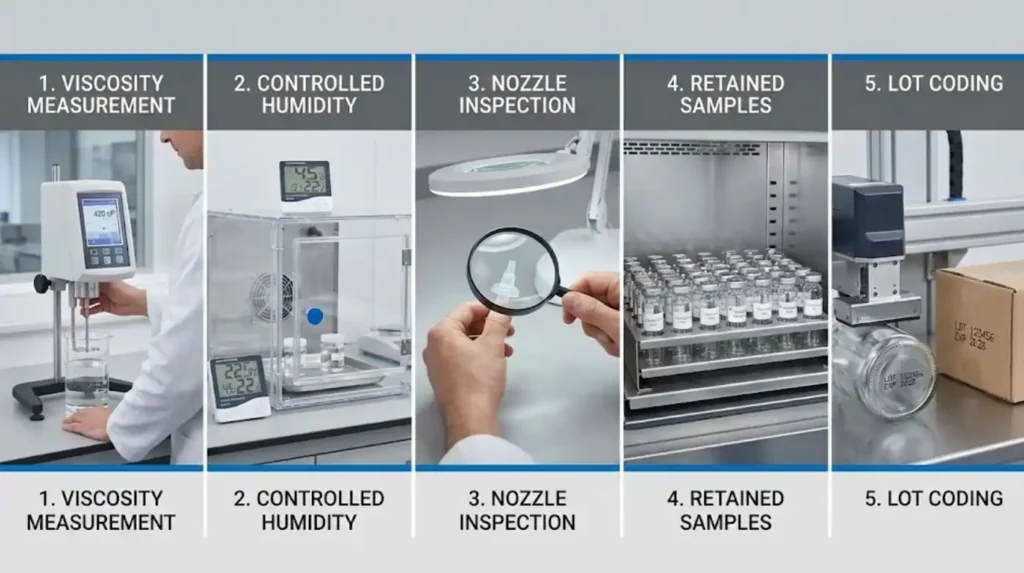
As a private label/OEM partner, we think “eye safety” starts upstream with consistency. Here are the manufacturing controls that reduce field complaints:
- Incoming raw material identity checks (correct monomer/grade, COAs verified)
- Viscosity window controls (too thin = wicking risk; too thick = poor bonding)
- Cure-speed verification in controlled humidity/temperature (speed claims must match reality)
- Fill-weight and nozzle inspection (drip behavior impacts placement safety)
- Batch retains + traceability so you can investigate complaints quickly
- GMP-aligned documentation (many cosmetics operations map to ISO 22716 principles)
Factory insight (info gain): We see “mystery irritation spikes” drop when brands standardize drop-change timing, humidity targets, and lash-room logging. When you pair salon logs with lot codes, investigations become objective instead of anecdotal.
Quick Checklist: Safe Positioning + Compliant Claims (Copy/Paste)
Salon / Pro-use
- ☐ Confirm eyes fully closed; pads placed without waterline contact
- ☐ Isolate natural lash; bond on lash shaft (no skin contact)
- ☐ Use minimal adhesive volume; avoid pooling
- ☐ Control room humidity/temperature; change drops on schedule
- ☐ Stop rules communicated (pain, swelling, vision changes → stop + seek care)
Brand / Marketing
- ☐ Claims match evidence files (tests, protocols, dates, samples)
- ☐ Avoid drug-like language (“treat,” “heal,” “stimulate growth”)
- ☐ “Free-from” claims are meaningful, fair, and test-backed
- ☐ Label includes clear precautions and traceable lot coding
FAQ
Can we claim “ophthalmologist tested”?
Only if you actually conducted an ophthalmologist-supervised assessment and can produce the protocol + results. For health/safety-adjacent claims, expect higher substantiation expectations.
Is “formaldehyde-free” safe to say?
It can be, but it’s a high-scrutiny claim. In the EU, “free-from” claims are evaluated against common criteria and guidance; you’ll want robust testing and contamination controls.
If someone reacts, is it definitely an allergy?
Not necessarily. Immediate burning during application can be technique/environment-related; true allergy often shows patterns consistent with contact dermatitis and may require clinical evaluation.
Do eyelash extensions affect dry eye?
Research suggests eyelash extensions can affect ocular surface measures and symptoms in some users, which is why conservative placement and clear stop rules matter.
Key Points
- Safe lash adhesive use is mostly placement + process control, not “magic gentle glue.”
- Keep adhesive off skin and waterline; bond to the natural lash shaft.
- Control environment and workflow to reduce stinging from vapors.
- Allergy to cyanoacrylates/acrylates is real—avoid absolute claims like “hypoallergenic.”
- In the EU, claims must meet common criteria and be supported by verifiable evidence.
- In the US, advertising claims need a reasonable basis; health/safety claims need stronger proof.
- Factory controls (viscosity, cure speed, packaging integrity, lot traceability) support both safety and compliance.
Conclusion
Fewer irritation complaints and fewer compliance headaches usually come from treating lash adhesive as a system: Technique (distance + no skin/waterline contact), environment (humidity/temperature + fume control), and documentation (claims matched to evidence and traceable lots).
If you standardize placement, reduce avoidable vapor exposure, and write claims that can be substantiated quickly, you’ll improve both client outcomes and audit resilience.
If you’re building or revising an adhesive line, we can help translate this guide into a practical package: claim language → substantiation plan → label copy → QC checkpoints → batch traceability.
Reference List
American Academy of Ophthalmology (AAO). Eyelash Extension Facts and Safety.
Han H, et al. The effects of eyelash extensions on the ocular surface. Contact Lens & Anterior Eye. 2023.
Symanzik C, Weinert LS, Babic I, et al. Allergic contact dermatitis caused by 2-hydroxyethyl methacrylate and ethyl cyanoacrylate contained in cosmetic glues among hairdressers and beauticians: A systematic review. Contact Dermatitis. 2022.
Bhargava K, White IR, White JML. Eyelid allergic contact dermatitis caused by ethyl cyanoacrylate-containing eyelash adhesive. Contact Dermatitis. 2012;67(5):306–307.
Milkovic M, et al. Exposure to Nail and False Eyelash Glue: A Case Series Study. International Journal of Environmental Research and Public Health. 2020.
Parać E, et al. Unwanted Skin Reactions to Acrylates: An Update. Cosmetics. 2024.
Voller LM, Warshaw EM. Acrylates: new sources and new allergens. Clinical and Experimental Dermatology. 2020.
European Chemicals Agency (ECHA). Substance Information: Ethyl 2-cyanoacrylate (harmonised classification: serious eye irritation/skin irritation/respiratory irritation).
Merck / Sigma-Aldrich. Safety Data Sheet (SDS).
Henkel LOCTITE®. LOCTITE 496 Technical Data Sheet (cure depends on ambient RH; Cure Speed vs. Humidity).