
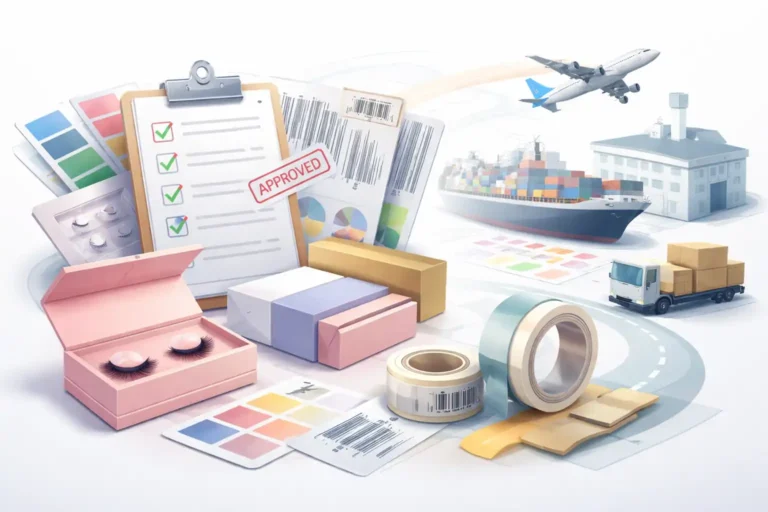
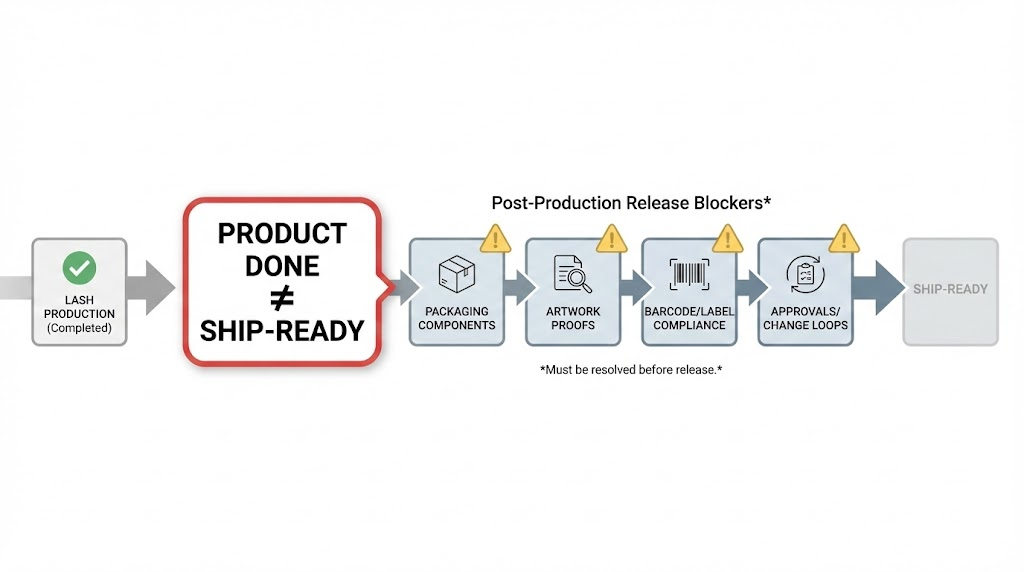
Private label delays rarely come from lash production. They come from release blockers: packaging components, artwork approvals, barcode/label compliance, and last-minute change loops.
This factory-tested checklist shows what to do in the first 24–72 hours to keep shipments moving without skipping QC.
Quick Answer
To avoid private label production delays, treat packaging + labeling as the critical path. First, identify the single release blocker (the one missing item that prevents shipping) and freeze non-essential changes.
Then execute one of four recovery paths: substitute a pre-approved component, simplify packaging (standard box + label/sleeve), split shipments, or switch shipping mode (often expediting packaging only).
Re-baseline dates, document change control, and run equivalency QC checks (barcode scan + adhesion + color/dimension tolerance) so speed doesn’t create refunds.
Most common cause: product is finished, but packaging/labels/barcodes/approvals aren’t ready to release inventory.
Copy/Paste: 24–72 Hour Disruption Checklist
GOAL: Clear the single release blocker, publish a new ship-ready date, protect QC.
0–24 HOURS — STABILIZE
[ ] Confirm what slipped (component, approval, freight, QC fail, docs)
[ ] Identify the single release blocker (the one thing preventing shipment)
[ ] Freeze non-essential changes (artwork tweaks, spec changes, new inserts)
[ ] Snapshot inventory + WIP (lashes, trays, boxes, labels, cartons, adhesives)
[ ] Pull alternates list (pre-approved materials, suppliers, formats)
[ ] Assign one owner for decisions + timeline updates
24–48 HOURS — CHOOSE A RECOVERY PATH (pick ONE)
[ ] Substitute component (use pre-approved alternate)
[ ] Simplify packaging (standard structure + label/sleeve)
[ ] Split shipment (ship minimum viable quantity first)
[ ] Mode switch (expedite packaging only; keep bulk on slower mode)
[ ] Re-baseline dates (new ship date + arrival date + launch impact)
[ ] Notify stakeholders (sales, marketing, 3PL, retail/partners)
48–72 HOURS — EXECUTE + PROTECT QUALITY
[ ] Document change control (what changed, why, who approved, date)
[ ] Run equivalency QC (barcode scan, adhesion/rub, color tolerance, dimensions)
[ ] Confirm carton marks + packing plan (SKU/qty/PO/destination)
[ ] Lock final files (one source of truth + version numbers)
[ ] Run daily 15-min standups until release blocker is cleared
Template: One-Page Critical Path + Release Blockers
ONE-PAGE CRITICAL PATH (PRIVATE LABEL)
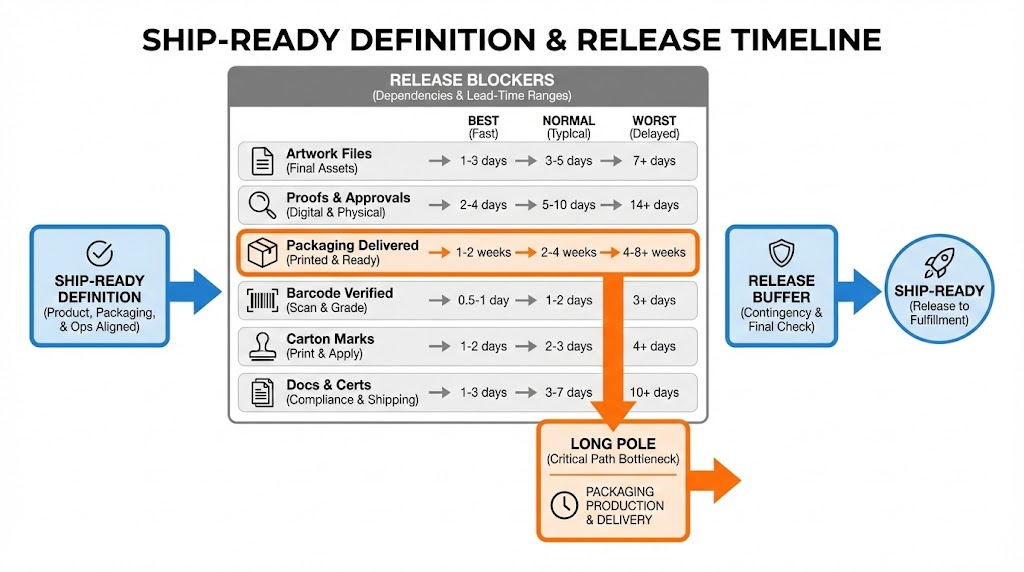
Ship-ready definition (what “done” means):
- Product finished + QC passed
- Packaging components at factory
- Final approved artwork + proof standard
- Barcode verified + placed correctly
- Carton marks confirmed
- Docs ready (PO, packing list format, compliance as needed)
Release blockers (list + lead time ranges):
1) ______ Best d Normal d Worst ___d Owner
2) ______ Best d Normal d Worst ___d Owner
3) ______ Best d Normal d Worst ___d Owner
Long pole (least flexible + longest lead time): __________
Buffers:
- Time buffer added to long pole: _ days
- Pre-approved alternate exists? Yes / No
- If No: define fallback (label/sleeve/standard structure) ______
Template: Packaging Substitution “Equivalency Sheet”
PACKAGING EQUIVALENCY (PRE-APPROVED SUBSTITUTIONS)
Component: __________
Primary spec: ________
Acceptable alternates (pre-approved):
- Material range: ______________
- Finish options: ______________
- Adhesive type (labels): _______
- Color tolerance: ______________
- Dimension tolerance: __________
Must-pass QC checks:
[ ] Barcode scan on final packaging
[ ] Adhesion/rub test
[ ] Visual alignment (print, dielines)
[ ] Fit test with product / tray
Approval:
Name _ Date Notes _________
Why private labeling causes production delays (and where they hide)
Private label adds “invisible” lead time: packaging components, artwork proofs, barcode placement/verification, labeling compliance, and change-control loops. When disruption hits, those steps stall shipments even if lashes are done.
Learn more about Private Label Lash Lead Time → Private Label Lash Lead Time & Delivery Dates
Common hidden blockers:
- Packaging components: custom boxes, sleeves, magnetic closures, inserts, and protective blisters often have separate suppliers and longer MOQs.
- Artwork and compliance approvals: dielines, color proofs, barcode verification, and country-specific labeling rules can add multiple rounds.
- Change orders midstream: “Just one small tweak” to logo size or finish can restart proofing and re-queue packaging.
- Bundling steps: if lashes are finished but packaging isn’t ready, goods sit—tying up space and cash.
Takeaway: Treat packaging + labeling as a “second supply chain” with backups, lead-time ranges, and its own QC gates.
Map your critical path (the only timeline that matters)
A disruption response works only if you already know what “done” means and what depends on what. We recommend building a one-page critical path that includes:
Step 1: List the release blockers
These are the items that can prevent shipment even if product is complete:
- Final approved artwork files
- Approved proof (physical or digital, agreed standard)
- Packaging components delivered to factory
- Barcodes validated + placed correctly
- Carton marks (outer cartons) confirmed
- Any required documentation (PO, packing list format, etc.)
Step 2: Put lead times next to each blocker
Don’t guess—use ranges (best/normal/worst). Example:
- Custom outer box: 12–20 days
- Printed inserts: 7–14 days
- Labels (roll): 5–10 days
- Freight to factory: 3–10 days (varies by region/mode)
Step 3: Identify the “long pole”
Whatever has the longest and least flexible lead time is your “long pole.” That’s what you buffer first.
Actionable takeaway: If your long pole is packaging, you don’t have a lash problem—you have a packaging strategy problem.
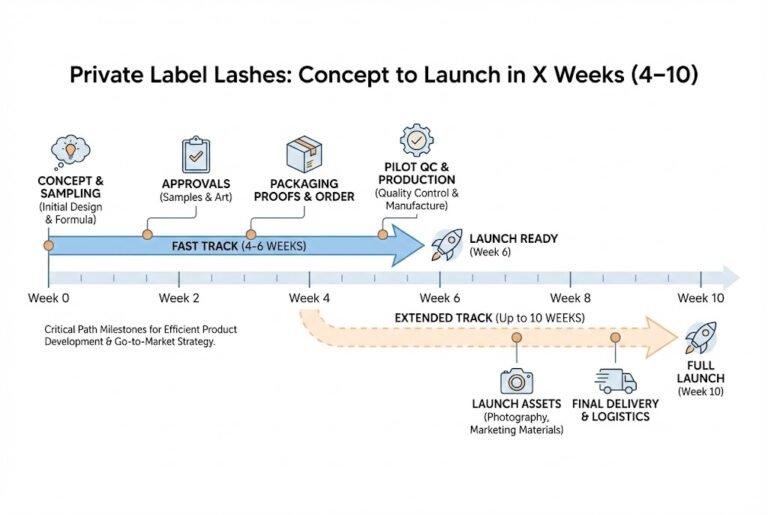
View the complete 6-week journey from Concept to Launch → Concept to Launch in 6 Weeks: Private Label Lashes
Preventive design: reduce custom complexity without losing brand impact
This is where brands win back weeks.
Standardize what customers don’t perceive
Many brands can keep a premium look while standardizing hidden components:
- Use a standard lash tray + custom sleeve instead of a fully custom rigid box
- Standard inner card with a custom sticker label (for short runs)
- Standard outer cartons + custom carton labels for seasonal SKUs
Pre-approve substitutions (before disruption)
Create an “equivalency sheet” for materials and finishes:
- Paper type (gsm range), lamination type (matte/gloss/soft-touch)
- Foil options and acceptable alternates
- Adhesive types (for labels) and acceptable alternates
- Tolerance for color shift (define what’s acceptable)
Citable snippet #2: If a component has no pre-approved substitute, assume it can stop your shipment. Approving alternates in advance is the cheapest form of lead-time insurance.
Match MOQ to your real forecast (not your wish)
Private label delays spike when brands order custom components at a MOQ that doesn’t match demand. In our experience, low-MOQ strategies work best when you:
- Keep the structure standard (tray/box size)
- Customize via print, sleeve, or label
- Scale to full custom packaging only after sell-through validates it
This aligns well with what we offer: customized lash styles + low MOQ options + factory-direct pricing—without forcing you into risky packaging commitments.
Explore all packaging structures and their associated delay risks → Custom Eyelash Packaging Guide: Create Your Own Lash Brand
Supply Chain Disruption Response Checklist (24–72 hours)
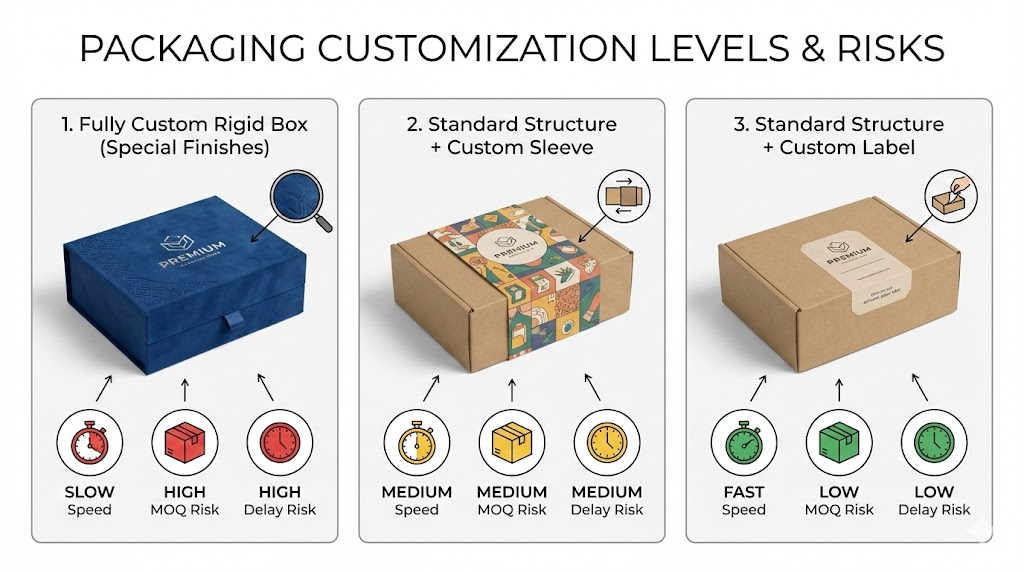
Use this as your “first response” playbook the moment a supplier slips, freight is delayed, or a component fails QC.
A) First 24 hours: stabilize
- Confirm what is actually delayed (component? artwork approval? freight? customs docs?)
- Freeze non-essential changes (artwork tweaks, spec changes, new inserts)
- Check factory inventory: lashes, trays, boxes, labels, cartons, adhesives
- Verify WIP status (what’s in production, what’s pending release)
- Identify the release blocker (what single item prevents shipping)
- Pull your alternates list (materials, printers, label formats)
- Set a single owner (one person responsible for timeline + decisions)
B) 24–48 hours: choose a recovery path
- Option 1: Substitute component (pre-approved alternate)
- Option 2: Simplify packaging (standard box + custom label/sleeve)
- Option 3: Split shipment (ship what’s ready, brand later if feasible)
- Option 4: Mode switch (air/express for packaging only; ocean for bulk)
- Re-baseline dates (new ship date + arrival date + launch impact)
- Update stakeholders (sales, marketing, warehouse, 3PL, retail partners)
C) 48–72 hours: execute + protect quality
- Issue formal change control (what changed, why, who approved)
- Run equivalency QC checks (color, dimensions, adhesion, barcode scan)
- Confirm carton markings (SKU, qty, PO, destination)
- Lock final packing plan (palletization, labels, documentation)
- Schedule daily 15-min standups until back on track
Actionable takeaway: The goal is not “no change.” The goal is “controlled change with known tradeoffs.”
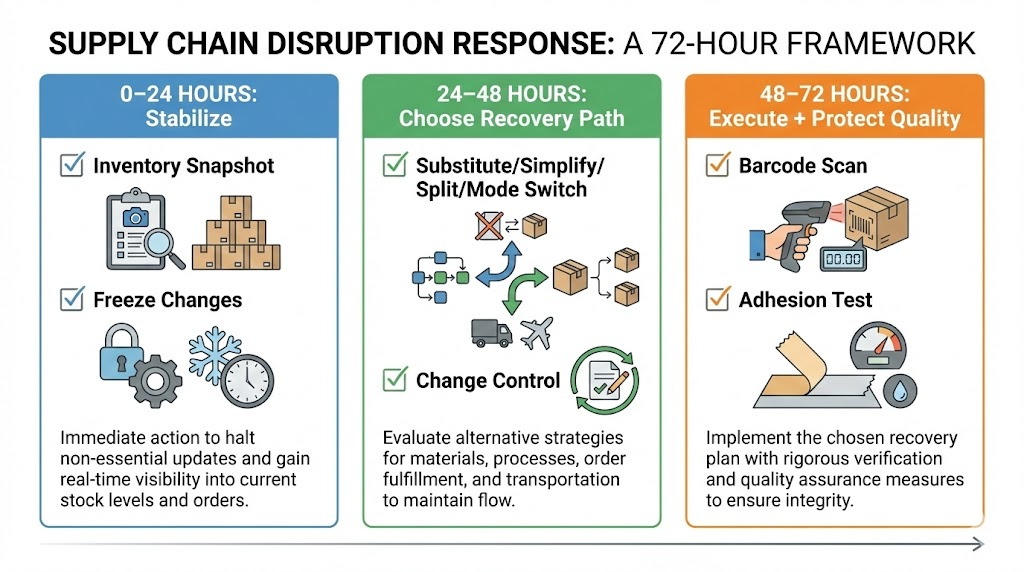
Packaging Choices vs Delay Risk (Decision Table)
Decision rule (fast pick):
- Launch ≤ 30 days: choose standard structure + label or standard structure + custom sleeve
- Launch 30–60 days: choose semi-custom (custom print on a standard dieline)
- Launch ≥ 60–90+ days: choose fully custom rigid + special finishes only if forecast is stable
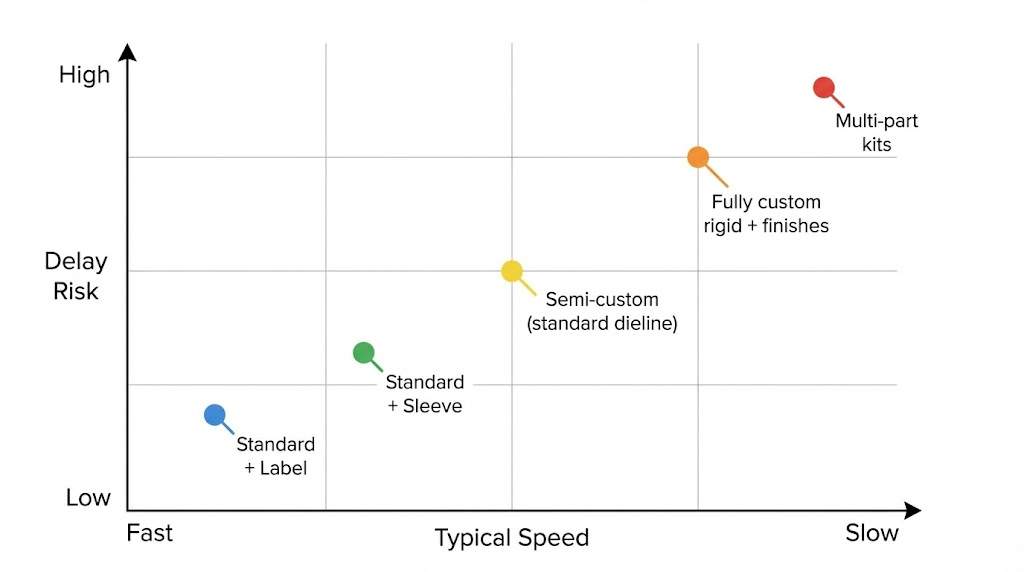
Definition: “Delay risk” here means the chance packaging becomes the release blocker even when product is finished (waiting on boxes, inserts, labels, proofs, barcodes, or compliance changes).
| Packaging option | What it is (definition) | Typical packaging lead-time impact* | Delay-risk drivers | Best for | Fastest recovery move (when disruption hits) |
|---|---|---|---|---|---|
| Standard structure + custom label | Use a ready-to-run tray/box size; apply branding via roll labels or sticker labels. | Fastest (often days) | Label print queue, adhesive/finish compatibility, barcode placement errors. | New launches, promos, demand tests, tight deadlines. | Switch to pre-approved alternate label stock/finish; keep barcode layout unchanged. |
| Standard structure + custom sleeve | Standard box/tray; premium feel comes from a printed sleeve (or belly band) + minimal inserts. | Fast (often 1–2 weeks) | Sleeve print delays, color proof loops, sleeve fit/tolerance issues. | DTC brands wanting “premium” with controlled timeline. | Ship with label-first packaging now, sleeve later (postponement) if channel allows. |
| Semi-custom (custom print, standard dieline) | Custom printed box using an existing dieline (no structural engineering), fewer moving parts than full custom. | Medium (often 2–4 weeks) | Proof approvals, print capacity, coating/lamination availability. | Growing SKUs, predictable demand, repeatable packaging. | Fallback to sleeve/label on the same standard structure to protect ship date. |
| Fully custom rigid box + special finishes | New structure + custom components (magnets, special paper, foil, emboss, custom inserts). | Slowest (often 4–8+ weeks) | Multiple suppliers, long MOQs, component shortages, high rework risk if artwork changes. | Flagship SKUs with stable forecast and long launch runway. | Freeze changes; remove non-essential finishes; downgrade to semi-custom for this batch. |
| Multi-part kits (custom inserts + bundles) | Multiple components (insert trays, booklets, dividers) that must arrive together for packing. | Medium–slow (variable) | Any missing component halts packing; kitting errors; higher inspection burden. | Sets/bundles where unboxing drives conversion. | Split-ship: ship core product now; kit components later if operationally valid. |
*Lead-time impact varies by region, print method, and supplier queue. The ranking is meant to help you choose the most schedule-resilient option when packaging is the release blocker.
Factory insight: If you need “premium” and speed, standard structure + custom sleeve is usually the best balance—because it reduces structural dependencies while preserving shelf impact.
Communication and approvals that don’t bottleneck
Disruptions get worse when approvals are unclear.
Set a simple RACI
- Responsible: who does the work (artwork updates, supplier calls)
- Accountable: who decides (one decision-maker)
- Consulted: QC, compliance, brand lead
- Informed: marketing, sales, 3PL
Use “approval windows”
Instead of “approve ASAP,” define a window:
- Proof review within 24 hours
- Change requests batched once per day
- Final sign-off by a specific time (e.g., 3pm)
Keep one source of truth
One timeline document, one version number for artwork, one change log. This avoids the classic “we approved the wrong file” delay.
Actionable takeaway: Approval speed is a process—not a personality trait. Build it into your workflow.
Inventory buffers and postponement strategies (how to ship on time)
If you want disruption resilience, you need at least one buffer that doesn’t destroy cash flow.
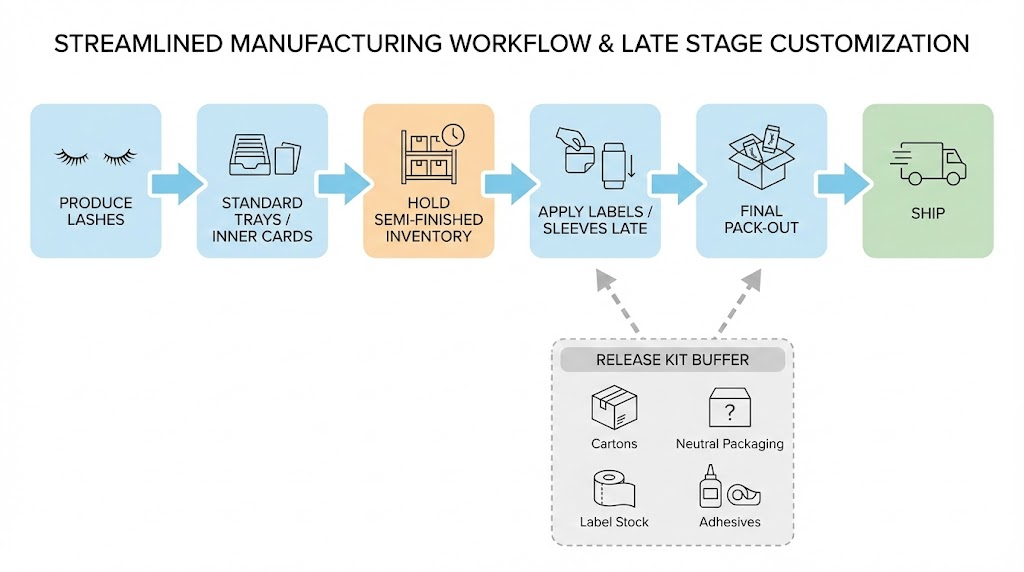
1) Decouple product from branding
A proven approach is to keep unbranded or semi-branded inventory ready:
- Produce lashes to spec
- Use standard trays/inner cards
- Apply final brand identity late via labels/sleeves/inserts
This is “postponement”—and it’s one of the most effective ways to stay on schedule during disruptions.
2) Keep a “release kit” buffer
We recommend holding a small buffer of:
- Standard cartons
- Neutral protective packaging
- Label stock (blank or generic template)
- Spare adhesives and packing materials
3) Split-risk for new SKUs
For new launches, consider:
- First batch: faster packaging (label/sleeve)
- Second batch: full custom packaging once demand is proven
This protects your launch date while still moving toward a premium final presentation.
Quality and compliance under pressure (don’t trade weeks for refunds)
When timelines tighten, the temptation is to “ship and fix later.” That’s risky—especially with private label where the brand owns the customer experience.
View OEM-level quality control and defect prevention standards → OEM Prevent Eyelash Defects: Shedding, Bent Bands, Curl Drift
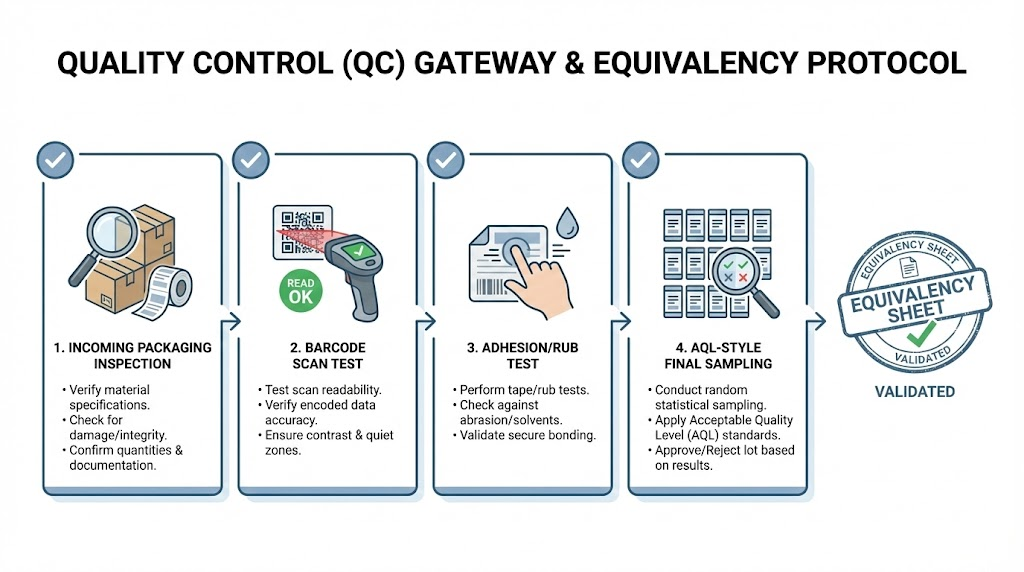
QC gates we recommend keeping (even in emergencies)
- Incoming packaging inspection (dimensions, print alignment, finish)
- Barcode scan test on the actual packaging
- Adhesion/rub test for labels and finishes
- Final AQL-style sampling on packed goods
Manage substitutions with controlled checks
If you swap a material or supplier, document:
- What changed (spec + supplier)
- Why it changed (disruption reason)
- What was tested (equivalency criteria)
- Who approved (date + name)
Actionable takeaway: Faster recovery comes from pre-defined QC equivalency, not from skipping inspection.
Logistics moves that reduce delay damage
Even without getting overly technical, a few tactics consistently help:
- Ship the constraint: If only packaging is late, expedite just packaging to the factory.
- Consolidate smartly: Combine SKUs into fewer cartons/pallets when possible to reduce handling delays.
- Document early: Packing list format, carton marks, and shipping labels should be ready before the last unit is packed.
- Plan for split shipments: If your launch depends on a minimum quantity, ship that first.
Common mistakes
- Mistake: Finalizing lashes before packaging is confirmed
Fix: Don’t start mass production until packaging blockers have “green” status. - Mistake: Too many custom components on a tight timeline
Fix: Use a standard structure + custom sleeve/label for the first run. - Mistake: Artwork changes after proof approval
Fix: Freeze artwork and route changes to the next batch unless legally required. - Mistake: No approved alternates
Fix: Pre-approve 1–2 substitute materials/finishes per key component.
FAQ
How early should we start private label packaging work?
As a rule, start packaging and artwork as soon as you confirm the product concept, not after you finalize lash specs. Packaging often becomes the long pole.
What’s the fastest “premium” packaging option?
Usually standard structure + custom sleeve. It looks high-end but avoids the longest custom box lead times.
Can we ship lashes first and package later?
Sometimes—if your sales channel allows it and you have a compliant, safe interim pack. For most brands, postponement works better: keep goods ready and apply final branding late.
How do we reduce delays without sacrificing brand identity?
Standardize hidden components (tray size, dielines) and customize what customers see (sleeves, print, inserts). That’s how you protect both timeline and shelf impact.
What should we ask our factory to provide during disruptions?
A clear WIP status, component inventory snapshot, alternate packaging options, and a re-baselined schedule with decision deadlines.
Key Points
- Private label delays often come from packaging, proofs, barcodes, and approvals—not lash production.
- Build a one-page critical path with lead-time ranges and identify the single release blocker.
- Reduce risk by standardizing structures and customizing via sleeves/labels where possible.
- Keep a 24–72 hour disruption checklist: freeze changes, confirm inventory, choose recovery path, protect QC.
- Use postponement: produce first, brand late.
- Maintain QC gates and document substitutions with change control.
- Consider split shipments and expediting only the constraint (often packaging).
- Align MOQs with real demand to avoid getting trapped by custom component lead times.
Conclusion
Avoiding private label production delays isn’t about predicting every disruption—it’s about building a system that can absorb shocks through standardization, flexibility, and clear decision rights. That’s consistent with classic supply-chain resilience research: the firms that recover fastest are the ones that invest before a disruption hits (buffers, modularity, qualified alternates, and practiced response routines).
The repeatable system (what to implement)
If you want launches to stay on track even when packaging, freight, or approvals go sideways, build these four “non-negotiables”:
- One-page critical path that highlights the release blocker (the single item that prevents shipping) and the true dependencies.
- Design for flexibility: standardize where customers don’t notice, and pre-approve substitutes where suppliers commonly slip (materials, finishes, label specs). (Flexibility is a widely cited risk-mitigation lever in supply-chain risk management.)
- Postponement: keep semi-finished or unbranded inventory “ship-ready,” then apply final branding late via labels/sleeves so packaging delays don’t freeze finished goods.
- Quality under pressure: compress QC via defined sampling and equivalency checks—don’t skip it. (Acceptance sampling with AQL-based plans is a standard approach to maintain consistent quality assurance.)
Citable takeaway: The fastest private label recoveries come from pre-built flexibility (approved alternates + postponement) and disciplined execution (critical path + controlled change), not from last-minute heroics.
What to do next (30-minute action plan)
- Draft your release-blocker list (artwork/proof, packaging components, barcode/label checks, carton marks, docs).
- Put best/normal/worst lead-time ranges next to each blocker and mark the long pole.
- Create an approved-alternates/equivalency sheet and assign a single decision owner for disruptions.
Need factory-side support?
If you want help turning this into a working private label system (templates + change-control + QC gates + packaging options that protect timeline and MOQ), we can map your critical path, define alternates, and set a disruption-ready workflow that prevents “small tweaks” from turning into expensive relaunches.
Get a custom quote and free packaging template now → Contact Us / Get Quote
References
[1] U.S. Food & Drug Administration (FDA). Summary of Cosmetics Labeling Requirements.
[2] Electronic Code of Federal Regulations (eCFR). 21 CFR Part 701 — Cosmetic Labeling.
[3] FDA. Cosmetics Labeling Regulations / Cosmetics Labeling resources.
[4] EUR-Lex. Regulation (EC) No 1223/2009 on Cosmetic Products (Official Journal PDF).
[5] UK Government (GOV.UK). Regulation (EC) No 1223/2009 and the Cosmetic Products Enforcement Regulations 2013 (Great Britain guidance).
[6] Health Canada. Industry Guide for the labelling of cosmetics.
[7] U.S. Government Publishing Office (GovInfo). FAIR PACKAGING AND LABELING ACT (FPLA) — compiled statute PDF.
[8] GS1. 1D Barcode Verification Process Implementation Guideline (PDF).
[9] GS1. GS1 General Specifications (official standard landing page / repository).
[10] ISO. ISO/IEC 15416:2025 — Automatic identification and data capture techniques — Bar code print quality test specification — Linear symbols.
[11] ISO. ISO/IEC 15415:2024 — Automatic identification and data capture techniques — Bar code symbol print quality test specification — Two-dimensional symbols.
[12] GS1 Canada. Symbology Placement Guidelines (PDF).