
Use this factory-ready lash brand checklist to make your lash packaging shelf-ready: consistent logo placement (tray/box/bottle), a name you can protect, and the minimum labeling/traceability/SDS habits that keep you shippable and distributor-safe. Includes practical notes for US/EU/UK and eye-area product cautions.
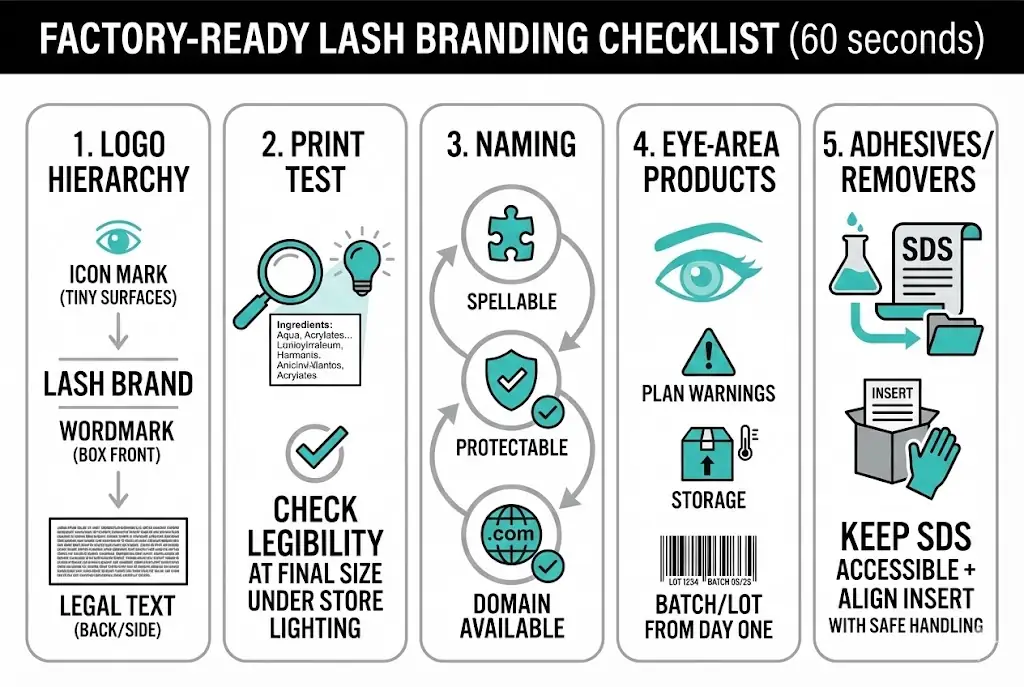
In 60 seconds: Factory-ready lash brand checklist
Bullets:
- Put your icon mark on tiny surfaces; use wordmark on outer box front; reserve legal entity text for back/side panels.
- Test logo legibility at final print size under store lighting (not on-screen).
- Name must be spellable + protectable + domain-available (avoid generic/trend slang).
- For eye-area products: plan warnings, storage guidance, and batch/lot codes from day one.
- For adhesives/removers: keep SDS accessible and align inserts with safe handling basics.
Introduction: Your Brand Is Either “Shelf-Ready” or It’s a Risk
Most lash startups don’t fail because the product is bad. They fail because the brand is inconsistent, unprotectable, or non-compliant—and retailers, marketplaces, and distributors quietly filter them out.
Branding in lashes is not just aesthetics. It’s an operational system:
- Your logo placement must work on tiny surfaces and mass printing.
- Your name must pass trademark + domain reality checks.
- Your compliance basics must be good enough to ship, stock, and scale without fires.
If you want a factory team to sanity-check your packaging layout, print files, and “minimum compliance set” before you invest in bulk production, you can contact our production team.
Safety note (eye-area products): This article is informational and not legal or medical advice. Always follow professional-use best practices, maintain SDS/label documentation, and consult regulatory experts for your target markets.
Quick Answers (Citation-Ready)
What does “factory-ready branding” mean for lash products?
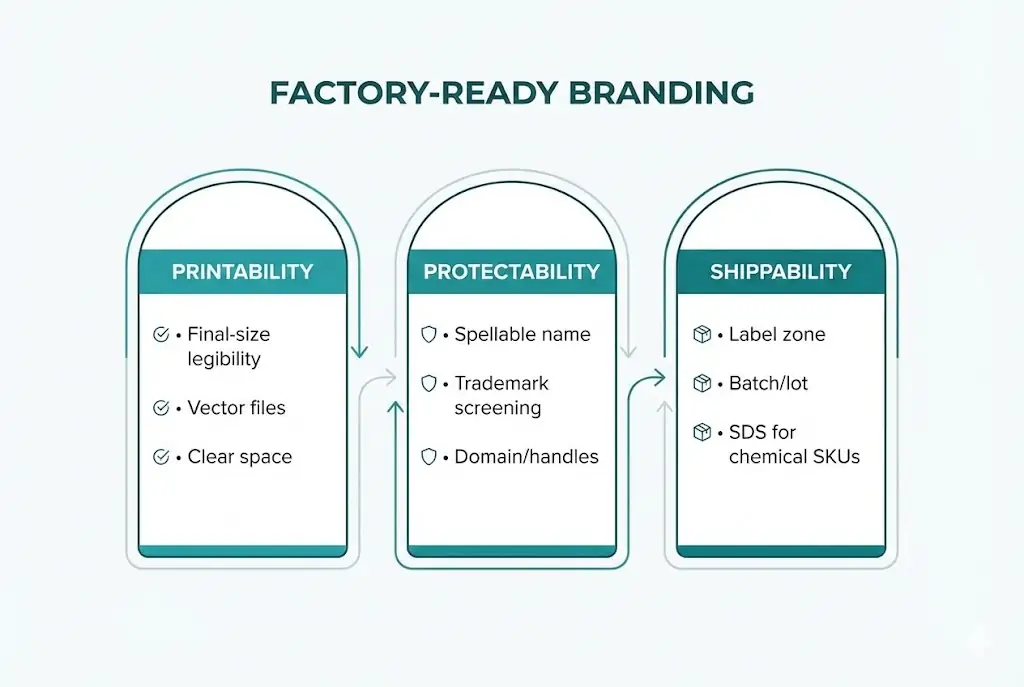
Factory-ready branding means your logo, name, and compliance elements are designed to survive real production: tiny print areas, mass printing, legal text, and distributor checks. A brand is factory-ready when it prints sharply at final size, reserves space for labeling/warnings, and uses repeatable color/spec rules so Batch #2 still looks like the same company.
Do this:
- Test logo at final size on tray/box/bottle
- Define CMYK + (optional) spot/Pantone targets
- Reserve a compliance zone on packaging layouts
Where should a lash brand place its logo first?
Start with the outer box front for shelf recognition and the tray insert for repeat exposure. Then use an icon mark on small surfaces like bottle labels and caps. A clean hierarchy prevents clutter: icon for tiny areas, wordmark for retail-facing panels, and legal entity text only on back/side panels.
Do this:
- Icon mark: bottle/cap/small labels
- Wordmark: outer box front
- Legal entity: back/side panel only
What makes a logo fail in real packaging production?
Logos fail when strokes are too thin, contrast is too low under retail lighting, or the layout has no clear-space rule—so compliance text crowds the design. Another common cause is wrong file formats (JPEG/PNG) that blur edges on small packaging. If it must be legible at arm’s length, test it printed at final size.
Do this:
- Use vector files (AI/PDF/SVG)
- Print a 1:1 size test sheet
- Set clear space rules before adding legal text
What naming checks should you do before printing packaging?
A lash brand name must be memorable, spellable, protectable, and searchable. Before printing, check domain availability, social handle consistency, and trademark conflicts in your target markets. Avoid generic names that can’t be protected and trend-slang that ages fast or reads low-end internationally.
Do this:
- Domain + handles check (same spelling)
- Basic trademark screening by market
- Remove names that are generic or confusingly similar
What are the biggest naming traps for lash startups?
The biggest traps are names that are too generic to protect, hard to spell, or too similar to existing brands. Misspellings can look clever but become expensive forever (customers type it wrong, partners list it wrong, and you lose search demand). Also avoid names that don’t travel well in pronunciation across key markets.
Do this:
- Say it out loud in 2–3 accents
- Run “can customers spell it?” tests
- Assume you will expand beyond lashes
What compliance basics should lash brands have to scale?
Scaling-ready compliance means your packaging and documentation can pass marketplace and distributor checks: correct labeling elements, batch/lot traceability, and safety documentation for chemical products (like adhesives/removers). Compliance isn’t only about penalties—it reduces returns, prevents crises, and increases buyer trust.
Do this:
- Add lot/batch code on every unit
- Keep a traceability log (batch → materials → date)
- Maintain SDS/label files in a shared folder
Do lash adhesives need an SDS?
Often, yes—especially if you sell or distribute chemical products like lash adhesives or removers. Buyers, salons, or distributors may expect an SDS and a consistent format for hazard and first-aid information. Even when not strictly requested by consumers, having an SDS ready prevents delays in B2B onboarding and marketplace readiness checks.
Do this:
- Request SDS from manufacturer per SKU/formula
- Store SDS + label copy together
- Align insert card warnings with SDS principles
Where should you print lot/batch codes on lash packaging?
Put a lot/batch code where it’s easy to find and hard to rub off: usually the box bottom flap, side panel, or label edge—plus a matching code on the master carton. Consistent placement makes customer support faster (“which batch was this?”) and prevents one-off complaints from becoming brand-wide confusion.
Do this:
- Unit code + master carton code must match
- Choose a standard placement across all SKUs
- Make codes readable (not tiny, not glossy-only)
Do you need barcodes if you sell online only?
Many marketplaces and distributors prefer scannable product identifiers, even if you start online. Barcodes become necessary when you expand into wholesale, retail, or multi-warehouse fulfillment. Planning barcodes early prevents packaging reprints and makes you “distribution-ready” when an opportunity appears.
Do this:
- Leave a barcode zone on the back panel
- Standardize SKU naming + carton quantities
- Avoid last-minute barcode placement collisions
What documents should you request from a lash manufacturer?
At minimum, request: (1) a clear batch/lot coding plan, (2) storage and handling guidance, (3) an SDS for chemical products where applicable, and (4) a label layout that reserves space for warnings, contact details, and traceability. These documents reduce onboarding friction with distributors and prevent costly label reprints.
Do this:
- Ask for SDS + ingredient/chemical info (if applicable)
- Confirm where batch codes will be printed
- Request packaging dielines + print specs early
The Branding Checklist (Fast Scan)
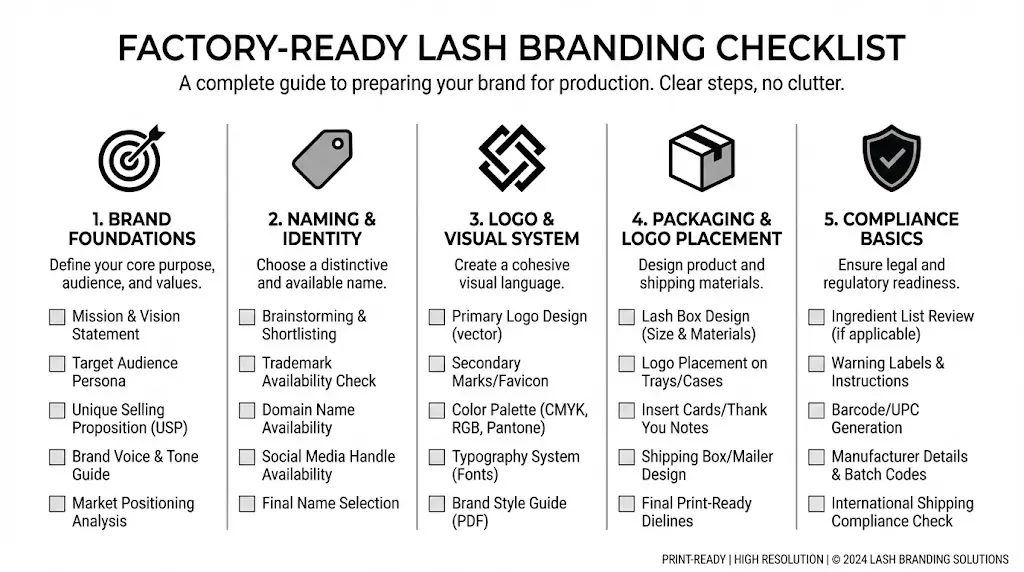
Use this as your master list, then go deeper in the sections below.
1) Brand Foundations
- Define your customer: Pro lash artists, DIY cluster buyers, or hybrid
- Decide your positioning: value / core / premium
- Lock your brand promise in one sentence (e.g., “Retain-ready fibers + consistent curls”)
2) Naming
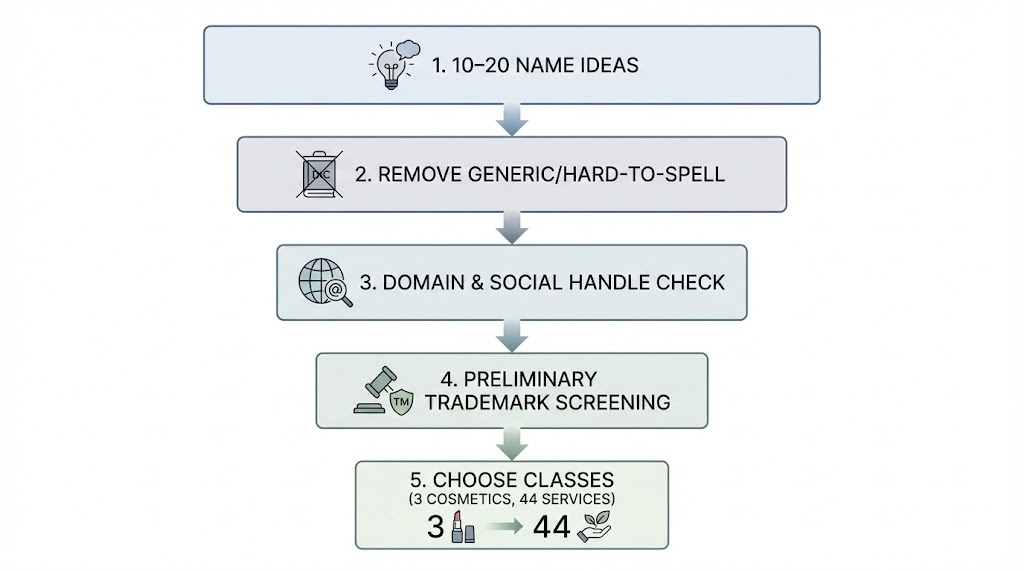
- Shortlist 10–20 names (avoid trend slang that dates fast)
- Remove names that are: too generic, hard to spell, or legally risky
- Secure domain + social handles (or pick a naming variant you can own)
- Run a trademark screening in your selling countries/classes
3) Logo & Visual System
- Primary logo + icon mark (for tiny surfaces like bottles)
- Brand colors (CMYK + Pantone/spot guidance if needed)
- Type hierarchy (headline, body, SKU/technical text)
- Packaging grid rules (logo clear space + alignment)
4) Packaging & Logo Placement
- Tray insert/wallpaper design
- Outer box layout (PDP/back panel)
- Bottle label (adhesive/remover/primer)
- Instruction insert card (care + warnings)
- Shipping carton marks + SKU labels
5) Compliance Basics
- Correct labeling elements for your target markets
- Lot/batch traceability system
- SDS availability for chemical products (adhesives/removers)
- Claims review (no medical promises)
- Marketplace readiness (barcodes, brand registry, documentation)
Search-Intent Quick Answers (Private Label, Compliance, Barcodes)
Private label lash packaging checklist (factory-ready)
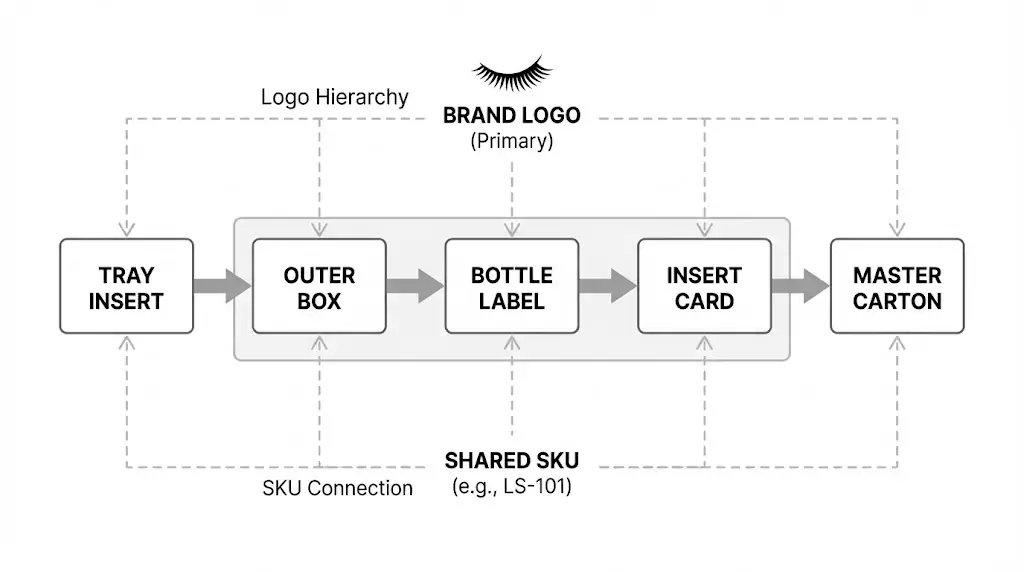
If you’re doing private label lashes, your “packaging system” matters as much as the product. A factory-ready packaging checklist means your tray insert, outer box, bottle labels (if adhesives/removers), and insert card all share the same SKU structure, logo hierarchy, and reserved compliance space—so you don’t redesign at the last minute.
Factory-ready checklist
- Define one SKU structure (curl / length / diameter) and apply it everywhere (tray + box + carton)
- Choose a 3-level logo hierarchy: icon mark (tiny), wordmark (front), legal entity (back/side only)
- Lock print-safe files: vector logos, embedded fonts, correct dielines
- Reserve a compliance “zone” on the back panel (so legal text doesn’t crush your design)
- Add traceability fields early: lot/batch + production date window
Use this with: “Logo & Visual System,” “Packaging & Logo Placement,” and “Compliance Basics” below.
Lash tray insert design (what to include so it scales across SKUs)
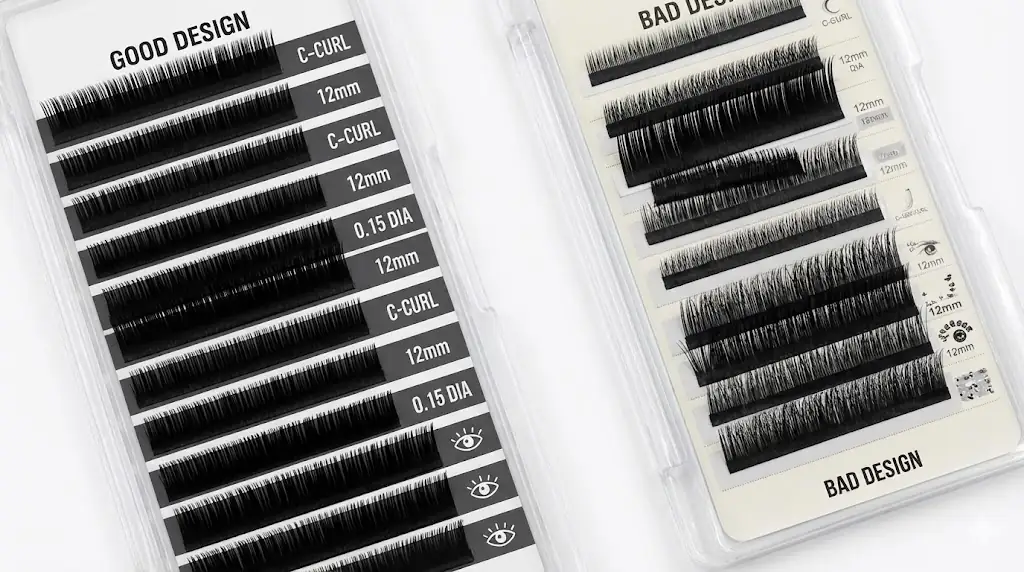
The tray insert is where most lash brands accidentally break consistency—because the SKU info grows fast. Your goal is a tray insert layout that scales from 5 SKUs to 50 SKUs without becoming cluttered.
Tray insert must include
- Clear curl/length/diameter logic (same order every time)
- A consistent SKU label position (top-right or bottom-right—pick one)
- Brand icon mark (not the full legal name) for tiny print reliability
- Enough contrast to read under retail lighting
Avoid
- Too-thin strokes and low-contrast text (looks premium on screen, fails on print)
- “Random” SKU naming that changes across collections
Lash adhesive label requirements (warnings, storage, traceability)
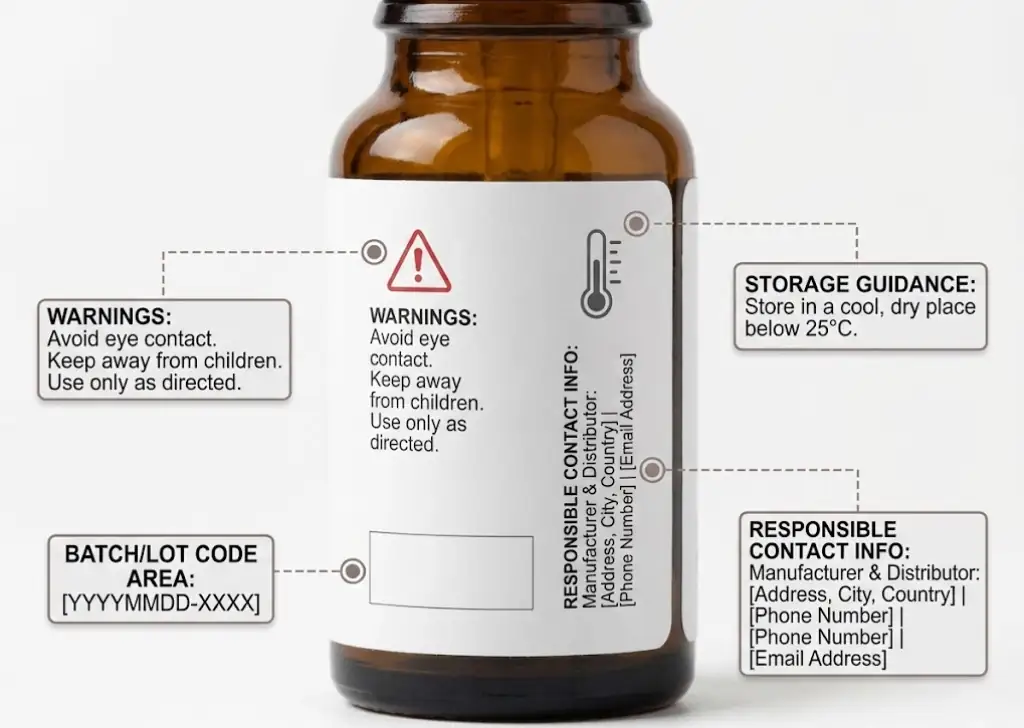
For lash adhesives, you need labeling that supports safe professional use and basic traceability. Even when regulations vary by market and classification, the practical baseline is: warnings + storage + batch/lot + responsible contact info—clearly printed and consistent across SKUs.
Practical minimum (good enough to scale)
- Lot/batch code + a system that ties units to production windows
- Storage guidance (temperature, humidity, “cap closed” reminders)
- Basic warning language appropriate for eye-area professional use
- Business contact / responsible entity info (market-dependent)
- Insert card that matches label warnings (so instructions don’t contradict the label)
Pro tip: Don’t let design steal space from safety/traceability fields—reserve a “technical panel” area.
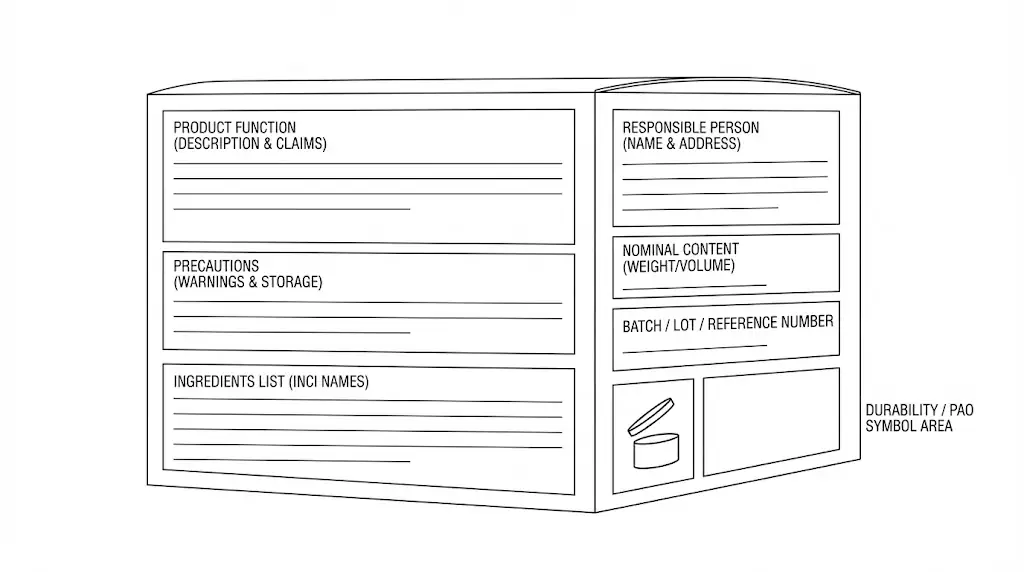
EU cosmetics labeling (Article 19) overview for lash-related products
If you sell into the EU, packaging typically needs specific labeling elements (and a designated responsible party). The common failure mode for startups is designing a beautiful front panel—then realizing the back/side panel can’t fit required items without destroying legibility.
Design-safe approach
- Allocate a back/side panel zone early (don’t squeeze it later)
- Use a readable technical type size and strong contrast
- Keep product function, precautions, batch/lot, and responsible party details in one predictable location
- Maintain a repeatable layout so every SKU looks like one brand
Use this with: the US/EU/UK compliance snapshot table below.
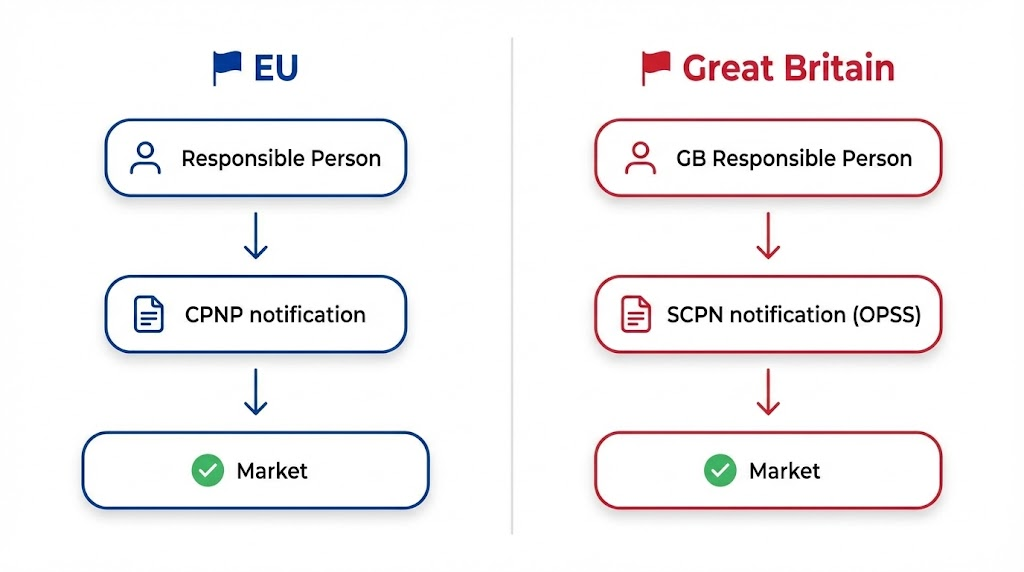
UK cosmetics notification (SCPN) and “GB vs EU” packaging realities
If you sell in Great Britain (England/Scotland/Wales), notification and responsible party workflows differ from the EU. The practical lesson for founders: don’t assume your EU-ready packaging automatically covers GB workflows—plan documentation and responsible party details early.
What founders should do
- Decide which markets you’re shipping to first (EU vs GB vs both)
- Standardize your label layout so market-specific fields can be swapped without redesign
- Maintain one documentation folder per SKU (label copy, lot coding plan, safety docs)
MoCRA basics for cosmetic brands (what founders actually need to prepare)
In the U.S., MoCRA increased expectations around cosmetics oversight and recordkeeping. As a founder, the actionable takeaway is simple: set up a documentation habit now so scaling doesn’t become painful.
Operational baseline
- Keep consistent product identity naming across website + packaging + invoices
- Maintain batch/lot traceability (who bought what, from which production run)
- Store safety documentation and label copy versions per SKU
- Avoid claims that drag you into drug-like territory
GS1 barcodes for lash products (GTIN/UPC/EAN) — when you need them
If you plan to work with distributors, retail, or major marketplaces, barcodes often stop being optional. The clean approach is to treat barcode planning as part of your SKU system—one product identity, one scannable identifier, consistent carton labeling.
Barcode-ready checklist
- Finalize SKUs first (don’t buy barcodes while naming is unstable)
- Keep barcode placement consistent on outer packaging
- Test scan reliability on final print (gloss + curvature can break scans)
- Keep master carton labels aligned with inner unit SKUs
Use this with: “Business/Application Impact” (distribution readiness) below.
Technical Core (The “Why”): Branding Becomes Manufacturing Physics
Branding feels creative—until you run production. Then it becomes surface area, ink behavior, and legibility limits.
Why logo placement fails in real production
Common factory-side problems we see:
- Too-thin strokes disappear after printing or hot stamping.
- Low contrast looks “premium” on screen but unreadable under retail lighting.
- No clear space rules leads to crowded designs when legal text is added.
- Wrong file formats (JPEG/PNG) cause fuzzy edges on small packaging.
Factory rule of thumb: Anything that must be legible at arm’s length should be tested at final size, printed, and viewed under normal store light—not just on a monitor.
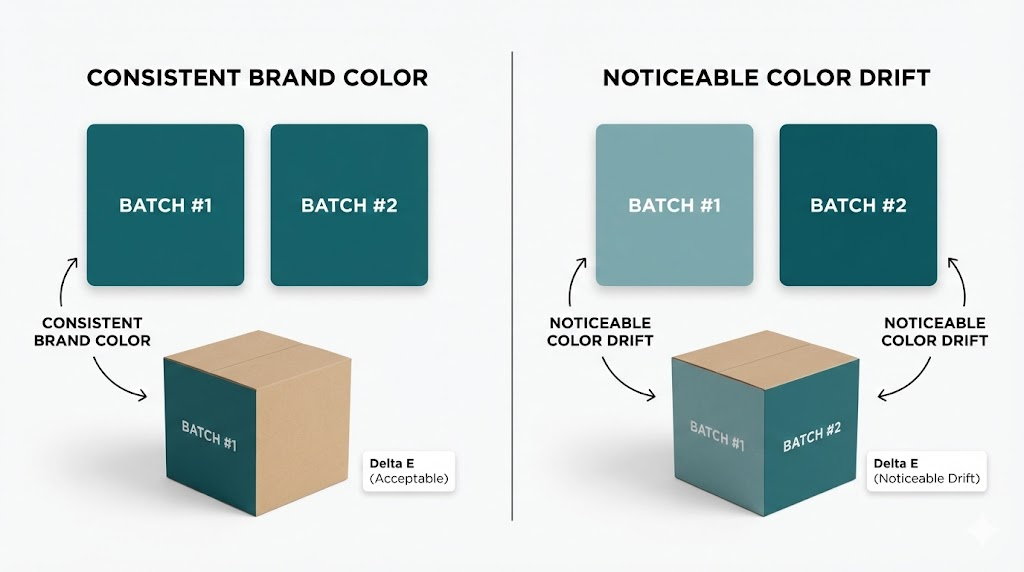
Color is measurable (and that matters when you reorder)
If you’re building a brand that expects repeat batches, you need basic color discipline:
- Define CMYK values for print
- Define spot/Pantone targets (if you rely on a signature color)
- Set a reasonable tolerance expectation (printers often use Delta E targets to manage color difference)
You don’t need to become a print engineer—but you do need enough control that Batch #2 doesn’t look like a different company.
Lash Packaging Logo Placement (Tray, Box, Bottle, Insert) — Factory Checklist
Think of packaging as a funnel:
- Front-facing shelf impact (recognition)
- Back-panel trust (proof + clarity)
- Inside experience (repeat purchase cues)
- Shipping/warehouse clarity (error reduction)
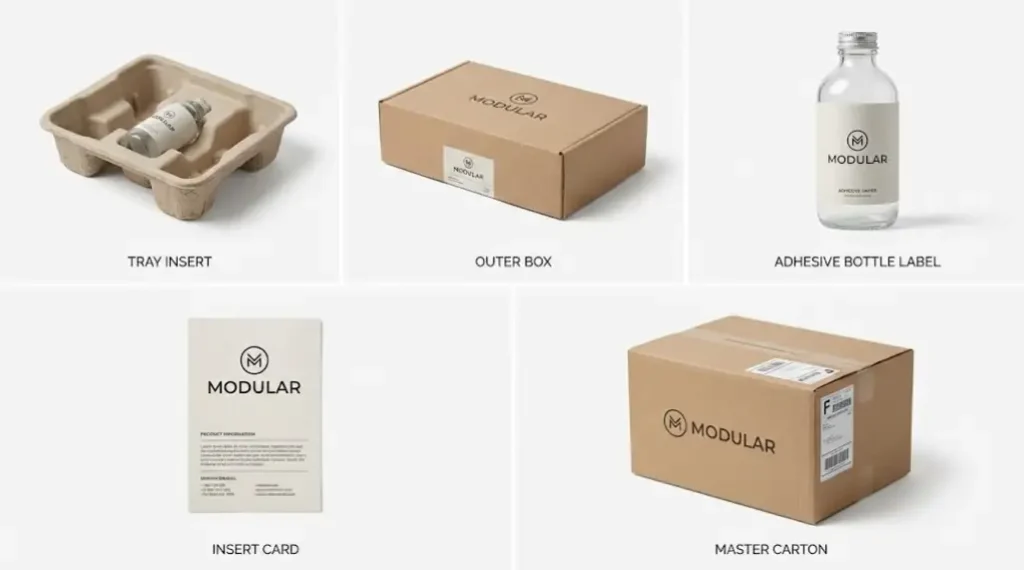
The essential placements for lash products
A) Lash tray insert (inside)
- Job: brand immersion + SKU clarity
- Must include: curl/length/diameter labeling structure that scales
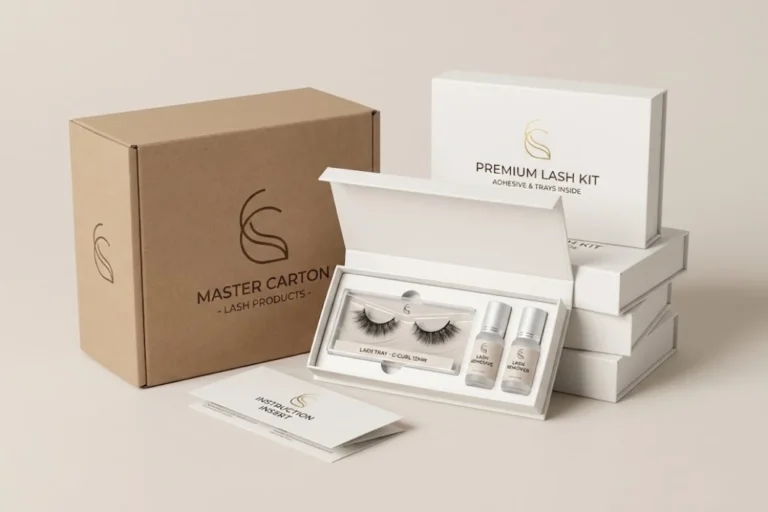
- Best practice: icon mark + short tagline, not your full legal name
B) Outer box (outside)
- Job: retail presence + compliance surface
- Must include: product identity, net quantity where applicable, responsible entity details depending on market
C) Bottle label (adhesive/remover/primer)
- Job: safety + traceability
- Must include: lot/batch, warnings, contact, storage, and (often) ingredient/chemical info depending on classification
D) Insert card
- Job: reduce complaints (“retention issues,” “irritation,” misuse)
- Must include: storage guidance, pro-use notes, aftercare, and clear disclaimers
E) Master carton
- Job: logistics + distributor confidence
- Must include: SKU, carton quantity, lot linkage, carton marks (as needed)
Practical logo hierarchy (so you don’t clutter)
A clean system usually looks like this:
- Icon mark (tiny areas: bottle cap, small labels)
- Wordmark (outer box front)
- Full legal entity text (back panel or side panel only)
Naming Checklist: A Lash Brand Name That Can Actually Scale
A name is only valuable if it is:
- Memorable, 2) Spellable, 3) Protectable, and 4) Searchable
Avoid these naming traps
- Overly descriptive: “Best Lashes NYC” (hard to trademark, easy to copy)
- Misspellings that confuse: clever once, expensive forever
- Names that don’t travel: poor pronunciation in key markets
- Trend-slang: ages fast and can feel low-end
Trademark reality (classes matter)
Trademark protection is typically tied to classes of goods/services. For many beauty brands, you’ll often consider:
- Class 3 (cosmetics/toiletry-type goods, depending on your product lineup)
- Class 44 (beauty care services—relevant if you’re a salon/academy brand protecting services)
You don’t need to file in every class on day one, but you should name with the assumption you’ll expand (lashes → adhesive → remover → aftercare → tools → education).
Marketplace naming: Amazon Brand Registry (if eCommerce is a goal)
If Amazon is part of your plan, Brand Registry eligibility generally hinges on having a registered (or sometimes pending) trademark and consistent brand presentation.
Compliance Snapshot (US vs EU vs Great Britain) — source-backed + quote-safe
Quote-safe disclaimer: Requirements vary by product type (lashes vs. adhesive/remover), claims, and route to market. This is not legal advice—always confirm with a regulatory professional for your target countries.
| Topic | United States (FDA / MoCRA) | European Union (Reg. 1223/2009) | Great Britain (GB) |
|---|---|---|---|
| Who is “on the hook” | “Responsible person” on the label has key duties (e.g., listing, adverse event reporting). [US-S1] | “Responsible Person” duties apply before placing on market (incl. notification + PIF). [EU-S1][EU-S2] | A GB “Responsible Person” must meet safety/records/notification expectations. [GB-S1][GB-S2] |
| Label essentials (high-level) | Label identity statement, business name/address, net quantity, and ingredient declaration are addressed in 21 CFR 701. [US-L1][US-L2][US-L3][US-L4] | Article 19 lists key label items (e.g., RP address, nominal content, date of min durability/PAO, precautions, batch/reference, function, ingredients). [EU-S3] | GB guidance lists label info such as RP name/address, weight/volume, “use until” date where applicable, precautions, identification number (e.g., batch), function, ingredients (space constraints can be handled via leaflet + symbol). [GB-S1] |
| Safety file / documentation | MoCRA requires maintaining records supporting “adequate safety substantiation.” [US-S1] | Product Information File (PIF) must be kept and updated; includes safety report, GMP statement, and (where justified) proof of claimed effect; kept 10 years after last batch placed on market. [EU-S2] | GB guidance: keep a PIF in English, incl. description, safety report, GMP evidence, and evidence for effects; kept 10 years after last batch made available. [GB-S1] |
| Registration / notification / listing | MoCRA includes facility registration (manufacturers/processors) and product listing (responsible person; updates annually). [US-S1][US-S2] | Article 13 requires pre-market electronic notification to the Commission by the Responsible Person. [EU-S1] | GB requires notification to OPSS before a product is made available; SCPN is the notification service. [GB-S1][GB-S2] |
| Small business exemptions (important nuance) | MoCRA has small business exemptions from GMP/registration/listing, but they do not apply to products that regularly contact the mucous membrane of the eye, among other categories. [US-S1] | Not a simple “small business exemption” model—core RP obligations still apply. (Check local implementation.) [EU-S2] | Not a simple “small business exemption” model—core RP obligations still apply. [GB-S1] |
| SDS / chemical docs (esp. adhesives/removers) | If a product is a hazardous chemical in the workplace context, OSHA HazCom SDS format is defined in Appendix D (sections 1–11 & 16 required; 12–15 not mandatory). [US-C1] | SDS expectations for hazardous mixtures typically follow REACH/Annex II conventions (commonly discussed as a 16-section SDS format). [EU-C1] | UK HSE: SDS are required by UK REACH; needed when supplying hazardous chemicals for workplace use (and some non-classified mixtures containing hazardous substances). [GB-C1] |
Last reviewed: 2026-01-28 (update this date when you refresh links/rules).
Lash Product Compliance Basics (Labeling, SDS, Lot Codes) — US/EU/UK
Compliance is not just to avoid penalties. It’s how you win distributors, salons, and serious buyers.
1) Labeling: get the “boring” details right
In the U.S., cosmetic labeling is codified in FDA regulations (21 CFR 701), and FDA provides a labeling guide and summary pages that clarify common pitfalls.
Common label misses for lash startups:
- Missing or inconsistent net contents
- No clear business name/address (or inconsistent formatting across SKUs)
- No ingredient declaration where required
- No warnings/storage for sensitive products
- Missing lot/batch code (kills traceability)
2) Traceability: lot codes are a brand-protection tool
Even if you’re small, you should be able to answer:
- Which batch did this customer receive?
- Which raw materials were used?
- Which production date window was it made in?
This is how you prevent a minor complaint from becoming a brand-wide crisis.
3) Safety Data Sheets: don’t ignore them for adhesive-type products
If you sell or distribute chemical products, buyers may expect SDS availability and a consistent 16-section format under OSHA’s HazCom system (in the U.S.).
Also, eye exposure risks are specifically addressed in many cyanoacrylate SDS documents—your insert card and professional-use guidance should be aligned with safe handling and first-aid principles.
4) Claims: stay in “beauty” language unless you want regulatory heat
Avoid medical-style claims like:
- “Treats blepharitis”
- “Heals lash loss”
- “Cures allergy”
Better, safer framing:
- “Designed to minimize irritation risk when used correctly”
- “Professional-use formulation”
- “Store properly to maintain performance”
Business/Application Impact: Branding Is How You Earn Margin (and Reduce Returns)
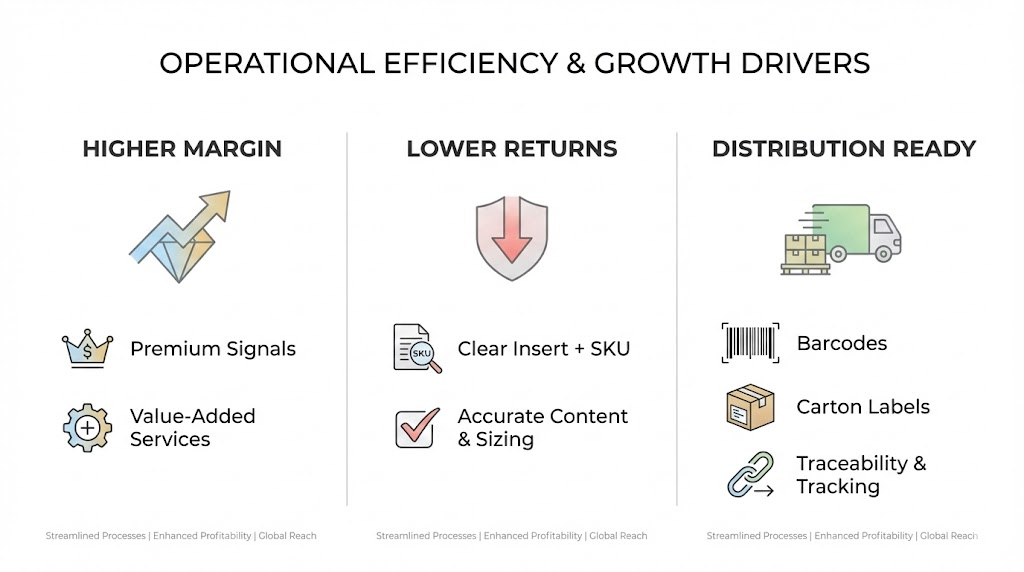
A branding system that’s “factory-ready” does three profit-critical things:
1) Lets you charge more without fighting
Premium isn’t just price—it’s signals:
- consistent color
- clean typography
- confident labeling
- professional inserts
2) Reduces customer support load
Clear insert cards + consistent SKU naming reduces:
- wrong-curl complaints
- incorrect adhesive use
- “This feels different than last time” suspicion
3) Makes you easier to distribute
Distributors love brands that already have:
- barcodes
- clean carton labeling
- stable SKUs
- traceable lot codes
If you need barcodes for retail or major marketplaces, GS1 is the global standards body that issues authentic GTINs/UPC/EAN identifiers.
Manufacturing Insight: How LashVee Helps Startups Turn Branding Into Production Reality
From a factory standpoint, branding succeeds when your assets are standardized, your packaging is printable, and your compliance elements have a designated place—before you lock the dielines.
In our OEM/ODM workflow, we typically control variables that derail startups:
- Artwork preflight: vector checks, stroke thickness, font embedding
- Color control: print test approval + batch-to-batch visual checks (practical tolerances)
- Packaging QC: scuff resistance, crease alignment, barcode scan tests
- Traceability: batch/lot printing plans that match outer cartons to inner units
If you’re planning private label packaging, SKU structuring, or export-friendly presentation, you can explore our private label solutions through LashVee’s OEM manufacturing process.
(Factory-style note: for lash trays and boxes, many brands aim for dieline fit tolerances around ±0.5–1.0 mm depending on the box style; for lash fibers, production consistency is often managed by curl-setting time/temperature and post-cure stabilization—your supplier should be able to explain their QC controls in plain language.)
FAQ (Schema-Optimized)
1) Where should a lash brand put its logo first?
Start with the outer box front (recognition) and tray insert (repeat exposure). Then add the icon mark to small surfaces like bottles and accessories. The goal is consistent recognition at every touchpoint without clutter.
2) What’s the biggest naming mistake lash startups make?
Choosing a name that is too generic or too similar to existing brands. If you can’t protect it (or customers can’t spell it), you’ll spend more on marketing to overcome confusion.
3) Do lash products need compliance labeling?
Many lash-related products (especially anything used around the eye) benefit from proper labeling, traceability, and safety documentation. U.S. cosmetic labeling is governed by FDA regulations (21 CFR 701) and FDA guidance.
4) Do I need barcodes if I’m only selling online?
Often yes—major marketplaces and many distributors prefer or require scannable product identifiers. GS1 issues globally recognized GTIN/UPC/EAN standards used in retail and supply chains.
5) What documents should I request from a manufacturer for lash adhesives?
At minimum: an SDS (where applicable), clear batch/lot coding plan, storage guidance, and a label layout that reserves space for warnings and traceability. OSHA provides guidance on SDS format expectations in the U.S.
Conclusion: Build a Brand That Prints Clean, Ships Clean, and Scales Clean
A “real” lash brand isn’t just a pretty logo. It’s a repeatable system:
- Logo placement that works on tiny surfaces and mass printing
- Naming that can be protected and expanded
- Compliance basics that keep you shipping confidently
If you’d like help translating your brand idea into production-ready packaging, labeling, and a scalable SKU system, request a sample kit or get a factory-direct quote.