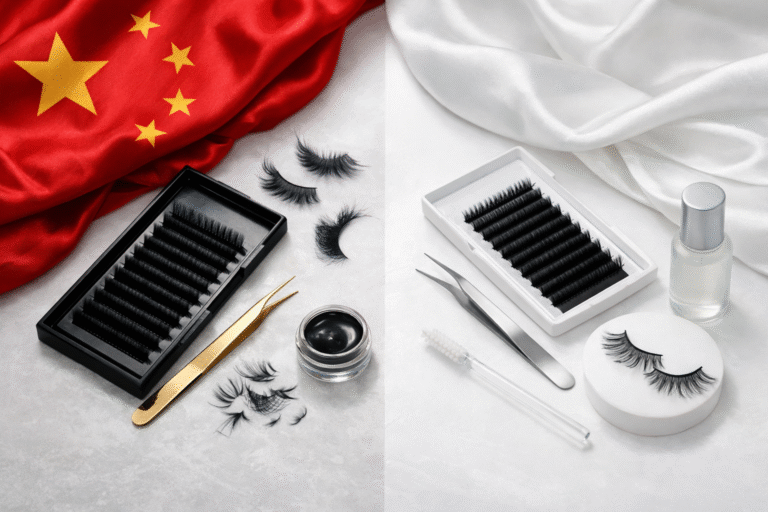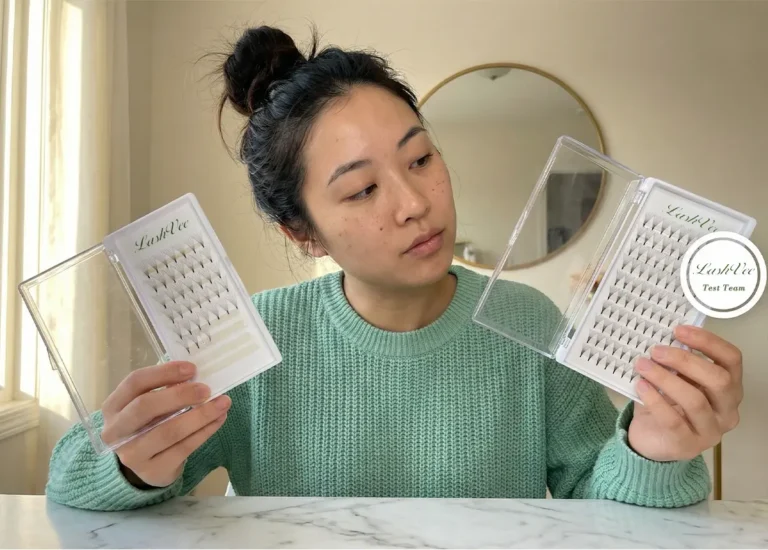

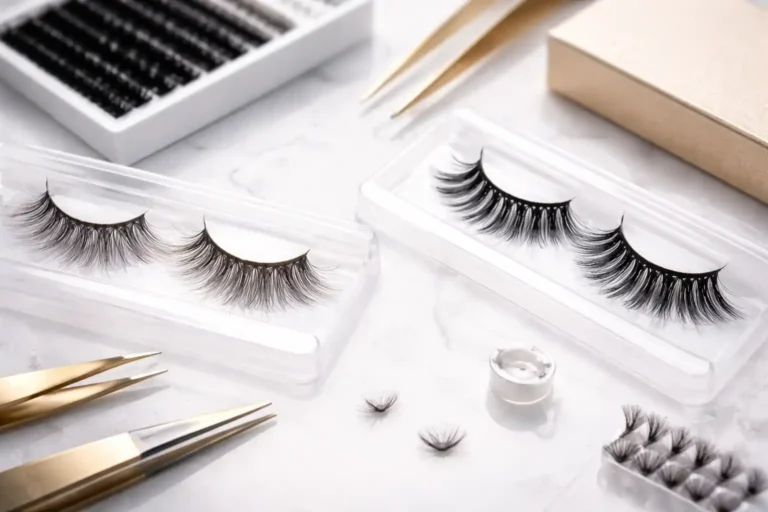
Wet set (wet-look) “wins” for high-definition, editorial texture—but only if technique consistency, SKU control, and QC can handle tighter tolerances. Wispy “wins” for broad appeal and repeatable outcomes, especially for strip lash lines and hybrid extension menus. Pick based on channel (strip vs extensions) and repeatability (training + inspection), not aesthetics alone.
Disclosure & safety: This is general manufacturing/sourcing guidance. Confirm market-specific requirements and safe technique training with qualified professionals.
Quick answer: Wispy vs Wet Set Lashes
In 2026, wet set (wet-look) lashes “win” for high-definition, editorial texture—but only when your artist skill level, SKU control, and QC are ready for tighter tolerances. Wispy lashes “win” for commercial consistency and broad appeal, especially for strip lash lines and hybrid extension menus. If you need one hero style, choose based on channel (strip vs extensions) and repeatability (training + inspection), not aesthetics alone.
We share general manufacturing and sourcing guidance. Confirm regulatory requirements for your target market with qualified professionals.
Key Points
- “Wispy” = mapped texture; “wet set” = narrow, closed spikes for a glossy grouped finish.
- In 2026, demand favors visible texture and definition, but repeatability is the real competitive edge. See more in our 2026–2027 Personalized Lash Trends.
- Wispy is the safer evergreen seller for strip lines and flexible extension menus.
- Wet set is the stronger signature look for content-driven clients—when training + QC are tight.
- Lock spike interval, symmetry tolerance, and labeling accuracy before scaling production.
- Use an AQL-based incoming inspection plan to reduce “uneven” and “mismatched” complaints.
- If adhesives are involved, rely on SDS and confirm requirements by market (US/EU rules differ).
- Clear Incoterms and packaging specs prevent profit leaks more than arguing over $0.03/unit.
Wispy vs Wet Set: what’s the difference?
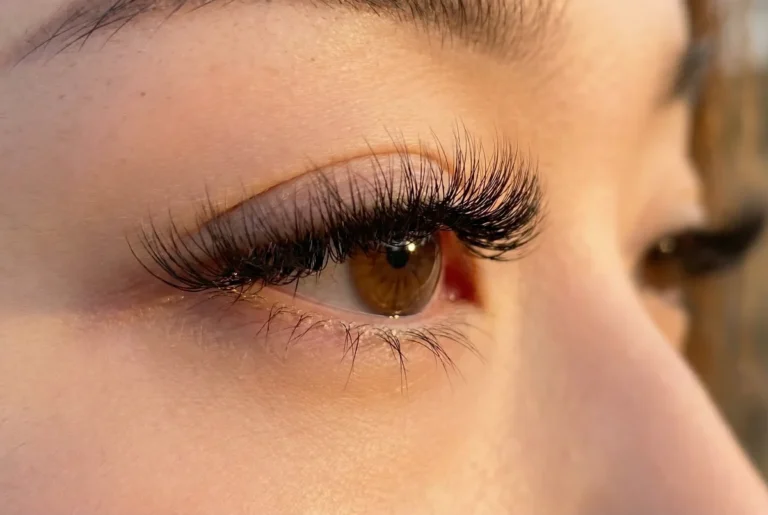
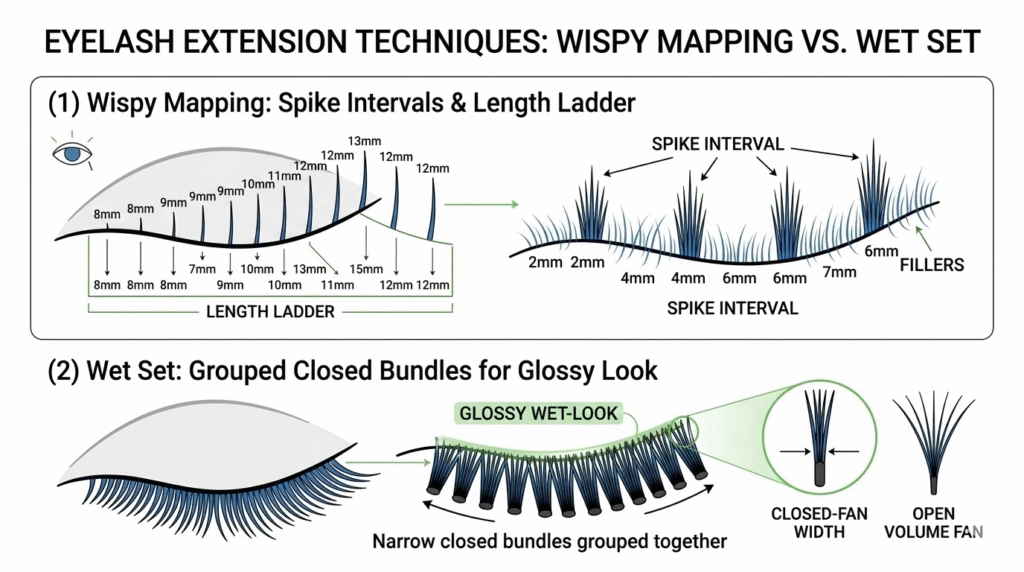
Answer: Wispy is a texture/mapping strategy—you place longer “spikes” among shorter fillers to create airy dimension. Wet set / wet-look is a finish—lashes look glossy and “just-applied mascara” defined because bundles stay narrow/closed (closed fans or tight spikes instead of wide fluffy fans). Many sets combine both; the sourcing difference is mapped length contrast (wispy) vs closed-bundle tolerance (wet set).
What we mean in this article (to prevent naming confusion):
- Wispy (production spec): a controlled mix of lengths + a defined spike interval (e.g., every X mm) layered over fillers.
- Wet set / wet-look (production spec): controlled bundle width (closed or nearly-closed) + consistent spike definition (tips + grouping).
Why people mix the terms (and how to interpret it):
- Some artists call any “spiky” set a wet set.
- Some call glossy grouped lashes wispy because it still looks textured.
- For buying/QC, treat them as different: wispy = mapping, wet set = bundle closure + definition.
RFQ translation (use these words with factories/suppliers):
- If you want wispy consistency, specify spike interval + length ladder + left/right symmetry tolerance.
- If you want wet set consistency, specify closed-fan/bundle width standard + pass/fail photo examples + labeling controls (mixed trays ruin wet-look fast).
Which “wins” for strip lashes in 2026? (Wispy vs wet-look / wet set)
Wispy strip lashes usually win as the evergreen seller because they read “natural but better,” suit more eye shapes (including cat-eye and doll-eye looks), and are more forgiving of tiny band or left/right variation—so shoppers report fewer “uneven” or “hard to apply” frustrations. Wet-look (wet set) wins as a trend/drop style—especially as clusters or spiky strips built for camera-first definition, where consumers expect visible texture.
Choose wispy if you want
- Higher repeat buys from daily wear customers (“soft enhancement”)
- Broader eye-shape compatibility (easy “cat-eye” effect without looking harsh)
- Lower risk of “too spiky / too dramatic” returns
Choose wet-look if you want
- A content-driven SKU that photographs glossy, grouped, defined
- A style aligned with ongoing interest in spiky/cluster lash aesthetics (often discussed alongside “manga/spiky/cluster” trends)
- A tighter spec + QC workflow (because small asymmetry reads as “messy”)
RFQ / QC priorities for strip lashes (what to lock before you sample)
- Band construction: material, stiffness, height/thickness (comfort + lift consistency)
- Left/right symmetry tolerance: define what passes/fails with side-by-side photos
- Spike spacing rule (if textured): spacing rhythm + length mix (controls “random vs messy”)
- Curl + fiber consistency: curl drift and taper uniformity across lots
- Packaging deformation test: simulate transit compression/heat, then re-check band shape + lash alignment
What’s different in 2026: texture is back, and “definition” sells
Two signals matter for sourcing decisions:
- Statement/visible lashes are reappearing in fashion and media (less “invisible clean girl,” more intentional eye detail).
- In the pro lash market, wet-look lashes have been repeatedly called out as a growing extension trend, with the caveat that curl choices and harshness can vary by client. (Explore full collection in our Eyelash Extensions.)
So the 2026 “winner” isn’t one style—it’s the brand that can deliver consistent texture at scale.
Decision table: which style wins for your business model?
| Your 2026 goal | Wispy wins when… | Wet set wins when… | What to specify in your RFQ |
|---|---|---|---|
| Launch a strip lash hero SKU | You need mass appeal + fewer returns from “too spiky” feedback | You’re doing a trend drop (clusters/strip that photographs “glossy”) | Fiber type, band height/thickness, spike interval, length mix, symmetry tolerance |
| Add a best-selling salon menu item | You want flexible mapping across eye shapes and client tastes | You want a clear, “defined spike” signature look clients can request by name | Spike-to-filler ratio, closed-fan width, curl set, length ladder, training SOP |
| Scale to multiple locations (standardization) | You can standardize 2–3 maps and control variation | You can enforce tighter technique + inspection on spikes/fans | “Pass/fail” photos, mapping diagram, AQL plan, tray/label controls |
| Minimize remake risk | Your team is mixed-skill or you’re onboarding fast | Your top artists are consistent and you can QA outcomes | Acceptance criteria: density, symmetry, spike spacing, lash line darkness |
Deep dive: Strip lashes (wispy vs wet-look)
In the query block above, we gave the short operational answer: wispy is the evergreen, wet-look is the drop. Here’s the longer breakdown of what drives conversions, what triggers returns, and what to lock in your RFQ for each style.
Wispy strips are still your commercial anchor
For DTC and wholesale, wispy strips tend to convert because they:
- Read as “natural but better” in everyday lighting
- Work across more eye shapes with fewer complaints
- Allow you to build an easy range: soft wispy → textured wispy → spiky wispy
Spec levers for strip-lash wispy (what changes cost + consistency):
- Band construction: cotton vs clear band; band height and stiffness drive comfort and lift
- Fiber taper + randomness: too uniform looks “manufactured,” too random looks messy
- Symmetry: wispy relies on controlled “imperfection”—but left/right mismatch causes returns
Wet-look in strip form: treat it like a limited drop or a cluster line
“Wet look” translates best as clusters or spiky strip styles intended for content (TikTok/IG, bridal trials, nightlife). It photographs extremely well—but it’s also where customers say:
- “Too spiky”
- “Too dramatic for daytime”
- “Looks uneven” (often a symmetry/QC issue)
Commercial move: keep wispy as evergreen, and add 1–2 wet-look SKUs as seasonal drops.
Which “wins” for extensions: wispy or wet set?
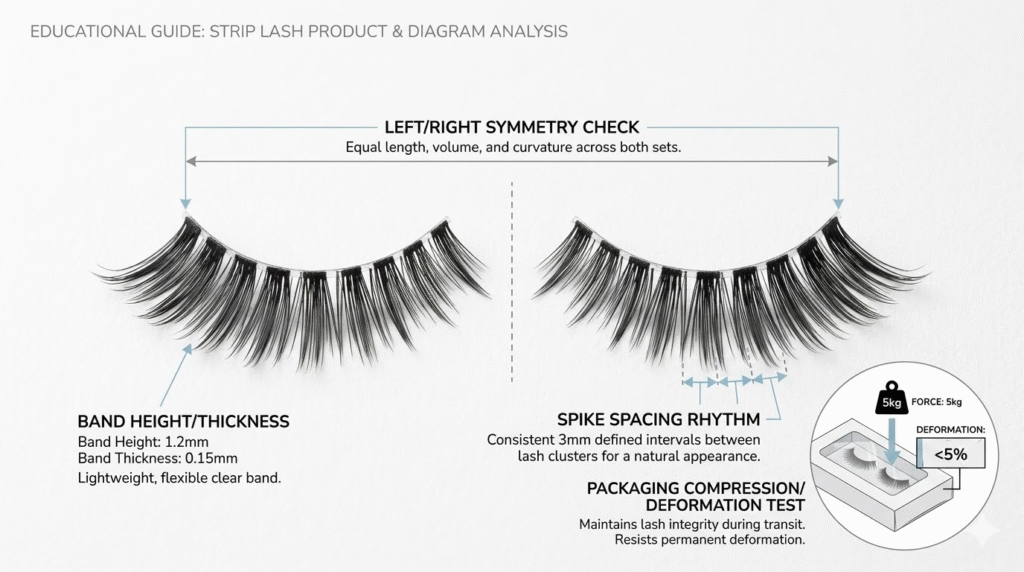
For extensions, wispy wins for flexibility and repeatability across clients, while wet set (wet-look) wins for camera-first definition—but only if your team can consistently create narrow, nearly closed “spikes/fans” with tight placement and QC. Wet-look is typically described as using closed or nearly closed fans to create a grouped, glossy finish.
- Choose wispy if you need a menu item most techs can deliver with small mapping adjustments (eye shape, density, texture level).
- Choose wet set if you’re building a signature service with a highly specific top-line texture and you can enforce tighter technique + inspection.
- Operational reality: wet set reads “right or wrong” faster, while wispy can still look good with minor variance.
The decision rule (what matters operationally)
If you’re selling services, the “winner” is the style that matches your ability to control (1) technique variance, (2) product inputs, and (3) photo-based QA.
- Wispy = mapping strategy (spikes + fillers) → more adjustable set-to-set
- Wet set / wet-look = grouped, glossy finish built from closed / nearly closed fans → more sensitive to drift
When wispy wins for extensions (repeatability + consult flexibility)
Wispy tends to outperform as a default menu item because techs can “tune” the look per client without breaking the aesthetic:
- Spike placement can shift (center-heavy, doll, cat) without looking like an error
- Texture intensity can be scaled (subtle → spiky) while staying “wispy”
- Density can adapt (classic/hybrid/volume base) and still match expectation
Standardize it by freezing:
- 2–3 approved maps (with exact length ladders)
- Spike interval rule (e.g., every X lashes or X mm)
- Photo standards (front + 45° + closed-eye lash line)
When wet set wins for extensions (signature look + content-driven clients)
Wet set is a strong “named look” because it has a recognizable grouped texture—often described as applying narrow, nearly closed fans to create a wet/mascara effect.
That same specificity makes it less forgiving:
- Small differences in bundle width or spacing are obvious
- Clumping/over-adhesion ruins the “defined spike” read (this should be trained formally with safe product education, not learned from blog posts)
Operational requirement to sell wet set confidently:
- One approved map (don’t allow freestyle until mastery)
- One controlled tray input (consistent curls/lengths)
- Pass/fail photo checklist (what counts as “too open,” “too thick,” “too clumped”)
See ready examples: Wispy W Lashes 0.07 Built-In Spike Wet Look Fans and Pre-Made Wet Lash Spikes – 0.07 5D Volume.
Why wet set is “binary” (and how to prevent remakes)
Wet set looks amazing when spikes are:
- narrow enough (closed),
- evenly spaced,
- and consistent along the lash line.
It looks “wrong” when:
- spikes open up,
- spacing becomes irregular,
- or the lash line gets patchy/dark in inconsistent segments.
Fix: define acceptance criteria visually:
- “Pass” reference photo set (3 angles)
- “Fail” examples (open spikes, clumps, gaps, drift)
- Touch-up rules (what gets repaired vs remade)
What to lock in your extensions RFQ (so the look survives scaling)
Wispy trays (extensions):
- Spike-to-filler strategy (or spike interval rule)
- Length ladder + spike increment (+2–4mm vs base)
- Curl plan (single curl vs controlled mix)
- Diameter inputs (base vs spikes)
- Label controls to prevent mixed trays
Wet set trays (extensions):
- Closed-fan width standard (define with pass/fail photos)
- Spike tip style (sharper vs softer tips changes perceived “wetness”)
- Lash line darkness target (wet looks denser at base—align expectations)
- Anti-mix labeling and tray segregation controls
Spec sheet cheat codes: what to lock before sampling
Whether you’re sourcing strips, clusters, or extension trays, the biggest “wins” come from freezing these variables early:
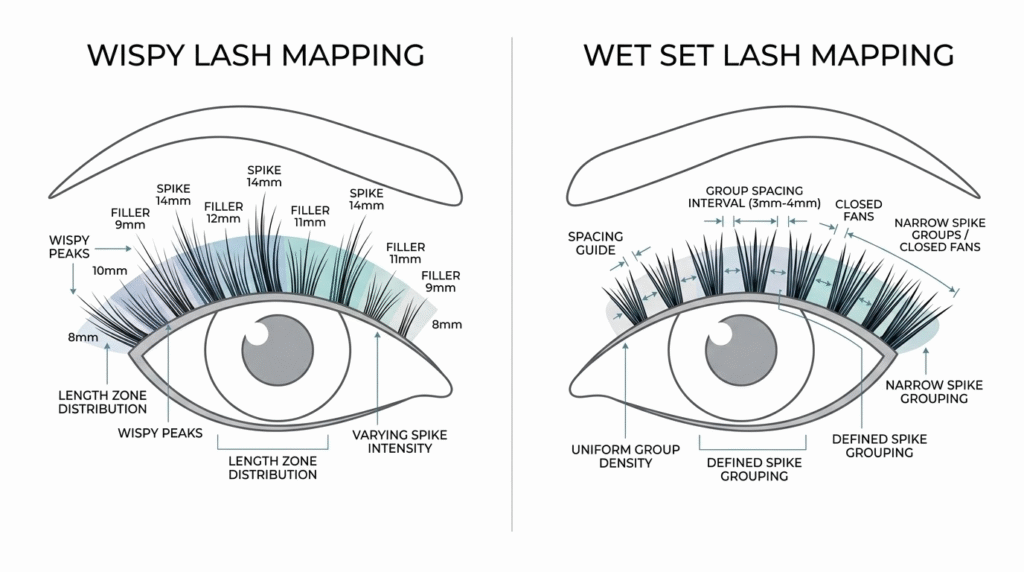
For wispy
- Spike interval: every X mm or every Y lashes (don’t leave it “artist preference” if you want repeatability)
- Length ladder: e.g., base 8–12 mm with spikes +2–4 mm (range varies by market preference)
- Curl mix: single curl for consistency vs dual curl for dimension (dual curl raises variance risk)
- Density target: light / medium / full (define by photo + unit weight, not adjectives)
For wet set
- Closed-fan width: define “closed” with a visual standard (what passes, what fails)
- Spike definition: sharp tips vs softer tips (tip quality changes perceived “wetness”)
- Lash line darkness: wet set often looks denser at the base—align with your market’s preference
- Tray labeling: curl/length must be error-proof (wet set failures often trace back to mixed trays)
Returns & complaints: what causes them (and how to prevent them)
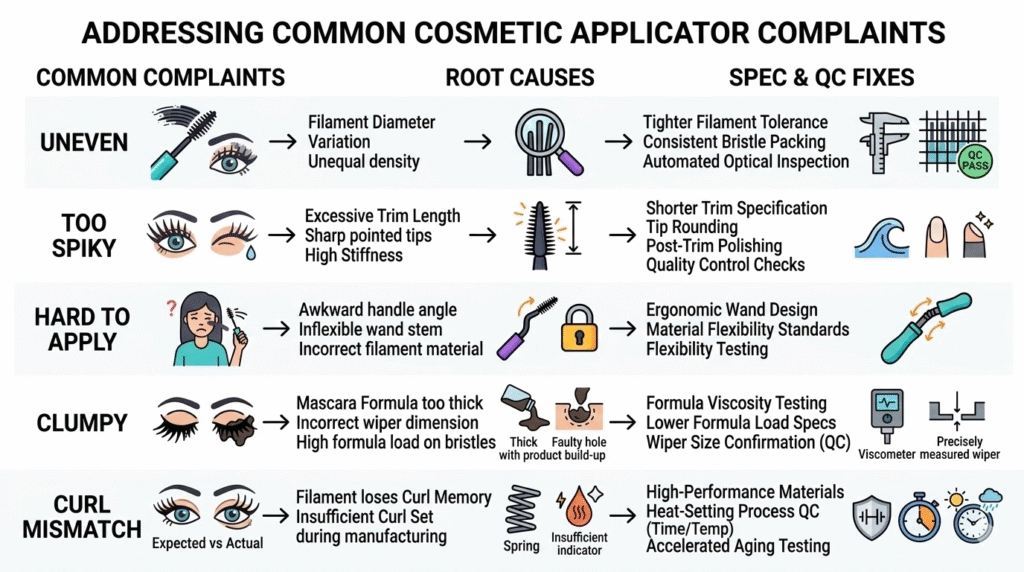
Returns happen when the customer’s complaint language (“uneven,” “too spiky,” “hard to apply”) doesn’t map to clear pass/fail production rules. The fix is to translate complaints into spec variables + inspection checkpoints so you can prevent drift between sample → reorder.
Complaint → root cause → spec/QC fix (RFQ-friendly)
| Customer complaint (what they say) | Likely root cause (what it is) | What to lock in the RFQ | QC checkpoint (what you inspect) |
|---|---|---|---|
| “Looks uneven” | Left/right mismatch; spike spacing drift | Symmetry tolerance, spike interval rule | Side-by-side L/R photo standard |
| “Too spiky” | Spike-to-filler ratio too high; tips too sharp | Spike:filler ratio, tip softness/sharpness | Reference photo + density check |
| “Hard to apply” (strips) | Band stiffness/height wrong; curvature variance | Band material + height/thickness | Flex test + band measurement |
| “Clumpy” (wet look) | Closed-fan width inconsistent; grouping not controlled | Closed-fan width definition + pass/fail photo | Bundle-width visual standard |
| “Curl/length mismatch” | Tray mixing; curl drift across batch | Label controls + lot traceability | Tray audit + batch curl verification |
| “Sheds / falls apart” | Fiber anchoring / band quality | Fiber retention expectation | Gentle comb test + band resilience |
The three highest-impact defects to monitor
- Curl drift / curl mismatch across batches (especially noticeable in spikes)
- Left/right asymmetry in wispy strips (customers think it’s “hard to apply”)
- Band or base inconsistency (strip band stiffness; extension base thickness)
AQL sampling: set it up like a grown-up brand
If you do incoming inspection, consider using an acceptance sampling approach such as ANSI/ASQ Z1.4 (inspection by attributes) to define sample size and acceptance criteria for defects.
Practical lash QC checkpoints (RFQ-friendly):
- Visual: symmetry, spike spacing, density consistency, lash-line darkness
- Handling: shedding during gentle combing, band resilience, tray integrity
- Packaging: deformation after compression (simulated transit)
Compliance & documentation: what’s relevant (and what’s not)
Lashes themselves are typically treated as beauty accessories, but adhesives and removers can fall under cosmetic rules depending on market and claims.
For the U.S., FDA provides an overview of cosmetic labeling expectations (ingredient declaration, identity statement, etc.).
For the EU, Cosmetic Regulation (EC) No 1223/2009 defines the framework for cosmetic products and responsibilities (case-by-case determination matters).
Factory-side process expectation: If you’re private labeling items that are regulated as cosmetics in your target market, look for GMP alignment—ISO 22716 is a widely recognized cosmetics GMP guideline covering production, control, storage, and shipment practices.
What to request (safe, non-legal-advice version):
- Product specs + batch/lot traceability
- Packaging/label files you can localize
- For adhesives/chemical products: SDS from the supplier + your market-specific compliance review
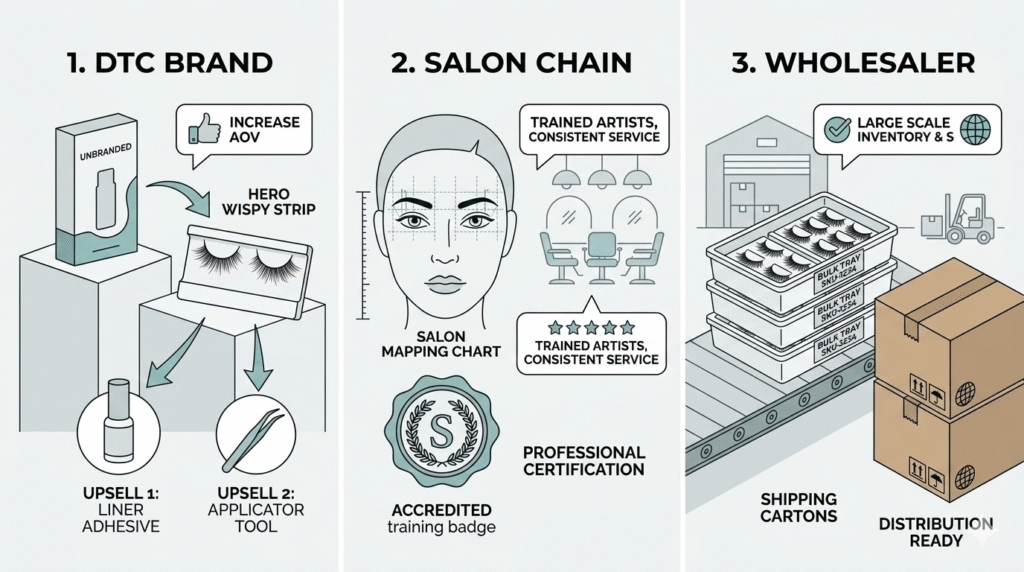
3 real-world sourcing scenarios we’re seeing in 2026
Scenario 1: DTC brand needs one hero style + two upsells
- Problem: High CAC, low repeat purchase on dramatic styles
- Move: Hero = soft wispy strip (daily wearable). Upsells = textured wispy + wet-look cluster kit for content days.
- QC focus: symmetry on hero SKU; spike interval consistency on upsells.
Scenario 2: Salon chain wants a “signature look” that’s teachable
- Problem: Wet set photos look great, but outcomes vary by technician
- Move: Offer wispy as default; offer wet set as “advanced” add-on after certification.
- Ops fix: one approved mapping chart, one approved tray SKU, pass/fail photo checklist.
Scenario 3: Wholesaler shipping mixed SKUs to EU + UK
- Problem: Returns from mis-labeled curl/length + packaging damage in transit
- Move: Reduce tray variety, standardize labels, and tighten carton packaging specs.
- Logistics note: clarify Incoterms® (who pays what, who handles customs, where risk transfers) early in the PO—Incoterms® 2020 is the current ICC framework used globally.
What should I specify in an RFQ for wispy vs wet set?
The biggest quality wins come from freezing 3–5 variables before sampling twice. For wispy, lock spike interval + length ladder + symmetry tolerance. For wet set, lock closed-fan width + spike tip definition + labeling controls. Then use acceptance sampling to prevent drift.
- Wispy RFQ: spike spacing rule, length mix, band spec (if strip), symmetry tolerance
- Wet set RFQ: closed-fan width standard (photo pass/fail), tip quality, lash-line darkness
- QC: define defect classes (critical/major/minor) + AQL sample plan
For wispy (strip or extensions):
- Target look: soft / textured / spiky wispy (include 3 reference photos)
- Length ladder + spike increment (+2 mm? +3 mm?)
- Curl(s) and fiber type
- Density target + acceptable tolerance (define with photo + weight/range)
- Packaging spec (tray/box) + barcode/label needs
- QC plan: AQL level + defect list (critical/major/minor)
For wet set:
- Wet look intensity: subtle / medium / bold (reference photos)
- Closed-fan/spike definition standard (what fails)
- Lash line darkness target
- Tray labeling controls (anti-mix system)
- Training assets needed: mapping diagram, before/after standards
FAQ
Are wet set lashes the same as wispy lashes?
Not exactly. Wet set is a finish (glossy, grouped spikes). Wispy is a texture strategy (spikes + fillers). Many looks combine both.
Which style has fewer returns for strip lashes?
Usually wispy, because it’s more forgiving on application and symmetry expectations—assuming your band and left/right matching are controlled.
Which style is easier to standardize across a salon team?
Often wet set, because the target look is very specific—but it requires tighter technical control and product consistency.
Should I launch both in 2026?
If budget allows: yes—wispy as evergreen, wet set as a trend SKU (clusters or an advanced service). That’s a common “portfolio hedge” against trend swings.
Conclusion and next steps
Wispy “wins” when you’re optimizing for broad demand, easier repeat buys, and scalable manufacturing. Wet set “wins” when you’re optimizing for camera-first definition and you can enforce tighter technique and QC.
If you’re building a 2026 assortment, your next step is simple:
- Pick one primary channel (strip retail vs extensions service).
- Freeze 3–5 spec variables (spike interval, curl, length ladder, density, labeling).
- Sample twice, then set inspection rules before you scale the PO.
If you’re sourcing private label lashes, LashVee typically supports OEM/ODM builds with clear spec sheets, packaging coordination, and QC checkpoints—so your “wispy” or “wet set” looks the same from sample to reorder. Get a quote today.
References
Teen Vogue — “KATSEYE Member Manon Joined the Manga Lashes Trend”
Nouveau Lashes — “What are wet look lashes?”
LashBase — “Let’s talk wet look lashes”
U.S. FDA — “Summary of Cosmetics Labeling Requirements”
eCFR — “21 CFR 701.3: Designation of ingredients”
EUR-Lex — “Regulation (EC) No 1223/2009 on cosmetic products”
ISO — “ISO 22716:2007 Cosmetics — Good Manufacturing Practices (GMP)”
International Chamber of Commerce (ICC) — “Incoterms® 2020”
U.S. OSHA — “Hazard Communication Standard: Safety Data Sheets”
NewBeauty — “Manga Lashes Are the Spiky Lash Trend Taking Over 2025”