Wholesale vs Private Label Lashes: MOQ, Packaging & Landed Cost
A practical cost breakdown of wholesale vs private label lashes—MOQs, packaging/printing, freight, Incoterms, and how to calculate true landed cost.
Introduction
When comparing wholesale lashes vs private label lashes, the cheapest option depends on your business model—not just the unit price. Wholesale is usually cheaper upfront (lower MOQ, faster turnaround), while private label costs more because of packaging/printing/setup—but often wins on margin if branding lets you charge more.
This guide breaks down the pricing models, the hidden cost buckets (MOQ, packaging, freight, Incoterms), and a simple way to estimate landed cost per sellable unit—so you can source and price confidently.
Quick answer (in 20 seconds)
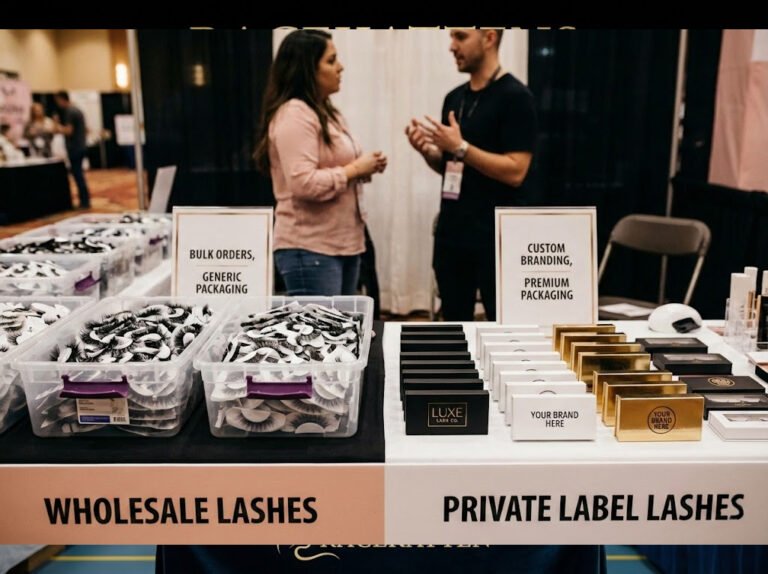
Wholesale lashes = stock styles + standard packaging + lower MOQ + faster lead time (best for speed, variety, testing)
Private label lashes = stock or semi-custom styles + your branding/packaging + setup/printing costs (best for differentiation + repeat customers)
OEM lashes = deeper customization (materials/feel/band/mapping/packaging) + highest MOQ/time (best for established brands scaling)
Which is cheaper?
For cash flow + speed → wholesale is usually cheaper
For brand margin + repeat sales → private label can be cheaper per profit, even if higher per unit
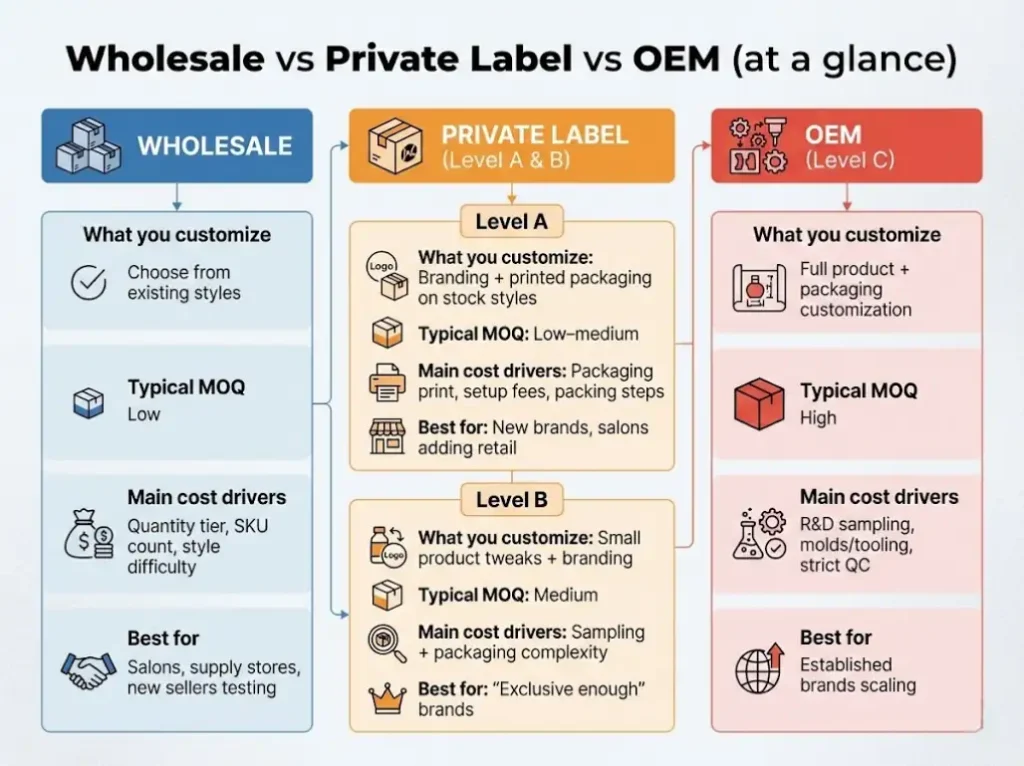
Wholesale vs Private Label vs OEM (at a glance)
Model
What you customize
Typical MOQ
Main cost drivers
Best for
Wholesale
Choose from existing styles
Low
quantity tier, SKU count, style difficulty
salons, supply stores, new sellers testing
Private label (Level A)
Branding + printed packaging on stock styles
Low–medium
packaging print, setup fees, packing steps
new brands, salons adding retail
Private label (Level B)
Small product tweaks + branding
Medium
sampling + packaging complexity
“exclusive enough” brands
OEM (Level C)
Full product + packaging customization
High
R&D sampling, molds/tooling, strict QC
established brands scaling
Practical takeaway: Wholesale optimizes speed and simplicity. Private label/OEM optimizes brand control and margin potential.
The simplest way to compare costs (landed cost)
Landed cost per unit = (Product + Packaging + Setup/Sampling) ÷ units + (Freight + Duties/Taxes + Local delivery) ÷ units + your defect/replacement buffer
If you only compare “unit price,” you’ll miss the real difference—especially when packaging gets heavier or Incoterms change.
Note: We’re writing this from a factory perspective (LashVee), so we’ll point out where costs typically appear in quotes—packaging steps, MOQs, QC, and Incoterms—so you can compare suppliers fairly.
What “Wholesale” and “Private Label” Really Mean (In Factory Terms)
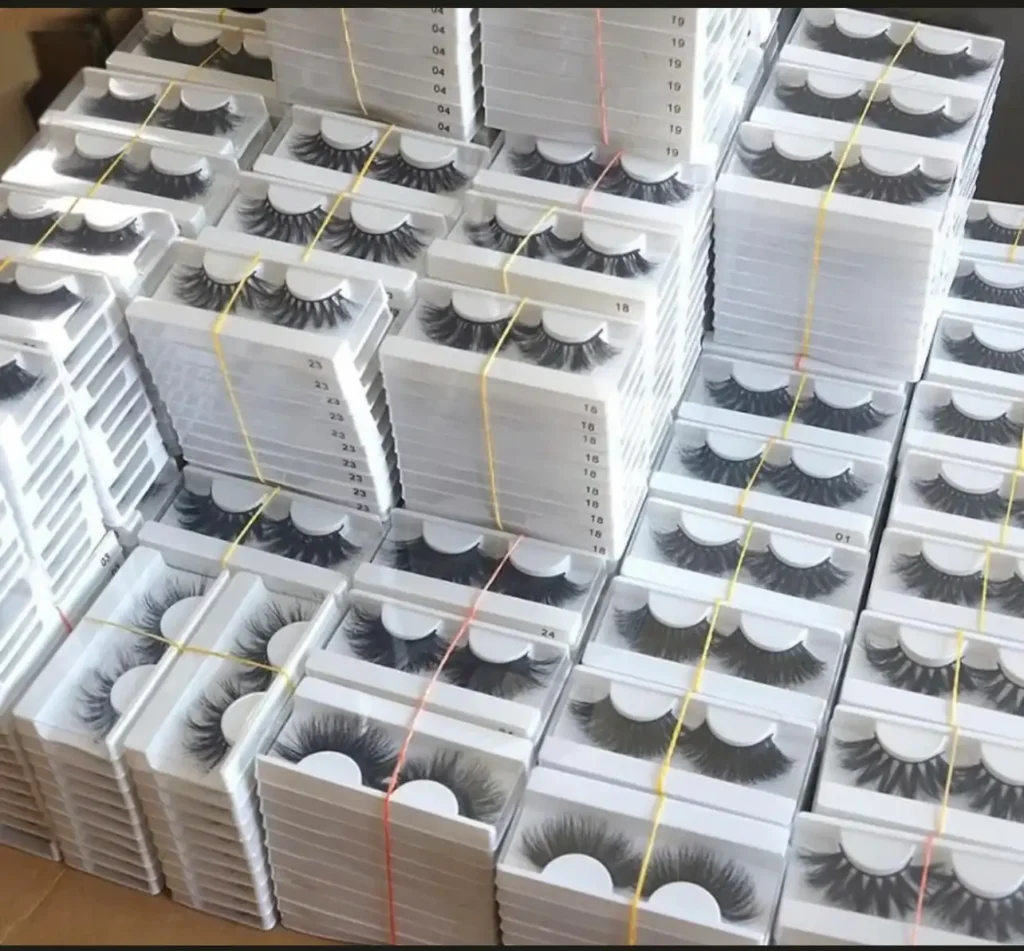
Wholesale lashes (stock / ready styles)
Wholesale usually means:
You choose from existing styles (curl, length mix, diameter, mapping, band type, tray layout).
Packaging is standard (or minimal).
Pricing is primarily based on quantity tiers.
MOQs are typically lower, and lead times are faster.
This is popular for:
Lash techs buying for clients
Beauty supply stores
New online sellers testing demand
Distributors who want variety without customization delays
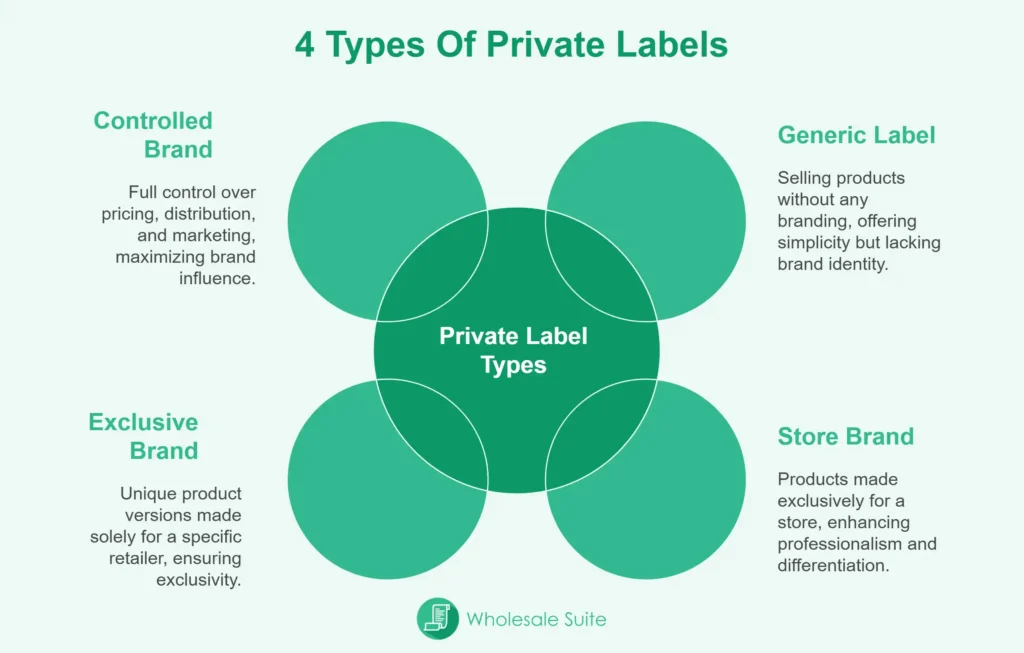
Private label lashes (your brand on it)
Private label typically means:
The lash style may be stock or custom, but the branding and packaging are yours.
You pay for printing, packaging, design support, and sometimes setup fees.
MOQs are higher than pure wholesale, but many factories (including us) support low MOQ entry options.
This is popular for:
Brand owners who want repeat customers and recognizable packaging
Salons building retail add-on revenue
Influencers and e-commerce sellers who need differentiation
Custom fiber feel, curl behavior, band stiffness, mapping, tray format
Custom molds or tooling (sometimes)
More sampling rounds, stricter QC specs
Higher MOQs and longer timelines
This is popular for:
Established brands scaling
Distributors launching exclusive lines
Teams with strong brand strategy and consistent reorder volume
Practical takeaway: Wholesale saves time and reduces complexity. Private label/OEM buys you brand equity and control. The “best price” depends on which outcome you value more.
The Building Blocks Behind Lash Pricing
No matter which route you choose, lash pricing is built from a few consistent cost buckets:
Raw materials
Fiber type (often PBT variations), softness, finish, consistency
Band material and adhesive used in strip lashes (or base in extensions)
Labor and process time
Hand-made steps (sorting, curling consistency checks, placement on tray)
Difficulty level of the style (wispy spikes, layered mapping, special bases)
Practical takeaway: When you “upgrade” from wholesale to private label, you’re not just paying for a logo—you’re paying for packaging complexity, print steps, and coordination.
Wholesale Lash Pricing Models (Most Common Structures)
1. Price per unit (tray / box / pair)
This is the simplest model. You’ll see pricing like:
$X per tray (lash extensions trays or strip lash trays)
$X per pair (consumer strip lashes)
$X per case/carton (for distributors)
What changes the unit price?
Quantity tier
Style difficulty
Material grade/finish
Tray format and included accessories (brush, glue, tweezers—if bundled)
2. Tiered volume pricing
Most factories use tiers such as:
50–199 units
200–499 units
500–999 units
1,000+ units
Illustrative example (not a quote):
100 trays: $2.30 each
500 trays: $1.90 each
1,000 trays: $1.70 each
Why it drops: fixed costs (setup, QC time, packing line changeover) get spread across more units.
3. MOQ by style (SKU-based MOQ)
In wholesale, the MOQ may be:
Low MOQ per style (good for variety)
Or a total MOQ across mixed styles (even better for testing)
If you’re building an assortment (like 12 styles), watch out for high MOQ per SKU, which can trap cash in slow-moving designs.
4. “Factory-direct” vs trading pricing
A factory-direct quote often has:
Clear tier breaks
Clear packaging assumptions
More stable QC standards
A trading company quote might be competitive too—but you’ll want clarity on:
Who controls QC?
Who owns lead time responsibility?
Who handles rework if specs are off?
Practical takeaway: For wholesale, the biggest lever is almost always volume + SKU planning, not aggressive negotiation.
Private Label Pricing Models (3 Common Levels)
Private label pricing usually falls into three “levels.” Knowing which one you’re in prevents surprise fees.
Level A: Stock lashes + your logo (fastest private label)
You choose:
Stock lash style(s)
Your packaging artwork/logo placement (on an existing dieline)
You pay for:
Product unit cost (similar to wholesale)
Printed packaging (box, label, insert)
Sometimes a printing setup fee (especially for small runs)
Brands that want “exclusive enough” without full R&D
Level C: Full OEM customization (most control)
You customize:
Lash feel + fiber behavior
Band/base specs
Mapping that’s unique to your brand identity
Fully custom packaging structure
You pay for:
More sampling rounds
Higher MOQs
Potential tooling/mold fees (depending on packaging or components)
Best for:
Brands with reliable reorder volume
Teams that want defensible differentiation
Practical takeaway: If your goal is brand-building but you’re still validating demand, Level A or B is usually the smartest entry point—especially with low MOQ programs.
MOQ: The Price Lever That Quietly Decides Everything
MOQ affects pricing in three ways:
Unit cost Lower MOQs usually mean higher unit costs because factories can’t optimize production flow.
Setup fees For small runs, factories may add:
print setup fee
packing line setup fee
manual label application fee
Your inventory risk The cheapest unit price can become the most expensive decision if you’re stuck with slow-moving stock.
What we recommend (practically):
If you’re new: prioritize manageable MOQ + variety
If you’re scaling: prioritize consistent reorders and lock in tiers
The Real Comparison: Landed Cost (Not Just “Unit Price”)
A common mistake is comparing:
“Wholesale unit price” vs “Private label unit price”
Instead, compare landed cost per sellable unit, which includes the costs to get it into your warehouse ready to sell.
Landed cost by destination: what changes (US / UK-EU / CA-AU)
Even if two suppliers quote the same unit price, your true landed cost can shift a lot by destination—mostly because of Incoterms, duties/taxes, clearance, and last-mile handling.
United States (US) – what usually changes
Incoterms clarity matters: DDP vs FOB can swing your “all-in” cost because import handling is bundled differently.
Importer-of-record + clearance: confirm who handles entry/clearance and what paperwork you’ll receive.
Labeling & retail readiness: if you sell retail, confirm barcode/lot labeling requirements before production.
United Kingdom / EU – what usually changes
VAT/import handling: your landed cost depends heavily on who is responsible for taxes/fees (again: Incoterms).
Documentation expectations: confirm commercial invoice details, HS codes, and labeling format needed by your channel/market.
Returns/replacements plan: clarify defect allowance and how replacements ship (separately or with next order).
Canada / Australia – what usually changes
Freight allocation per unit: longer distance means carton size and packaging weight become bigger cost levers.
Shipping method tradeoffs: express vs air vs sea changes cash-flow timing and per-unit freight allocation.
Delivery-to-door fees: last-mile and remote area surcharges (if applicable) can surprise you—ask up front.
Practical takeaway: Destination isn’t a “shipping detail”—it’s part of the pricing model. Always normalize quotes to landed cost to your delivery point, not just unit price.
A simple landed cost checklist
Product cost
Packaging cost (box/label/insert/shrink)
Sampling cost (if any)
Freight (air/sea/express)
Duties/taxes (varies by destination)
Local delivery to your door (or fulfillment center)
Payment fees (wire, card, platform fees)
Quality buffer (allowance for replacements/defects)
Illustrative mini-example:
Product: $2.00
Packaging: $0.35
Freight + duties allocated per unit: $0.40 Landed cost: $2.75 per unit
If private label helps you sell that same unit for $3–$8 more at retail (depending on market), the higher upfront work is often worth it.
Practical takeaway: We always advise customers to build pricing around landed cost + target margin, not factory quote alone.
Which One Should You Choose? (By Business Stage)
If you’re a salon owner
Start with wholesale if you mainly need reliable stock for services.
Add private label if you want retail add-ons (aftercare kits, strip lash upsells) and brand presence.
A workable approach:
Wholesale for day-to-day variety
Private label “hero SKUs” (your top 2–4 best sellers)
If you’re a new brand owner (Shopify/Amazon/TikTok)
Private label (Level A) is often the best balance:
faster launch
stronger brand
controllable MOQs (especially with low MOQ options)
Wholesale can still help you test:
which curls/lengths convert
which price points move
If you’re a wholesaler/distributor
Wholesale wins if you need broad catalogs and fast turns.
Private label wins if you want exclusivity and customer stickiness.
Many distributors do both:
Carry wholesale assortment
Build a house brand through OEM/private label
Practical takeaway: It’s not either/or. Many of our long-term clients use wholesale to learn the market, then private label to own it.
How We Structure Quotes (So You Can Compare Apples to Apples)
When you request quotes—whether from us or any supplier—ask for a breakdown like this and include your destination assumptions, so “total cost” is comparable across suppliers:
MOQ affects not just unit price, but also inventory risk and setup fees.
Always compare landed cost per sellable unit, not just factory unit price.
Many businesses succeed with a hybrid: wholesale for assortment + private label for hero SKUs.
Ask suppliers for a clear quote structure: specs, tiers, MOQ rules, packaging assumptions, Incoterms, lead time, QC.
Factory-direct relationships often help with stable quality, better QC alignment, and clearer pricing.
Low MOQ programs can be a smart bridge into private label without overbuying.
Closing: A Simple Way to Choose
If you need speed and flexibility today, wholesale lashes are the cleanest path. If you’re building a recognizable business that customers come back to, private label (and eventually OEM) is where branding and margin potential really grow.
At LashVee, we support both routes—factory-direct pricing, stable quality, customized lash styles, and OEM/private label options with practical MOQs—so you can scale at a pace that matches real demand.
If you want, tell us your target market (salon retail, e-commerce, or wholesale distribution), your preferred lash type (strip vs extension trays), and your estimated monthly volume—we can help you map the most cost-effective pricing model to your goals.
Are wholesale lashes or private label lashes cheaper?
Wholesale is usually cheaper per unit because it uses stock styles and standard packaging. Private label often costs more per unit due to printed packaging, setup steps, and coordination, but it can improve retail pricing power and repeat purchases.
What’s the difference between wholesale, private label, and OEM lashes?
Wholesale = stock styles and standard packaging. Private label = your branding/packaging on stock or semi-custom styles. OEM = deeper customization (materials/feel/band/mapping/packaging) with more sampling and typically higher MOQs.
What affects private label lash MOQ the most?
MOQ is often driven by packaging complexity (custom boxes, inserts, finishes) more than the lash style itself. The more print steps and components involved, the harder it is for suppliers to run small batches efficiently.
Can I do private label using stock lash styles?
Yes. A common low-risk approach is stock lash styles + custom printed packaging. It’s usually faster than OEM and often has more manageable MOQs than fully custom product development.
What costs get added when moving from wholesale to private label?
Common add-ons include printed packaging, print setup fees, sampling rounds, and extra QC/packing steps. These costs are why “private label” isn’t just paying for a logo—it’s paying for packaging operations and coordination.
How do I calculate landed cost per tray/pair?
Landed cost per unit = (product cost + packaging + sampling allocation) + (freight + duties/taxes + local delivery allocated per unit) + payment fees + defect/replacement buffer. Compare options using landed cost—not factory unit price.
Which Incoterms matter most for comparing quotes (EXW/FOB/CIF/DDP)?
Incoterms define what’s included in the price and who pays which shipping/tax steps. Two quotes can look very different if one is EXW (shipping not included) and another is DDP (delivered with many costs included)—so normalize everything to landed cost.
What’s the best way to lower cost without lowering quality?
Reduce SKU sprawl, standardize best-sellers, use packaging that ships efficiently, and align QC standards early. Cost savings usually come from operational simplification and reorder consistency, not pushing the lowest unit price.
Is “white label” the same as private label?
Often, “white label” implies a stock product with minimal customization (sometimes just a label). “Private label” usually means stronger branding and packaging control. Suppliers use terms differently, so confirm what’s included: product specs, packaging, MOQ rules, and setup fees.
What should I prepare before requesting lash quotes?
Provide lash type (strip or extension tray), key specs (curl/length/diameter), packaging requirements, target quantity, shipping destination, and timeline. Ask the supplier to list unit tiers, MOQ rules, packaging assumptions, Incoterms, lead time, and QC tolerance.
At LashVee, we help lash brands and professional buyers avoid common sourcing mistakes—from inconsistent curl and fiber quality to unstable band bonding in mass production. Our work focuses on translating design intent into repeatable, production-ready lash styles.
If you’re evaluating suppliers, refining a lash design, or planning a private label order, we’re happy to share practical input or provide samples to support your decision.
At LashVee, we help lash brands and professional buyers avoid common sourcing mistakes—from inconsistent curl and fiber quality to unstable band bonding in mass production. Our work focuses on translating design intent into repeatable, production-ready lash styles.
If you’re evaluating suppliers, refining a lash design, or planning a private label order, we’re happy to share practical input or provide samples to support your decision.