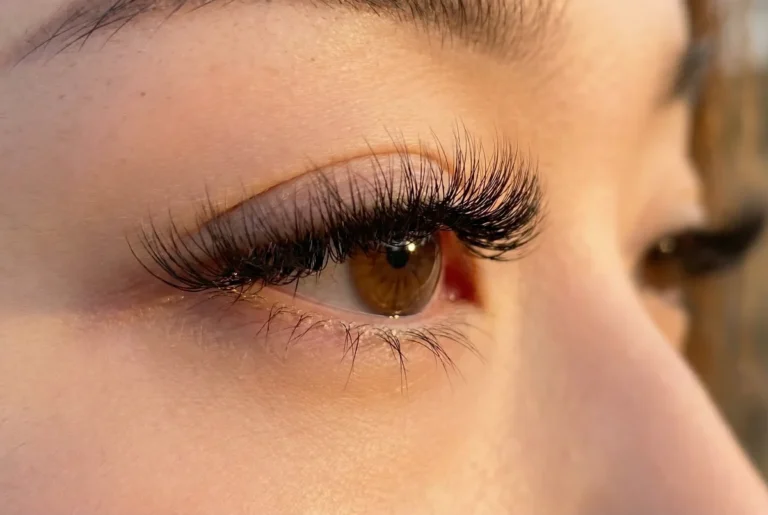

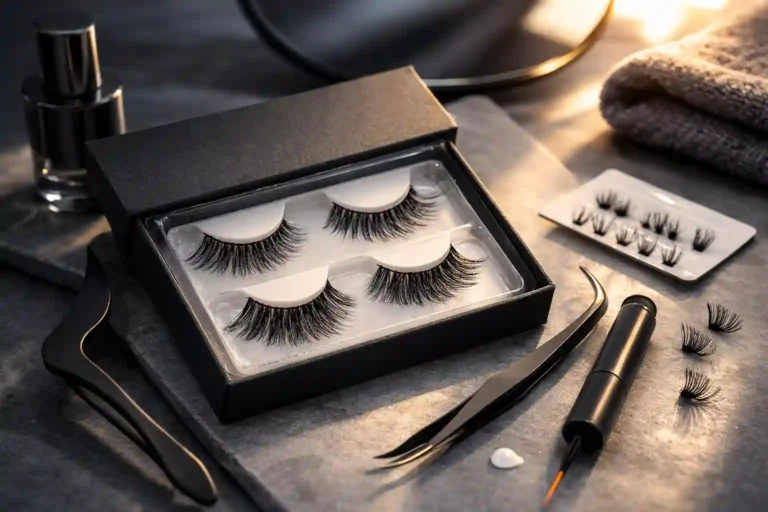
Build a “value curve” that feels natural for men, inclusive for everyone, and operationally simple for a private label supply chain.
Men’s/unisex eyelashes are best positioned as a grooming and performance outcome, not “glam.” A blue-ocean move is to sell camera-ready eye definition and easy repeatability (few SKUs, simple application, consistent QC) instead of competing on drama and endless styles.
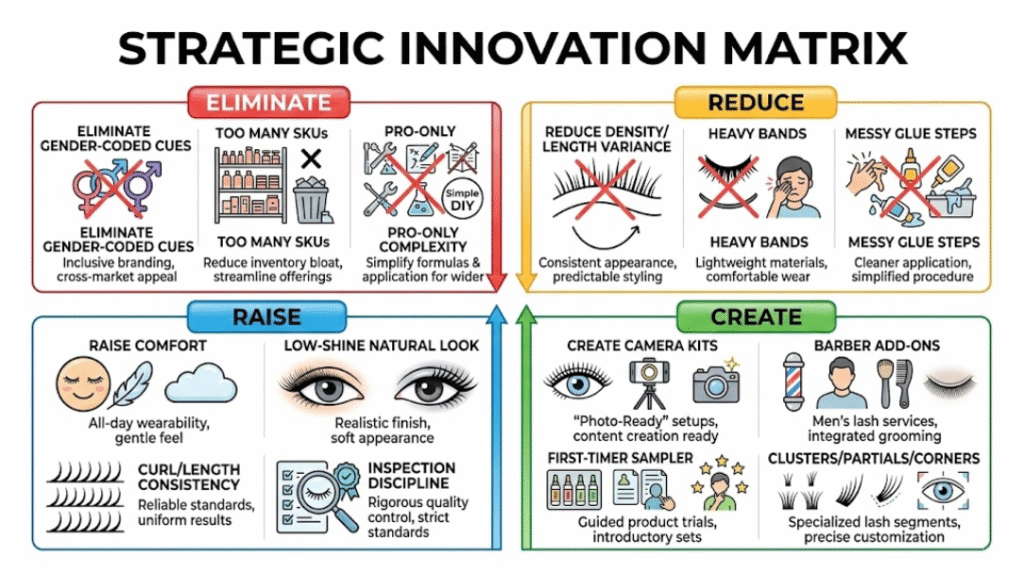
Design method (Blue Ocean ERRC):
- Eliminate friction: stigma cues, complex application, too many SKUs
- Reduce intensity: density/length variance, heavy bands, messy glue steps
- Raise proof: comfort, natural look, curl/length consistency, QC discipline
- Create new triggers: camera kits, barber/salon add-ons, first-timer samplers
Operational constraint: Your promise must be supported by specs + QC + documentation, especially for eye-area cosmetics. (General info, not legal advice.)
What “men’s/unisex eyelashes” means (and why “unisex” usually beats “for men”)
Men’s/unisex eyelashes are not a separate manufacturing category—they’re primarily a positioning + SKU-design approach: natural-first looks, simpler application, neutral packaging, and naming that describes use cases (camera, grooming, stage) instead of identity (“for men”). This typically converts better and keeps private label inventory simple.
What “unisex lashes” means on this page:
- Product design: subtle-first lengths/density, comfort-first band choices, low-shine finish
- Buying mindset: “grooming utility” (quick, functional, low-fuss), not “glam identity”
- Merchandising: use-case labels that work for men, women, and pros without splitting SKUs
Why “unisex + use-case naming” often wins (2–3 reasons):
- Lower friction: avoids stigma or self-consciousness triggered by explicitly gendered packaging (“for men”)
- Higher reach: the same SKU can meet multiple intents (men’s lashes, unisex lashes, natural lashes, camera-ready)
- Cleaner operations: fewer segmented variations → fewer MOQs, fewer replenishment headaches, more consistent QC
Evidence signals you can cite (keep conservative):
- Search and social trend reporting show growing interest in men’s beauty/self-expression, but shopping behavior often favors simple, functional framing (grooming language). (Add your citation: e.g., Pinterest Men’s Trend Report / newsroom source.)
- The broader beauty market continues to reward personalization + “newness,” creating room for niche, utility-led product systems. (Add your citation if you have one; keep it general if not.)
How to implement this on a private-label page (practical rules):
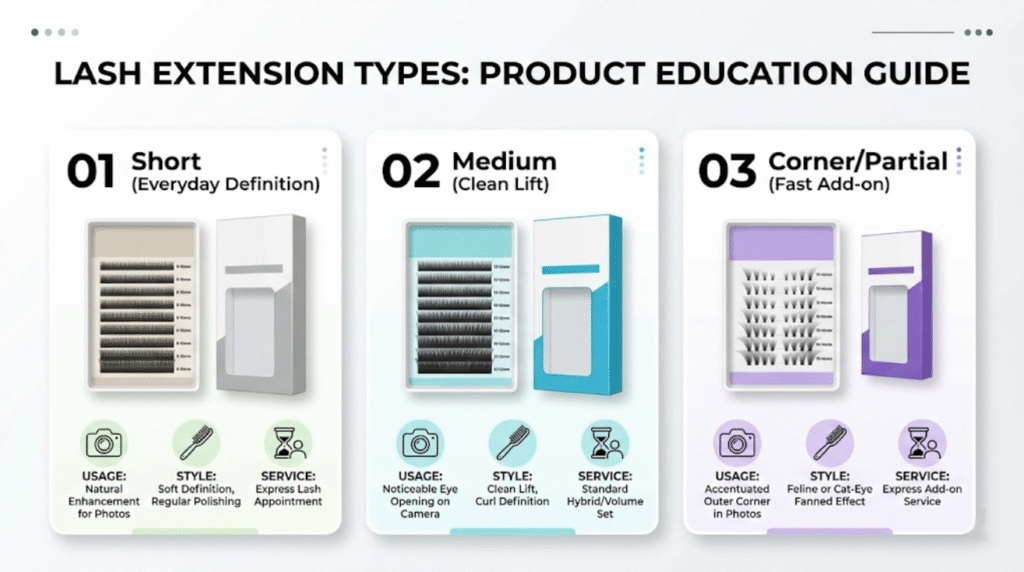
- Rename by outcome/context: “Camera Set,” “Clean Lift,” “Corner Accent,” “01/02/03”
- Keep launch simple: 3 core SKUs (Short / Medium / Corner) so first-time buyers don’t face decision fatigue
- Match copy to the buyer job: “awake/sharp definition,” “60-second application,” “comfort + repeatability”
- Avoid identity claims: don’t write “made for men’s eyes”—write “designed for subtle definition and fast application”
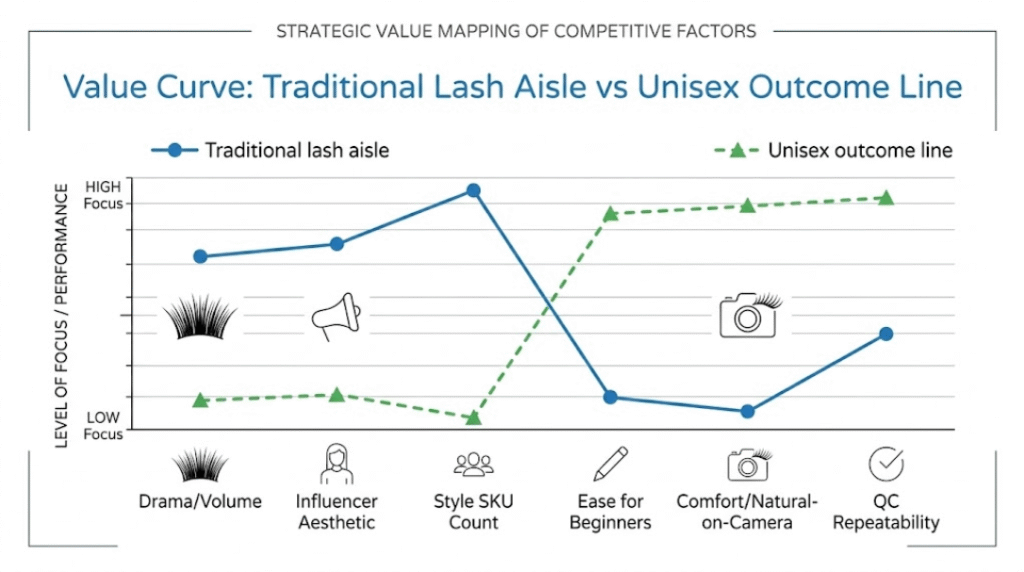
Use Blue Ocean thinking to escape the crowded lash aisle
Direct answer: Most eyelash brands compete on the same visible factors—drama, volume, influencer aesthetics, and endless style SKUs. Blue Ocean strategy helps you win by changing what you compete on: outcomes (camera-ready definition, grooming simplicity, comfort) and operational repeatability (few SKUs, tight QC), not just “more styles.”
What changes when you apply Blue Ocean to men’s/unisex lashes
Instead of asking “Which lash styles are trending?”, you ask:
- What job is the buyer hiring lashes to do? (look awake on camera, quick grooming upgrade, stage visibility)
- What friction prevents first-time adoption? (stigma cues, complexity, glue mess, too many choices)
- What proof reduces regret? (comfort, natural look, consistency, QC discipline)
The ERRC preview (how you redesign value + reduce cost)
Use the Four Actions Framework (ERRC) to rebuild the offer:
- Eliminate: identity-coded packaging/naming, pro-only complexity, oversized SKU menus
- Reduce: density/length variance, heavy bands, steps that add mess or skill burden
- Raise: comfort, “natural on camera” design cues, curl/length consistency, inspection discipline
- Create: camera kits, first-timer samplers, barber/salon add-ons, clusters/partials/corners
Why this matters for private label: ERRC naturally pushes you toward a line that is easier to explain, easier to manufacture consistently, and easier to scale because it avoids SKU sprawl.
ERRC grid (launch checklist for men’s/unisex private label lashes)
Direct answer (quotable): Use ERRC to make men’s/unisex lashes a “blue ocean” offer by removing friction (skill, stigma, mess), raising proof (comfort, natural look, QC consistency), and creating new triggers (camera kits, barber add-ons) while keeping the SKU count small.
Eliminate (remove friction you don’t get paid for)
- ☐ Overly gender-coded cues (e.g., “hyper-femme” naming/visuals that increase stigma for first-time buyers)
- ☐ Too many styles at launch (avoid 20–30+ SKUs that create decision fatigue and inventory risk)
- ☐ “Pro-only” application complexity in entry kits (minimize steps/tools for beginners)
Reduce (make “subtle-first” the default)
- ☐ Lash density and length variance (limit extremes; keep most SKUs natural-first)
- ☐ Heavy bands and stiff fibers (common comfort complaints)
- ☐ Messy glue steps where possible (favor formats and packaging that reduce glue-related errors)
Raise (increase trust and repeatability)
- ☐ Comfort proof: lightweight band, consistent curl, low-shine/low-gloss finish
- ☐ Consistency proof: tight tolerances + inspection plan for curl/length/band defects
- ☐ Beginner education: “60-second application” instructions that assume zero makeup fluency
Create (new reasons to buy + new channels)
- ☐ Use-case kits: Camera/Zoom, Clean Lift, First Lashes Sampler
- ☐ Hybrid formats: clusters, partials, corner accents (faster, lower-stigma adoption)
- ☐ Gender-neutral packaging system that looks like grooming gear (inclusive and retail-friendly)
Output (what this grid should produce):
- ☐ 1–2 positioning wedges you can credibly own
- ☐ 3 core SKUs you can keep consistent
- ☐ A proof plan (QC checkpoints + defect list) that matches the promise
Pick 1–2 positioning wedges (primary + optional secondary)
A wedge is the single reason buyers believe your lash line fits their job-to-be-done. Choose one primary wedge (the promise you are known for) and one optional secondary wedge (a supporting benefit). If you pick more than two, your specs, SKUs, and messaging will contradict each other.
The rule (enforced)
- Primary wedge (required): what you lead with everywhere (H1, first screen, hero SKU, ads).
- Secondary wedge (optional): allowed only if it reinforces the primary wedge without changing the product design.
If you can’t express your wedge in one sentence, you haven’t chosen.
Step 1 — Choose your wedge using this 60-second test
Pick the wedge that you can answer “yes” to all four questions:
- Buyer job is specific: “They want X outcome in Y context.”
- Product can signal it fast: a first-time buyer understands it in 3 seconds.
- You can prove it operationally: specs + QC checkpoints can support the promise.
- It simplifies SKUs: the wedge naturally leads to fewer launch styles.
Step 2 — Choose from the 4 wedge options (use these exact labels)
Important: Use these wedge labels consistently across the page (and in your internal docs). Consistency improves both SEO clustering and AI quoting.
Wedge A — Camera-ready definition (most universal)
Buyer job: Look awake/sharp on video, photos, meetings, content, events—without obvious makeup.
What “success” looks like: “People notice I look better, not that I’m wearing lashes.”
Signals you must support: natural taper, low shine, invisible/thin band, consistent curl.
Best formats: short/medium strips, corner accents, subtle clusters.
Wedge B — Grooming upgrade (lowest friction)
Buyer job: Add lashes into a simple grooming routine (fast, clean, repeatable).
What “success” looks like: “I can do this without being ‘good at makeup’.”
Signals you must support: minimal tools, simple naming, predictable results, minimal mess.
Best formats: starter sampler, corner/partial, easy strip options.
Wedge C — Performance & nightlife (channel-specific)
Buyer job: High visibility for stage, club, drag-inspired artistry, bold looks.
What “success” looks like: “My eyes read from distance/on stage.”
Signals you must support: bolder density options, cluster variety, stronger packaging.
Best formats: clusters, higher-density strips, graphic effects (after validation).
Wedge D — Comfort-first (trust and retention)
Buyer job: Comfortable wear with conservative risk perception (especially eye-area sensitivity concerns).
What “success” looks like: “I forget I’m wearing them.”
Signals you must support: lightweight band, softness, conservative claims, clear guidance.
Best formats: thin-band strips, soft fibers, simple adhesive guidance.
Constraint note: Avoid medical claims (“safe for sensitive eyes”). Position comfort as design + QC + instructions—not health outcomes.
Step 3 — Allowed wedge pairings (to enforce “choose 1–2”)
Use this pairing logic so your product and message don’t split:
Best pairings (coherent):
- A + B (Camera-ready + Grooming) → “fast, natural definition”
- A + D (Camera-ready + Comfort-first) → “natural definition that wears well”
Risky pairings (often contradictory):
- C + D (Performance + Comfort-first) → bold designs often increase weight/complexity
- B + C (Grooming + Performance) → one wants minimalism, one wants variety
Hard rule: If you choose C (Performance) as primary, do not also launch as “3-SKU minimal.” Performance usually demands more look variation—so keep it channel-led and staged.
Step 4 — Write your one-line wedge statement (use this everywhere)
Fill in this sentence and place it:
- in your intro (first screen),
- in your product naming logic,
- in your RFQ brief to suppliers.
Wedge statement template:
“We help [buyer type] achieve [outcome] in [context] in [time/effort], using [format], proven by [proof you control: comfort/QC/consistency].”
Example (A + B):
“We help first-time buyers get camera-ready eye definition for calls and content in 60 seconds using subtle strips and corner accents, proven by consistent curl and a comfort-first band spec.”
Step 5 — Tie wedge choice to what you build (so it’s not just copy)
If your wedge is A or B: your hero SKU should be Short/Medium/Corner (subtle-first).
If your wedge is C: your hero SKU should be Cluster kit (and packaging must be transit-proof).
If your wedge is D: your hero SKU should emphasize band comfort + repeatable QC checkpoints.
Next action: Pick your primary wedge now, then rewrite your SKU names, product specs, and QC checklist so they all point to the same promise.
Compact decision table: positioning → specs → proof
| Positioning wedge | Hero SKU (launch) | Spec choices that signal it | Packaging language | Proof to request from factory |
|---|---|---|---|---|
| Camera-ready definition | “Clean Lift” strip | 8–12 mm, soft taper, low shine, thin band | “Natural definition in 60 seconds” | Curl/length consistency checks; band comfort feedback loop |
| Grooming upgrade | Starter sampler | 3 styles max (short/medium/corner) | “Grooming kit” not “glam set” | AQL plan + defect taxonomy (band lift, kink, glue residue) |
| Performance/nightlife | Cluster kit | Mixed cluster lengths; higher density | “Stage / Night” | Cluster adhesion + packaging drop test for transit |
| Comfort-first | “All-day wear” strip | Lightweight band, soft fiber | “Comfort & fit” | Wear test notes + packaging seal integrity |
| Pro channel (salon/barber add-on) | Corner accent | Partial lash for quick service | “Add-on service” | Bulk pack QC + consistent tray counts |
For acceptance sampling and AQL language in your QC plan, ANSI/ASQ Z1.4 is a commonly referenced standard for attribute inspection systems.
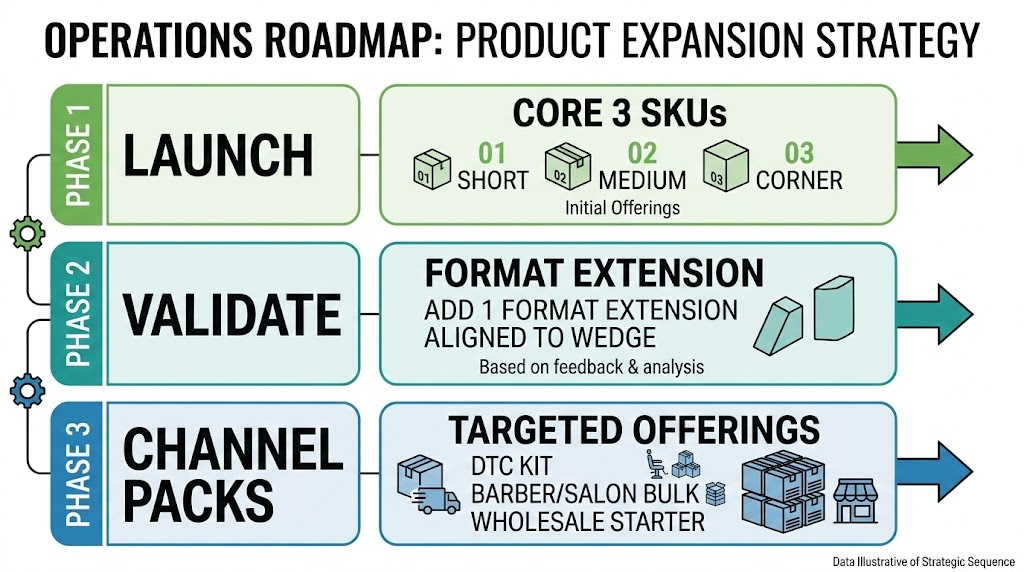
Build a small SKU architecture that scales (private label launch plan)
For private label eyelashes, the fastest and lowest-risk launch is a 3-core-SKU system that covers 80% of “natural-first” use cases, then expands with 1–2 add-ons only after demand and QC consistency are proven.
Phase 1: Launch (Core = 3 SKUs)
These three SKUs keep MOQ, replenishment, and QC simple while still serving most buyers:
- 01 Short (Everyday Definition)
- Best for: first-timers, low-stigma “grooming” buyers, subtle camera improvement
- Spec direction: short length range, soft taper, low shine, thin band
- 02 Medium (Clean Lift)
- Best for: the default “looks better on camera” set
- Spec direction: medium length range, natural density, consistent curl, lightweight band
- 03 Corner/Partial (Fast Add-on)
- Best for: barber/salon add-ons and buyers who want quick results with minimal effort
- Spec direction: corner or partial format, fast placement, minimal tools required
Launch rule: Don’t exceed 3 core SKUs until you can maintain tight curl/length tolerances and a clear defect taxonomy (curl drift, band roughness, shedding, tray damage).
Phase 2: Validate (Add 1 “format extension” SKU)
After you confirm traction (repeat purchases + stable QC), add one SKU that matches your wedge:
- If your wedge is camera-ready / grooming: add a cluster kit (natural-first cluster lengths)
- If your wedge is performance/nightlife: add a denser cluster or a bolder strip variant
- If your wedge is service add-on: add a bulk corner pack designed for fast application
Validation trigger: only expand when your top SKU has stable returns/complaints and your factory can hold consistency across production lots.
Phase 3: Channel packs (same SKUs, different packaging)
Avoid inventing new styles for new channels—repackage the same 3 SKUs:
- DTC Kit: 3-SKU sampler + simple instructions (60-second guide)
- Barber/Salon Bulk: 20-pair box (same SKU), service-friendly tray labeling
- Wholesale Starter: 5-pair kits + reorder cards or QR instructions
Operational benefit: One SKU system → fewer molds/trays → simpler inventory → easier QC → stronger “proof” story.
What to lock in before scaling (so you don’t break repeatability)
- Specs: length range, curl target, band thickness/material, fiber finish (low shine)
- QC checkpoints: tray count accuracy, curl drift, band edge roughness, shedding
- Packaging durability: inner tray rigidity + basic drop/stack expectations for transit
Next action: Pick your wedge (camera-ready, grooming, performance, comfort-first), then label your three launch SKUs with use-case names (01/02/03 or “Short/Medium/Corner”) so buyers can choose in seconds.
Naming + packaging that men will actually buy (without excluding anyone)
The rule: name by use case, not by identity.
Good naming patterns:
- Outcome: Clean Lift, Sharp Line, Wide Awake
- Context: Camera Set, Night Set, Stage Set
- System: 01 / 02 / 03 (like grooming or skincare)
Packaging cues that reduce stigma:
- Neutral colors, matte finishes, “tool-like” layout
- Clear application diagram on inner flap
- Avoid “hyper-femme” typography unless you’re deliberately in the nightlife wedge
Pinterest’s reporting on men blending boundaries is a reminder: keep it inclusive, not apologetic.
See our eyelash packaging guide for factory-ready options and custom branding examples.
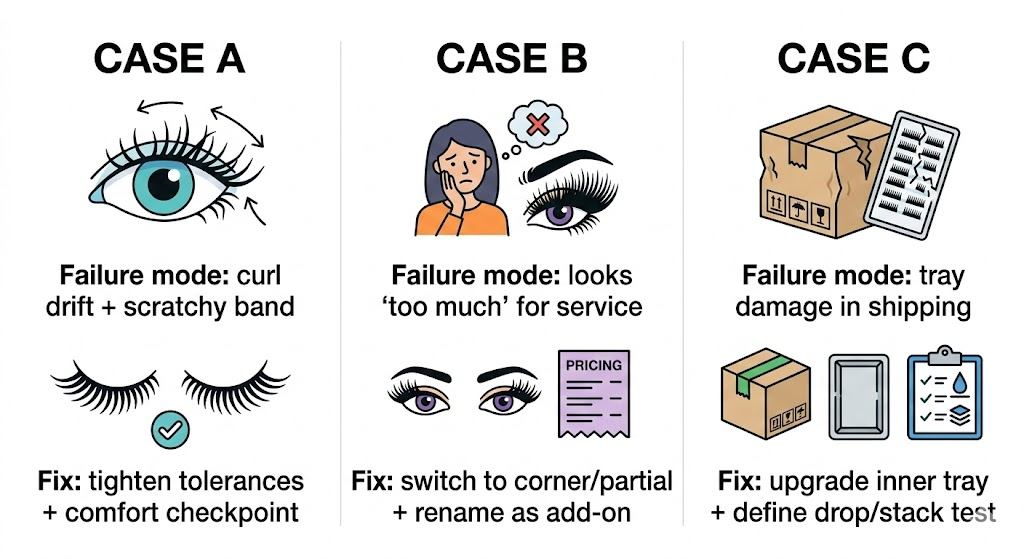
Three sourcing case blocks (what breaks first + the single lesson)
Case A: Camera-ready founder (consistency breaks first)
Situation: A DTC founder wants “better genetics” lashes for men/unisex buyers—subtle on video, natural in daylight.
Failure mode: Samples look great in photos, but production varies: curl drift between trays and band edge irritation after several hours.
Fix that actually works:
- Specify curl tolerance (acceptable range) and require tray-to-tray consistency checks
- Specify band material + edge finish (softness, thickness target)
- Add a comfort checkpoint to pre-shipment inspection (wear test notes, not medical claims)
Single lesson: If your wedge is camera-ready definition, your “product” is consistency + comfort—not style variety.
Case B: Salon/barber add-on (intensity breaks adoption)
Situation: A salon/barber chain wants a 2-minute add-on after brow services—fast, repeatable, low drama.
Failure mode: Trial clients say the result feels “too much,” so uptake stalls even if application is quick.
Fix that actually works:
- Switch from full strips to corner/partial accents (lower intensity, faster service)
- Rename the service as “eye definition add-on” (use-case language)
- Use bulk trays with clear labeling for service flow (counts, left/right, style code)
Single lesson: For service channels, the winning spec is subtlety + speed—not maximum visual impact.
Case C: Creator/performance kit (packaging breaks fulfillment)
Situation: A creator wants clusters for stage/night looks, shipped DTC with repeat orders.
Failure mode: First shipment arrives with damaged trays and missing clusters due to weak inner packaging and transit vibration.
Fix that actually works:
Clarify shipping responsibility via Incoterms and damage terms to avoid disputes
Single lesson: For performance kits, packaging is part of product quality—transit-proofing drives reviews and refunds.
Upgrade inner tray rigidity and add anti-shift inserts
Define a basic transit test (drop/stack requirements) for packaging approval
Compliance and documentation (don’t let positioning create risk)
False eyelashes, extensions, and adhesives are treated as cosmetic products in the US, with safety and labeling expectations; FDA also highlights special concerns around eye-area products.
In the EU, cosmetic products fall under Regulation (EC) No 1223/2009, including obligations around responsible persons and notification via CPNP.
In Great Britain, cosmetics must be notified through SCPN and have a Responsible Person.
Operationally, many brands use ISO 22716 as a cosmetics GMP reference point for production, control, storage, and shipment.
If you sell lash adhesive or any chemical-bearing item through B2B channels, you may also need Safety Data Sheets (SDS) for workplace and logistics contexts; OSHA describes SDS structure and requirements under HazCom.
We share general manufacturing and sourcing guidance. Confirm regulatory requirements for your target market with qualified professionals.
RFQ-ready supplier checklist (copy/paste)
Ask suppliers to quote by wedge, not by “one price for lashes.”
Product
- Fiber type, finish (low shine vs glossy), curl options, length range
- Band type (cotton/clear/invisible), band thickness target
- Tray count accuracy and tolerance
Quality
- AQL level and inspection scope (appearance, curl, band, counts)
- Defect taxonomy (kink, shedding, uneven curl, glue residue, tray damage)
- Retention samples + batch traceability
Compliance
- Labeling support for target market (US/EU/UK)
- Documentation pack: COA (where relevant), materials declarations, SDS for adhesives (if applicable)
- GMP alignment (e.g., ISO 22716-based processes)
Commercial
- MOQ by SKU + packaging option
- Sampling timeline + production lead time
- Incoterms offered (EXW/FOB/CIF/DDP etc.)
Key Points (6–10)
- “Unisex + use-case naming” usually converts better than “for men” branding while keeping inventory flexible.
- Start with 3 core SKUs and one seasonal trend SKU; resist 20-style launches.
- Use ERRC to remove friction (skill, stigma, mess) and raise proof (comfort, repeatability).
- Winning wedges are functional: camera-ready, grooming upgrade, performance, comfort-first.
- Write QC into the positioning—curl consistency and band comfort are your reputation.
- If adhesives are involved, treat documentation seriously (labeling + SDS where applicable).
- For EU/UK sales, plan Responsible Person + notification workflows early.
- Choose Incoterms intentionally to avoid surprise cost/risk disputes.
FAQ
Are men’s lashes a separate product category or just “unisex lashes” marketed differently?
Most of the differentiation is positioning + SKU design (natural-first, easy application, neutral packaging), not fundamentally new materials. The supply chain stays cleaner when your line works for everyone.
Browse our full strip and cluster options to see real examples.
Should I launch strips, clusters, or extensions first?
For private label DTC, strips or clusters are usually faster to validate. If your wedge is “barber/salon add-on,” partials/corners can outperform full strips.
Can I claim “safe for sensitive eyes”?
Be conservative. Eye-area products face scrutiny and consumer sensitivity; rely on appropriate labeling, testing/QA, and avoid medical claims.
Conclusion and next steps
A true blue-ocean move in men’s/unisex eyelashes isn’t “more dramatic styles”—it’s a simpler, more repeatable, less intimidating lash system that solves a clear job (camera definition, grooming, performance, comfort). Build your first line around 1–2 wedges, lock the specs that support that promise, and make QC and documentation part of your product story (not an afterthought).
If you want a low-risk way to test this as a private label program, share your target wedge + channel (DTC, salon, barber, wholesale), and I can translate it into a 3-SKU launch spec and an RFQ pack (materials, tolerances, AQL checkpoints, and packaging options).
If you work with an OEM/ODM that can iterate samples quickly and document QC under one roof, you’ll usually validate faster. Contact us for your custom lash project and free quote.
Reference
References(访问日期:2026-03-03)
Blue Ocean Strategy. “Eliminate-Reduce-Raise-Create (ERRC) Grid.”
Blue Ocean Strategy. “Four Actions Framework.”
Blue Ocean Strategy. “Strategy Canvas.”
Electronic Code of Federal Regulations (eCFR). “21 CFR Part 701 — Cosmetic Labeling.”
eCFR. “21 CFR Part 740 — Cosmetic Product Warning Statements.”
EUR-Lex. “Regulation (EC) No 1223/2009 on cosmetic products (recast).”
European Commission (Single Market). “Cosmetic product notification portal (CPNP).”
GOV.UK (OPSS). “Submit a cosmetic product notification.”
American Society for Quality (ASQ). “ANSI/ASQ Z1.4 & Z1.9 Sampling Plan Standards for Quality Control.”
Pinterest Newsroom. “The Pinterest Men’s Trend Report.”