
Choosing a lash manufacturer is not just about finding the lowest price. For most beauty entrepreneurs, it’s the single decision that determines whether their brand scales — or stalls.
In today’s competitive beauty market, switching suppliers is expensive, time-consuming, and often disruptive to brand credibility. According to Grand View Research, the global false eyelashes market was valued at over USD 1.6 billion in 2023 and is projected to grow at a CAGR of more than 6% through 2030. Growth is strong — but competition is stronger.
More reading:False Eyelashes Market (2025 – 2030)
If your supplier cannot grow with you, your margins shrink, delivery times stretch, and customers churn.
So how do serious B-side buyers evaluate a lash manufacturer beyond surface-level claims?
Below are the seven criteria experienced brand owners use before committing long-term production.

1. Eyelash Production Capacity That Matches Your Growth Plans
Many startups only think about MOQ. Mature buyers think about scalability.
A manufacturer that can handle 2,000 trays today but struggles with 50,000 next season will eventually slow you down.
Ask:
- What is their monthly production capacity?
- How many production lines do they operate?
- What is their peak season output?
- Do they currently serve established brands?
Why this matters:
Beauty demand spikes during Q4, holiday launches, influencer collaborations, and viral trends. If your supplier operates at full capacity during peak seasons, your orders may be deprioritized.
Reliable manufacturers often disclose:
- Factory size
- Workforce scale
- Years in operation
- Number of active brand clients
For example, some established manufacturers operate with 500+ trained workers and multi-million-pair monthly output, allowing them to support both small private label orders and large wholesale volumes without production conflicts.
Capacity isn’t about size — it’s about flexibility.
2. Transparent Cost Structure (Not Just a Low Unit Price)
Low price per tray does not equal high profitability.
According to McKinsey’s 2024 State of Fashion report, supply chain volatility and raw material fluctuations continue to pressure beauty margins globally. Brands that understand their landed cost structure outperform those chasing short-term savings.
When evaluating a manufacturer, request clarity on:
- Raw material composition (synthetic fiber, faux mink, silk blends)
- Labor component
- Quality control cost
- Packaging cost (box type, insert, printing)
- Sampling charges
- Freight consolidation options
If a supplier cannot explain cost drivers, they likely cannot help you optimize them.
🔎 Small but powerful insight:
Cluster lashes and pre-mapped lashes often have higher labor components due to hand placement precision — something many buyers overlook when comparing quotes.
Understanding how unit price translates into landed cost is critical for margin control. For a detailed breakdown of how wholesale and private label pricing structures differ in real scenarios, see this practical cost comparison guide.
This strengthens authority and keeps users on your site.
3. Quality Consistency Across Batches
Many buyers only test samples.
Experienced buyers test consistency.
The real risk isn’t whether the sample looks good. It’s whether batch #7 matches batch #1.
Industry surveys from Cosmetics Business (2023 report) indicate that over 40% of private label beauty complaints stem from inconsistency between initial samples and mass production³.
Ask your manufacturer:
- Do they have in-line QC inspections?
- Are curl retention tests conducted?
- Are fiber thickness tolerances controlled?
- How are defective units handled?
- Can they provide QC documentation?
A reliable lash factory should be able to discuss:
- Curl memory testing
- Adhesive bonding strength
- Lash band flexibility durability
- Humidity resistance during storage
If they cannot explain testing methods, quality may depend on luck.
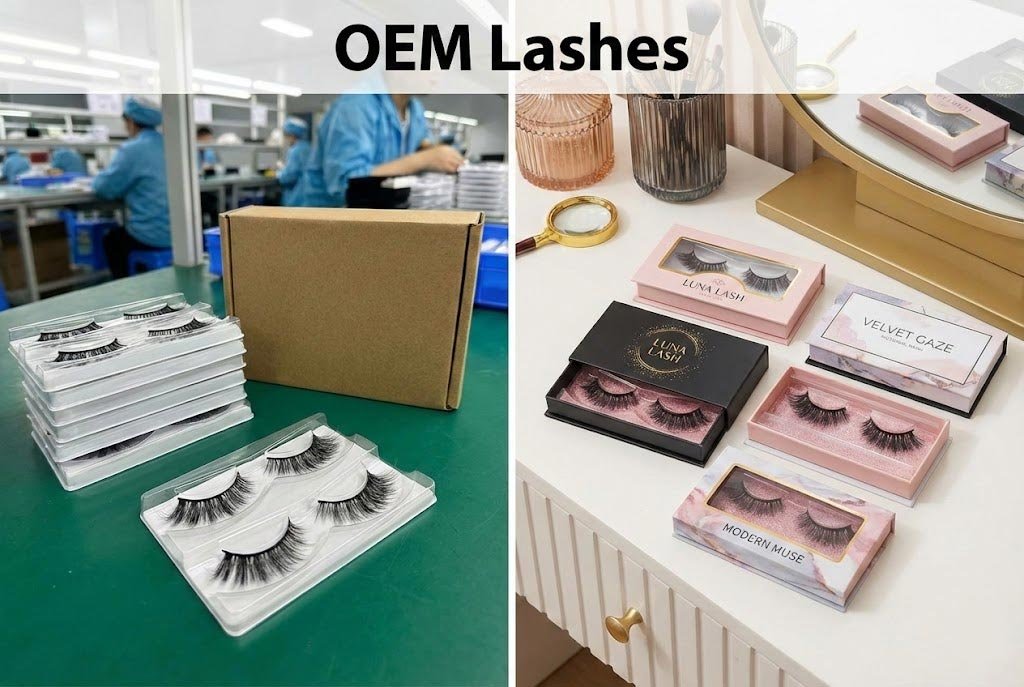
4. Clear Private Label & OEM Capabilities
Not all manufacturers define OEM and Private Label the same way.
Some suppliers call logo printing “OEM.” Others offer full mold development, custom curl design, and exclusive style mapping.
Understanding the difference affects your brand positioning and long-term defensibility.
Generally:
Private Label = Existing styles + your logo + packaging
OEM = Custom lash design, fiber spec, band shape, curl mapping
Why this matters:
- Private label reduces risk and shortens time to market.
- OEM increases differentiation and long-term pricing power.
According to Statista, 67% of Gen Z beauty buyers value “unique” or “limited” products over mass styles. That directly impacts whether OEM investment makes sense for your target market.
Explore the differance of OEM.
5. Lead Time Stability (Especially During Peak Seasons)
Late deliveries cost more than higher pricing.
Amazon sellers, for example, can lose Buy Box ranking if inventory runs out. Shopify brands may lose ad momentum during restock gaps.
Average industry lead times:
- Sample: 5–10 days
- Private label production: 20–30 days
- OEM new mold development: 30–45 days
However, during Q4 or major trade seasons (Cosmoprof, Beautyworld), lead times can extend 20–40%.
Ask:
- What is their historical on-time delivery rate?
- Do they provide production schedules?
- Do they allow split shipments?
- Do they offer freight consolidation?
A professional manufacturer should proactively discuss timeline risks — not wait for delays to occur.
6. Packaging & Brand Development Support
Packaging is no longer secondary.
A 2023 Nielsen Beauty Packaging Study found that 72% of consumers say packaging design influences purchase decisions in beauty categories.
For B-side buyers, packaging determines:
- Shelf appeal
- Unboxing experience
- Perceived value
- Retail pricing leverage
Ask your manufacturer:
- Do they offer structural packaging customization?
- Can they assist with insert design?
- Do they source magnetic boxes, eco-friendly materials?
- What is the MOQ difference between packaging types?
🔎 Small but valuable insight:
Magnetic rigid boxes significantly increase perceived value but also increase freight weight and shipping cost. Folding carton options may improve margins for high-volume e-commerce brands.
You maybe interested in:Custom Eyelash Packaging Wholesale Guide
7. Communication & Problem-Solving Capability
This is the most underestimated factor.
According to a 2024 Alibaba B2B buyer survey, communication clarity and response speed ranked above price in long-term supplier satisfaction⁶.
Look for:
- Response time (within 24–48 hours?)
- Clear English documentation
- Proactive production updates
- Willingness to explain technical differences
- Transparency about delays
A profitable manufacturer doesn’t just produce. They advise.
For example:
If your target market prefers wispy natural styles over dramatic volume (as 37% of Gen Z prefer natural-style makeup, while expressive looks such as exaggerated eyelashes are also worn by them for specific occasions), a knowledgeable supplier should guide product development accordingly.
More reading:The Gen Z Beauty Consumer
Manufacturers who follow market trends can help reduce slow-moving inventory.
Red Flags to Watch For
- Extremely low MOQ with extremely low pricing
- No factory photos or production transparency
- Refusal to provide QC explanation
- Inconsistent response times
- Vague production timelines
In beauty manufacturing, cheap mistakes become expensive inventory.
Final Thoughts: Profitability Is Built on Stability
The right lash manufacturer is not the cheapest.
It is the one that:
- Maintains consistent quality
- Supports your brand positioning
- Protects your margins
- Delivers on time
- Scales with your growth
In a market projected to exceed USD 2 billion within the next few years, the opportunity is real — but only for brands supported by reliable supply chains.
Before committing, ask better questions.
The answers will tell you everything.