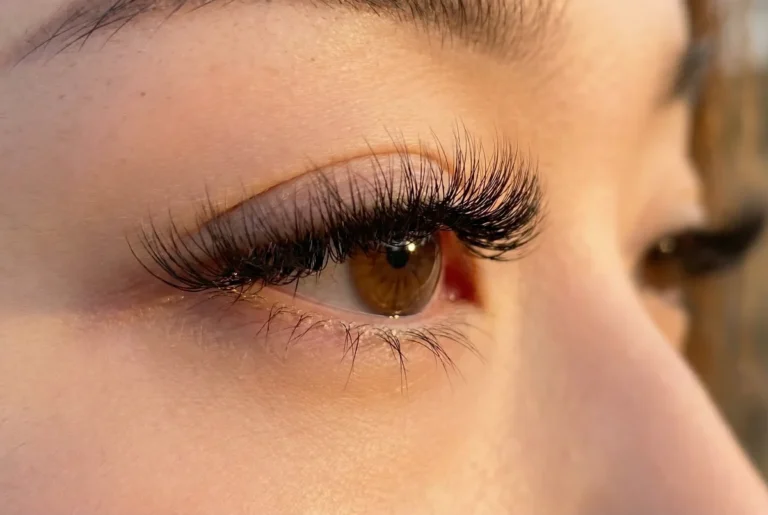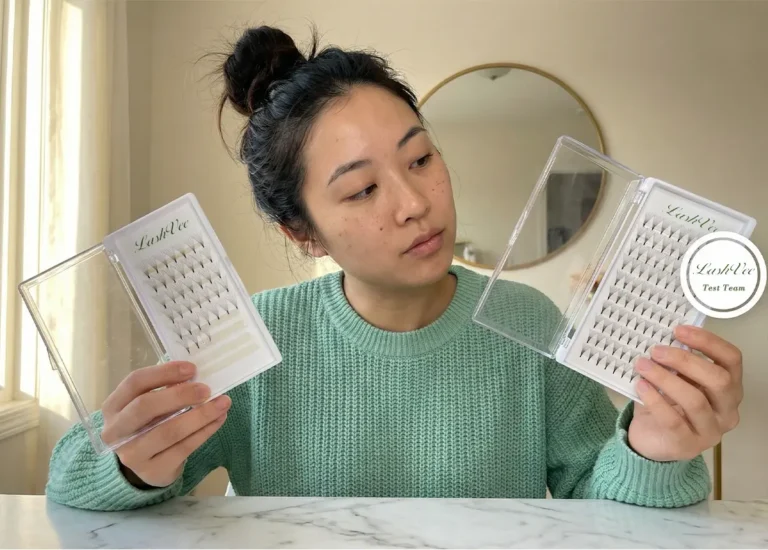

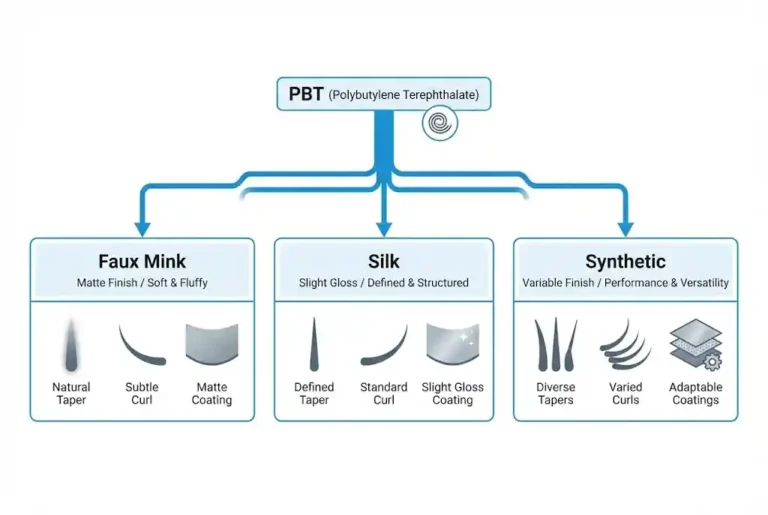
Short answer: Most “faux mink,” “silk,” and “synthetic” lash extensions in the professional market use the same base fiber—most commonly PBT (Polybutylene Terephthalate)—and differ mainly by finish, taper, coating, and curl-setting consistency. For wholesale or private-label buying, evaluate diameter tolerance, taper quality, curl stability, coating chemistry, and batch QC documentation—not marketing names.
If you only check 5 things before buying:
- Diameter tolerance (especially for 0.03–0.07 volume sizes)
- Taper profile + tip integrity (clean tip, minimal hooking/kinking)
- Curl stability (heat-set consistency + packaging/transport resilience)
- Surface finish / coating behavior (shine level + adhesive grip)
- Tray-to-tray + batch consistency (repeatability + QC proof)
Introduction
Most lash buyers think they’re choosing between three different materials: faux mink, silk, and synthetic.
In reality, these labels usually describe manufacturing outcomes—how the fiber is extruded, tapered, heat-set, and finished. The name on the box is often shorthand for feel, shine level, and styling result, not a scientific guarantee of what the lash is made from.
That’s why two “faux mink” trays from different suppliers can feel completely different. Or why “silk” sometimes looks glossier than expected. Or why “synthetic” can perform better than both—depending on process control.
If you’re sourcing for a salon group, distributor, or private label brand, the safest move is simple: buy by spec, not by buzzword.
Need help translating “mink/silk/synthetic” into specs and SKUs? Share your target price tier and customer profile, and we’ll suggest a spec sheet + sample plan that fits your lineup.
Disclosure: LashVee manufactures lash extensions. This article is written as a buyer reference and the evaluation steps apply even if you source from other suppliers.
Technical Core (The “Why”)
1) The fiber reality: many modern pro extensions use PBT (a thermoplastic polyester)
Polybutylene terephthalate (PBT) is a semi-crystalline thermoplastic polyester widely used in engineered plastics and fibers because it combines chemical resistance, dimensional stability, and strong performance after thermal processing.
In the lash industry, many “synthetic,” “silk,” and “faux mink” extensions are produced from synthetic fibers that include PBT—and this isn’t just marketing language. For example, patents covering lash-extension fibers explicitly describe extensions made of synthetic fibers “such as polybutylene terephthalate.”
Mainstream beauty coverage also references “silk” lash products made from Korean PBT (polybutylene terephthalate), reinforcing that the “silk” label often describes a finish/category rather than literal silk.
Why buyers get confused: “Material” is only step one. The biggest differences in feel, shine, and performance typically come from fiber geometry (diameter/taper), heat-setting (curl), and surface finishing/coatings—not from the marketing name on the tray.
2) What actually creates “faux mink softness”
“Faux mink” typically describes a lash that is:
- More matte
- Softer touch
- More natural-tapered
- Less reflective on camera
That result usually comes from surface finishing + fiber geometry, not a different base polymer.
Key manufacturing variables that drive the “mink-like” effect:
A) Surface finish / matte effect
A more matte lash can be achieved by:
- Micro-texturing during extrusion
- Controlled coatings that reduce reflectivity
- Avoiding overly glossy top-layers
B) Taper profile (the real “luxury” signal)
A premium faux mink tray often has:
- Cleaner taper (thin tip without “hooking”)
- Less bluntness at the tip
- Consistent taper length across batches
C) Softness = diameter control + polymer draw ratio
Softness is strongly affected by:
- Tight diameter tolerance (e.g., ±0.01 mm target range for premium lines)
- Controlled draw/stretch during fiber formation
- Avoiding overly heavy coatings that make lashes “plasticky”
Buyer takeaway: If a supplier can’t talk about taper control and diameter tolerance, “faux mink” is just a label.
3) What “silk” usually means in the lash industry
In professional lash extensions, “silk” is almost always a marketing term, not literal silk fiber.
In practice, “silk” commonly signals:
- A slightly glossier finish
- A darker, more defined lash line
- A lash that can look “cleaner” for classic sets and photos
Why the gloss? Often due to:
- A smoother fiber surface
- Different finishing/coating approach
- A slightly thicker-feeling profile at the same stated diameter (because of coating weight)
Buyer takeaway: If you want a luxe “silk look,” buy it for finish and styling outcome—not because you believe it’s a different natural material.
4) What “synthetic” can mean (and why it’s not automatically “cheap”)
“Synthetic” is the most ambiguous term.
It can refer to:
- Standard PBT extensions without a “mink” or “silk” positioning
- Budget fibers that are stiffer, shinier, or inconsistent
- High-performance fibers designed for better curl memory and less deformation under heat/humidity
In other words, “synthetic” can be entry-level or premium—depending on the factory controls behind it.
Buyer takeaway: Synthetic isn’t a quality grade. Specs and QC are.
5) The hidden performance factors buyers should test
If you’re buying for resale or private label, these technical details matter more than the name:
A) Curl stability (J/B/C/CC/D/L/M, etc.)
Curl is typically heat-set. Stability depends on:
- Temperature curve accuracy
- Heat exposure time
- Cooling cycle consistency
- Packaging + transport conditions
B) Fiber “snapback” vs plastic deformation
A good lash returns to shape after handling. Poor fibers stay kinked.
C) Tip integrity (especially for volume diameters)
For 0.03–0.07 mm, tip quality determines:
- Fan opening behavior
- Stickiness when creating spikes
- Natural finish
D) Coating chemistry & adhesive interaction
Overly slick coatings can reduce grip. Overly heavy coatings can increase weight and reduce softness.
E) Tray-to-tray consistency
Your brand reputation depends on repeatability. One “perfect” sample tray means nothing if batch #2 behaves differently.
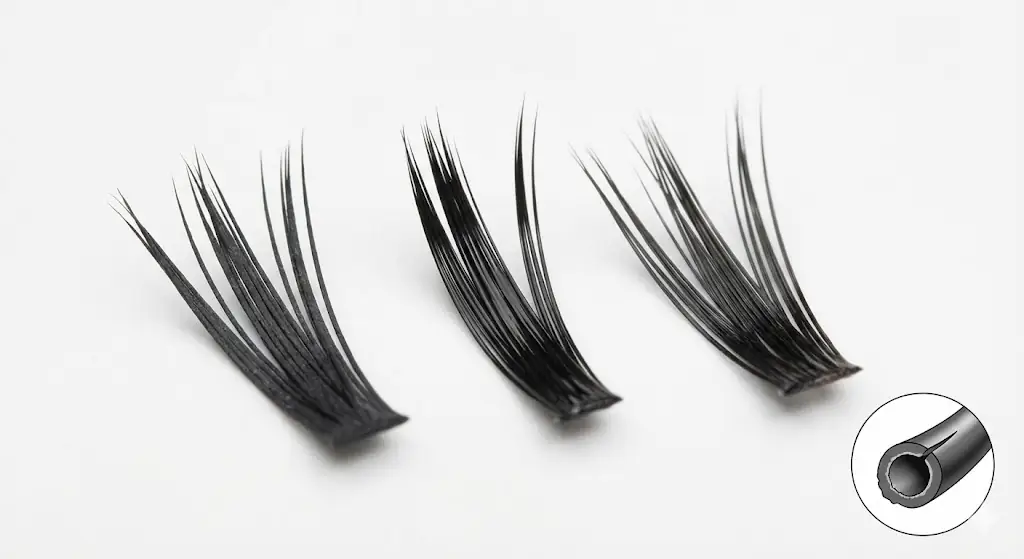
Comparison Table: Faux Mink vs “Silk” vs Synthetic (Buyer Meaning)
How to read this: These terms usually describe finish + taper + processing outcomes, not three different base materials. Use this table to buy by spec and QC proof.
| Buyer factor | Faux mink (industry meaning) | “Silk” (industry meaning) | Synthetic (broad category) | What to ask / check |
|---|---|---|---|---|
| Typical base polymer | Usually PBT | Usually PBT | Often PBT; sometimes blends | “Is the fiber PBT? Any blend? Can you provide a material disclosure?” |
| Finish (shine) | Matte / low-reflection | Slightly glossy / more defined | Varies: matte to shiny | Request finish photos under ring light + daylight using the same exposure. |
| Hand-feel (softness) | Softer, more “natural” feel | Can feel slightly firmer from finish/coating | Can be soft or stiff | Ask for touch-test samples across diameters (e.g., 0.05 / 0.07 / 0.15). |
| Look on camera | Natural, less reflective | Darker, higher contrast lash line | Depends on finish | Ask for model set photos with identical lighting and angles (no filters). |
| Best fit (use cases) | Natural sets, premium positioning, clients sensitive to shine | Classic sets, crisp lash lines, photo-forward looks | Workhorse lines, performance lines, broad catalogs | Match the finish to your customer avatar + price tier + top-selling set styles. |
| Common misconception | “It’s real mink” | “It’s real silk” | “Synthetic is always cheap” | Align naming with truthful education (e.g., “faux mink effect,” “silk finish”). |
| Key sourcing risk | Matte softness varies between batches | Gloss level drifts if coating varies | Term is too vague; quality ranges widely | Demand a spec sheet + batch QC evidence (not just one “perfect” sample tray). |
| High-value QC metric | Diameter tolerance + taper consistency + matte uniformity | Gloss uniformity + curl memory + coating consistency | Curl retention + tray-to-tray consistency | Define acceptance criteria (example: diameter tolerance target, curl check method, finish reference photos). |
If you can only verify 3 things: (1) diameter tolerance (especially 0.03–0.07), (2) taper/tip integrity, (3) curl stability across batches.
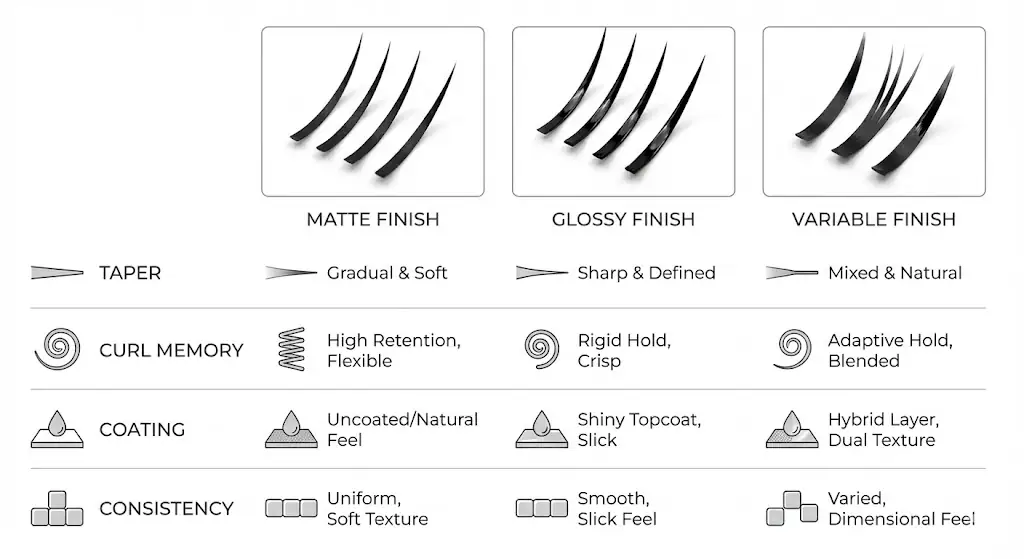
Buyer Checklist: How to Source Smarter (and Avoid “Marketing Traps”)
Ask for these before you place a bulk order
- Base material disclosure (PBT or blend)
- Diameter tolerance target (especially for 0.03–0.07)
- Curl stability standard (how curl is verified across batches)
- Finish standard (matte/gloss reference photos)
- Taper quality evidence (macro photos, tip consistency samples)
- Length accuracy (e.g., 8–15 mm mapping and tolerance targets)
- Adhesive compatibility notes (surface finish can affect grip)
- Packaging/label compliance (truthful naming, ingredient/material statements)
- MOQ + reorder lead time (avoid “one-batch wonders”)
- Sample policy tied to production batch (samples should match real production)
Simple in-house tests that reveal real quality
- Fan test (volume): does the fiber open evenly without sticking?
- Kink test: bend lightly and release—does it snap back?
- Light test: ring light + daylight—does finish match your positioning?
- Consistency test: compare 3 trays from the same batch.
Manufacturing Insight: How LashVee Controls the Variables That Actually Matter
In lash extensions, “faux mink,” “silk,” and “synthetic” are finish targets—not reliable indicators of a different base material. In OEM/ODM production, the outcomes buyers feel (softness, shine level, curl retention, tray consistency) come from controlled spinning, drawing, heat-setting, finishing, and statistically sound QC.
Below is how we standardize those variables for repeatable B2B supply.
1) Diameter control and tolerance (weight + fan behavior start here)
What we control: filament formation parameters (extrusion + spinneret output, take-up speed, draw ratio) and the measurement plan used to verify results. Fiber spinning processes allow properties like linear density/size to be tuned through process settings, including draw/take-up conditions.
How buyers benefit:
- 0.03–0.07 mm (volume): tighter diameter variation helps keep fan weight and opening behavior more predictable tray-to-tray.
- 0.10–0.20 mm (classic): stable diameter supports uniform lash-line density and reduces “some trays feel thicker” complaints.
How we document it: we define acceptance criteria per diameter range and verify with a sampling plan suitable for lot inspection (commonly AQL-based acceptance sampling).
(Note: numeric tolerance targets depend on the SKU and diameter; we set the target to match your positioning and risk tolerance.)
2) Taper engineering (where “premium” is usually won)
What we control: taper length uniformity and tip formation consistency—because tip geometry drives how “light” the lash looks and how comfortable it feels.
What we check in practice (buyer-relevant):
- taper length consistency across lengths in the same tray
- reduced blunt tips (helps avoid a heavy, “marker-like” lash line)
- minimized tip hook/kink (helps reduce scratchy feel and placement friction)
What you can request: macro tip photos from multiple trays + a simple “tip defect” acceptance definition (what counts as blunt/hooked).
3) Curl setting with controlled heat cycles (curl memory is process-sensitive)
Curl is a thermoplastic “set” outcome. In oriented synthetic filaments, shrinkage and dimensional stability during heating depend on variables like temperature, time, and tension—which is why curl consistency improves when the heat-set window and cooling sequence are controlled.
What we standardize:
- oven temperature window + dwell time (by curl type/SKU)
- cooling sequence (to reduce batch drift)
- packaging conditions that protect curl during storage/transport
What you can request: a curl verification method (how we check curl across batches) and a shipment/packaging note for hot/humid routes.
4) Finish control: matte vs. gloss (the “faux mink vs silk” look lives here)
Most perceived “mink softness” vs “silk definition” is a surface finish outcome (micro-texture + coating behavior), not a different fiber category.
How we keep it consistent:
- standard finish references (ring light + daylight photo protocol)
- coating controls to avoid “plastic-shiny” trays or overly slick fibers that can affect handling
If you need an objective benchmark for shine, specular gloss is commonly defined and measured with standardized glossmeter geometries (e.g., 60°/20°/85°) in materials testing.
(For lashes, we typically use standardized lighting photos; glossmeter measurement is more practical on flat witness samples of the same coating system.)
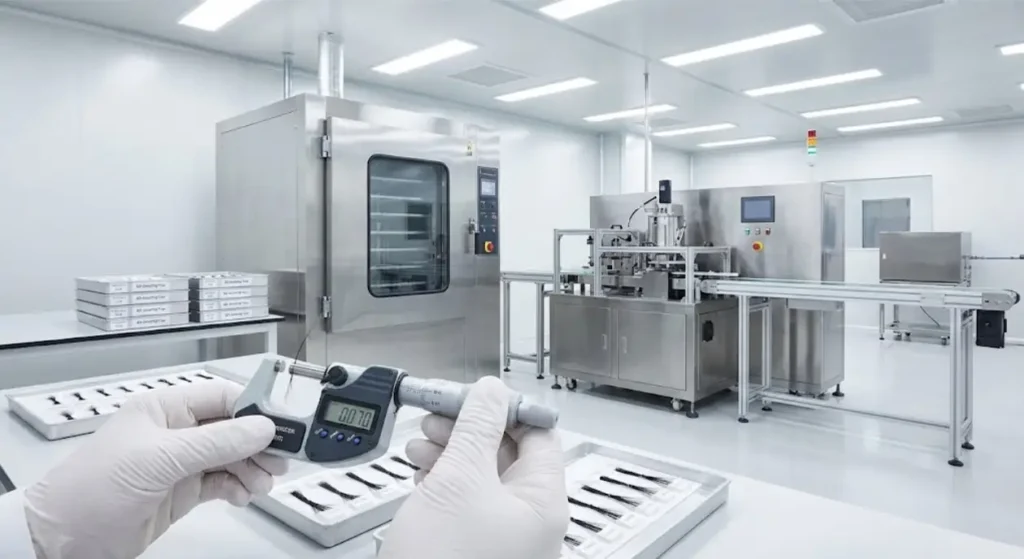
5) Batch QC and tray consistency checks (avoiding “sample tray magic”)
A great sample tray only matters if production trays behave the same. We run tray-level checks designed to catch drift before it ships, and we maintain documented process control practices aligned with quality management principles used across manufacturing.
What wholesalers/private-label brands usually ask for:
- batch identifiers tied to production records
- acceptance sampling approach for key defects (tips, curl, length mapping, tray uniformity)
- photo/video evidence from multiple trays, not a single “hero” sample
If you’re building a private label line
If you want a spec pack (curl chart, diameter targets by SKU, finish references, tray formats, packaging options), our team can map “mink/silk/synthetic” positioning into measurable acceptance criteria and a sampling plan that supports repeatable B2B supply.
FAQ (Schema-Optimized)
Are faux mink lash extensions made from real mink fur?
Most professional “faux mink” lash extensions are not animal-derived. They are typically made from PBT fiber and processed to create a soft, matte, “mink-like” effect. For brand safety, label clearly and avoid wording that could imply animal content.
Are “silk” lash extensions actually silk?
In the lash extension industry, “silk” usually refers to a finish style (often slightly glossier and more defined), not literal silk fiber. Always verify the base polymer and request finish reference photos.
Is synthetic always lower quality than faux mink?
No. “Synthetic” is a broad label. High-quality synthetic (often PBT) can outperform some faux mink trays in curl stability and consistency. Quality is determined by diameter control, taper, finish, and QC—more than the category name.
What matters most for wholesalers: softness, curl, or consistency?
For B2B, consistency is the #1 driver of repeat orders. Softness and curl matter, but salons reorder when every tray behaves the same across batches—especially in volume diameters.
How can I private label faux mink or “silk” lashes without misleading claims?
Use truthful naming like “faux mink effect” or “silk finish,” disclose base material when appropriate, and keep claims consistent across packaging and listings. A factory partner should help you align marketing language with real specifications.
Conclusion
Faux mink, “silk,” and synthetic lash extensions aren’t three cleanly separated materials—they’re three common ways the market describes finish, softness, and styling outcome. If you buy by the label alone, you’ll eventually pay for it in batch inconsistency, complaints, and brand trust issues.
Buy by specs:
- base polymer transparency (often PBT)
- taper and tip quality
- diameter tolerance
- curl stability across batches
- finish control under real lighting
Safety / Eye-Health Disclaimer
Lash extensions are cosmetic products applied near the eye. Performance and comfort depend on technician skill, hygiene, adhesive selection, client sensitivity, and aftercare. This article is educational and not medical advice; for irritation, swelling, or suspected allergy, clients should consult a qualified healthcare professional.
If You’re Building a Private Label Line
If you’re building a lash lineup for wholesale or private label, the fastest way to avoid “one perfect sample tray” problems is to define acceptance criteria upfront (diameter tolerance, taper reference, curl stability checks, finish reference photos, and batch QC documentation).
If you want help translating your market positioning into a production spec + sample plan, LashVee can assist. Share your target customer, price tier, curl/diameter range, and hero SKUs, and we’ll recommend a spec and verification plan.
References (external)
PBT material definition & properties
- PBT as a semi-crystalline polyester; overview of characteristics.
- PBT properties (chemical resistance / thermal stability context).
- PBT classified as a thermoplastic polyester (properties summary).
Evidence that lash extensions may use PBT fibers
- Patent describing lash-extension fibers made from synthetic fibers such as PBT.
- Mainstream beauty coverage referencing lash products described as “silk” made of Korean PBT.
Market naming (“silk/mink/synthetic”) as finish/category language