

Cat-eye sets often look perfect in photos but inconsistent on clients. The risk comes from wrong mapping, over-weighted outer corners, and uneven curl control. I will show a repeatable approach.
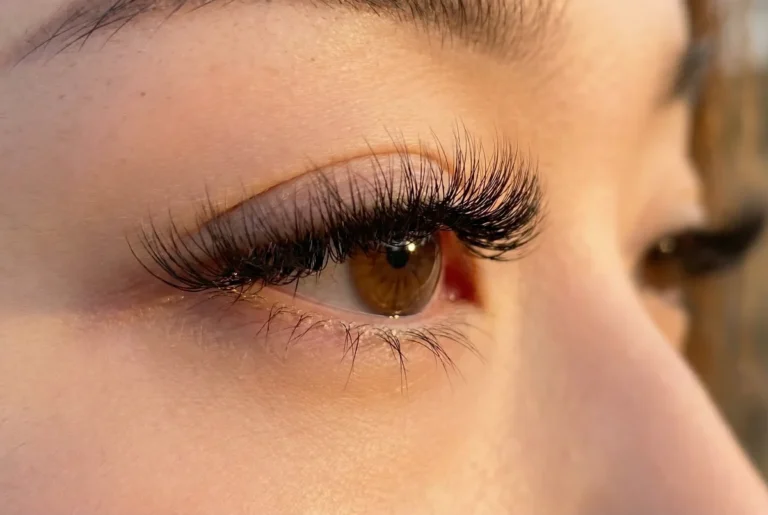
Cat eyelash extensions create an elongated eye by increasing length and sometimes curl from inner to outer corner, while controlling weight at the outer zone. The best results come from correct lash mapping, light fibre selection, stable curl setting, and strict tray-level consistency.
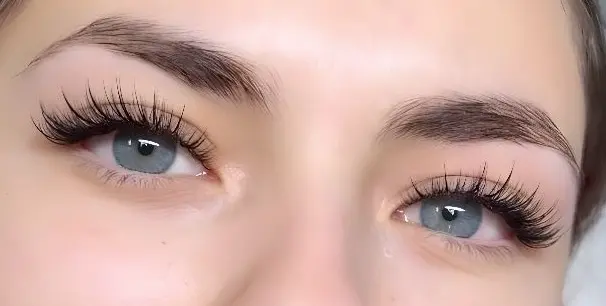
Cat-eye is not a “style name” in manufacturing. It is a design outcome created by length distribution, curl strategy, diameter choice, and placement discipline. For buyers and brand owners, it is also a sourcing test: small production variance becomes visible because the longest fibres sit in the most fragile retention zone.
What makes a cat-eye lash map look lifted instead of harsh?
Many cat-eye complaints come from copying a social-media map without checking the client’s outer-corner growth direction. When the longest lashes fight the natural direction, the set looks droopy or sharp.
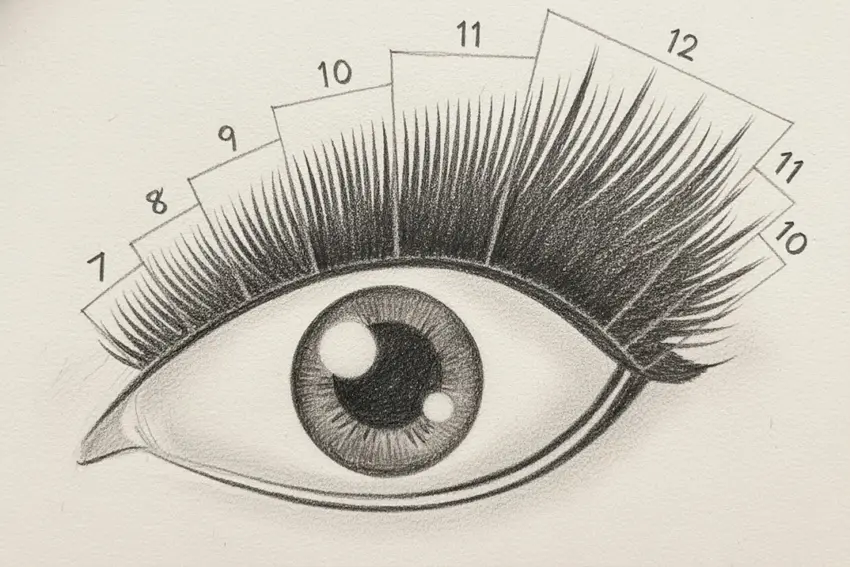
A lifted cat-eye map increases length gradually, then stops short of the absolute outer corner. Most artists place the longest lengths one segment inward to avoid dragging the eye down. Manufacturers support this by keeping length accuracy tight and taper consistent so “long” does not become “heavy.”
From a factory perspective, “cat-eye mapping” is a customer-facing term for a distribution problem. The product must allow predictable stepping across lengths while staying light enough for the outer third of the eye. When I inspect returns labelled “cat-eye failed,” I usually see one of three root causes: length drift (the 11 mm behaves like 12 mm), curl inconsistency across batches, or fibre taper that is too blunt for the chosen diameter.
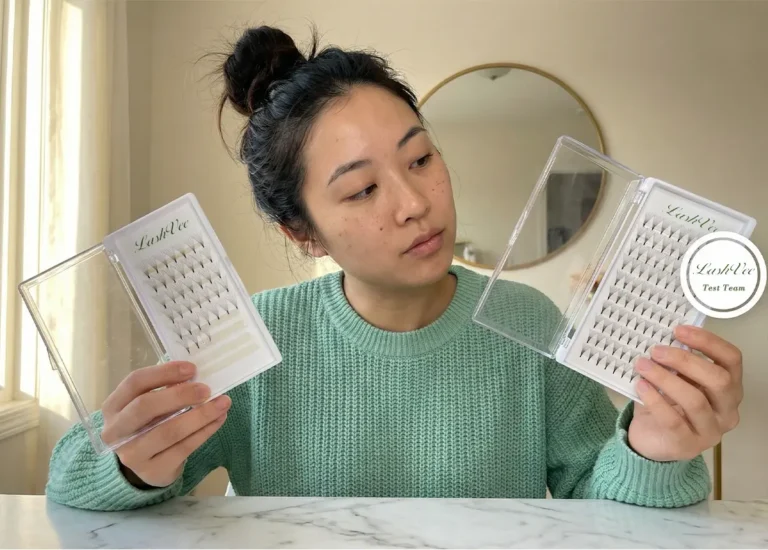
Practical mapping logic I use when Lashvee Team validate a new tray design
A cat-eye effect depends more on where the peak length sits than on the maximum length itself. If the longest fibres are placed on the last 10–15% of the lash line, they often exaggerate downward lash direction and create a “droop.” If the peak sits slightly inward, the eye reads longer but stays lifted.
Here is a conservative mapping baseline many studios use for mixed trays (adjust to client features and lash health):
| Zone | Inner 20% | Mid 40% | Outer 30% | Tail 10% (very outer) |
|---|---|---|---|---|
| Suggested length step | 7–8 mm | 8–10 mm | 10–12 mm | drop 1 mm from peak |
This “peak then soften” rule reduces the weight and leverage on the outermost natural lashes, which are often finer and more exposed to friction (sleeping, hair, mask straps).
How manufacturing choices affect whether the map stays “clean”
- Length tolerance: If a tray has ±0.5 mm drift, the map visually collapses. A “10–11–12” sequence becomes “10.5–11.5–12.5” on the eye, and the outer corner looks abrupt.
- Taper profile: A long, fine taper makes the same length read lighter. A blunt taper makes it read heavier, even if the diameter label is identical.
- Curl stability: Cat-eye sets often use stronger curls (C/D/CC, or L/LC) to keep the outer section lifted. If curl relaxes unevenly after production, the mapping looks correct on the palette but not on the eye.
What I look for when I evaluate a supplier for cat-eye trays
I ask to see:
- Length measurement method (ruler vs jig vs optical). A factory that uses a repeatable jig or camera measurement reduces drift risk.
- Curl-setting parameters (mould temperature/time and cooling control). Stable curl is a process, not a promise.
- In-tray uniformity checks (random picks per row). Cat-eye sells on visible gradients, so row-level QC matters more than average QC.
A manufacturer-led approach works better here because the product design and the process window must match. Trend-driven suppliers often copy maps but cannot hold tolerances across volume runs.
Which lash specifications matter most for cat-eye extensions?
Many buyers compare only curl letters and length ranges, then wonder why cat-eye sets feel heavy or lose retention at the outer corner. The real drivers are fibre weight, taper, and curl stability.
For cat-eye extensions, I prioritise low-weight fibres (often finer diameters or lighter volume construction), stable curl-setting, and consistent taper. Stronger curls can lift the outer third, but the safest improvement comes from reducing outer-corner load and keeping the base clean for bonding.
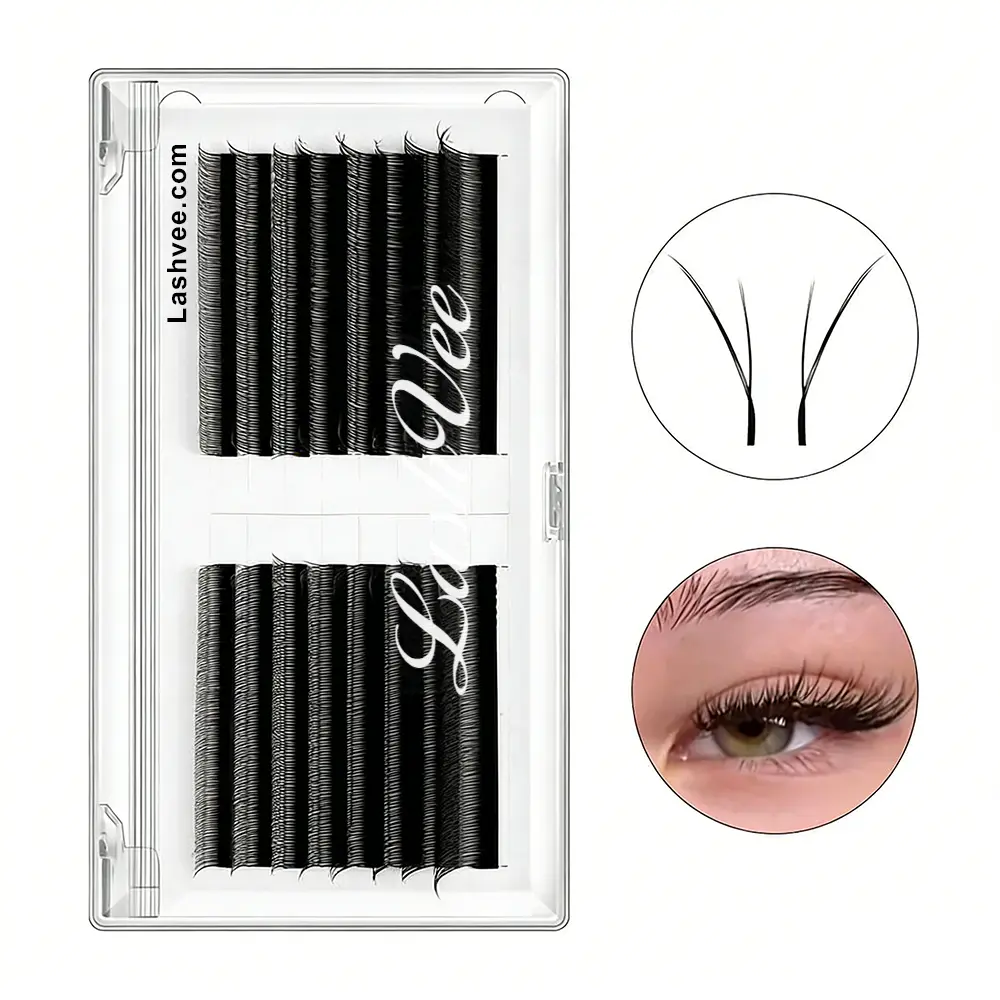
When I build a cat-eye tray specification for OEM, I treat the outer third as a high-risk zone. The lashes are more exposed to movement, cosmetics, and friction, and clients notice defects there first. So I reverse the common buying habit. I do not start with “C or D curl?” I start with weight per fibre and base behaviour.
Fibre material and why it matters in production
Most professional lash extensions use PBT (polybutylene terephthalate) because it can be extruded into fine monofilaments, drawn for strength, and heat-set for curl. The curl is not “natural.” It is a controlled deformation set by temperature, time, mould geometry, and cooling. If a supplier cannot explain their curl-setting control, the curl will vary across batches.
The four specs that decide cat-eye performance
- Diameter (or volume fan equivalent):
Thicker fibres amplify the cat-eye peak but increase torque on the outer lashes. Many studios reduce diameter on the outer third or switch to lighter volume structures. From a manufacturing angle, I also watch diameter tolerance. A 0.07 mm product that fluctuates upward behaves like a heavier fibre. - Taper geometry:
Taper is the hidden variable behind “soft vs plastic.” Two lashes can share the same diameter label but feel different because the taper starts earlier or later. Earlier taper = lighter visual finish and less stiffness at the tip. - Curl type and curl stability:
Strong curls can lift the outer third, but only if they remain stable after storage and normal humidity exposure. Curl drift makes cat-eye look messy because the longest fibres lose alignment. I validate curl stability with accelerated conditioning checks and row-level comparison, not just a single sample. - Base form (single, flat, ellipse, or pre-made structures):
Cat-eye relies on clean bonding and directional control. Flat or ellipse bases can improve contact area for some adhesives and techniques, but they also change stiffness. I treat base choice as a technique compatibility decision, not a universal upgrade.
A technical way to compare tray specs
| Spec | What buyers often assume | What actually happens in cat-eye |
|---|---|---|
| “0.15 classic is fine” | Strong definition | Outer corner can look heavy and lose retention if natural lashes are fine |
| “D curl fixes droop” | More lift solves it | Over-curl can look spiky; curl drift becomes obvious on the longest fibres |
| “Matte = premium” | Better quality feel | Matte finish is a surface choice; taper and diameter control matter more |
Supplier evaluation focus
A reliable supplier shows:
- Process transparency for diameter control, curl setting, and taper tooling.
- Batch traceability (date, mould line, operator, and inspection records).
- Standardised QC aligned with cosmetics GMP principles (even for accessories), because controlled production reduces variation risk.
This is why I treat cat-eye as a sourcing audit. If a factory can deliver consistent cat-eye trays, it can usually deliver consistent basics too.
How do I build a consistent cat-eye product line for OEM/ODM?
Many brands launch cat-eye trays that look good in one batch but shift in the next. The issue is not design creativity. The issue is production control, packaging integrity, and spec discipline.
To build consistent cat-eye SKUs, I lock a clear spec (length tolerance, curl window, taper profile, finish), define a tray structure that supports mapping, and require batch-level inspection data. I also validate adhesive and technique compatibility to reduce field failures.
When a brand asks me for a “cat-eye line,” I treat it as a small system, not one tray. Cat-eye succeeds when the product, the mapping intent, and the user technique align. OEM/ODM problems usually happen when the brand briefs an aesthetic goal but leaves the technical spec open-ended.
Step 1: Translate “cat-eye” into measurable specifications
I define:
- Length set and stepping rule: for example, 7–13 mm with a controlled gradient, or 8–14 mm for drama. I also define whether the tray is single-length, mixed-length, or “cat map tray” (pre-arranged rows).
- Length tolerance: a numeric requirement (tight enough to preserve the gradient).
- Curl window: a defined acceptable range, not just a curl letter.
- Taper requirement: long taper vs standard taper, and a sampling method to verify it.
- Finish: matte vs semi-gloss, because finish changes perception of thickness and softness.
Step 2: Choose packaging and tray structure that protects mapping
Mixed trays fail when fibres shift in transit or when row labelling is unclear. For cat-eye, I prefer:
- Clear row labels with consistent reading order.
- Stable adhesive strip strength on the tray so rows do not lift or distort.
- Humidity-safe carton and inner wrap to reduce curl drift risk during shipping and warehousing.
Step 3: Control the two biggest causes of inconsistency: curl and length
I require supplier-side controls such as:
- Curl-setting record: mould ID, temperature range, dwell time, and cooling method.
- Length verification per row: random picks from each critical length (especially the longest two rows).
- Visual uniformity checks: alignment, fibre spacing, and kink defects.
A simple acceptance checklist I use with buyers:
| Checkpoint | How to verify | Why it matters for cat-eye |
|---|---|---|
| Row-to-row length accuracy | measure random fibres from each row | gradients must stay readable |
| Curl uniformity across tray | compare fibres from top/bottom rows | longest fibres expose curl drift |
| Tip consistency | microscope or macro photo sampling | blunt tips read harsh at outer corner |
| Base cleanliness | visual + pick-up behaviour | messy bases reduce bonding quality |
Step 4: Build product education into the SKU, not marketing
Brands reduce complaints when they include a neutral mapping note, such as “peak length sits one segment inward.” This is not promotion. It is risk reduction.
Step 5: What matters most when choosing an eyelash manufacturer
I prioritise:
- Process control over catalogue size.
- Transparent QC standards that a buyer can audit.
- Stable production capacity so the same tooling and setting windows are used across repeat orders.
- Documentation discipline aligned with cosmetics GMP thinking, because repeatability is the core of supply reliability.
This is the manufacturing advantage I bring as LashVee. I do not treat cat-eye as a trend SKU. I treat it as a controlled product outcome built from measurable specs and repeatable processes.
Conclusion
Cat eyelash extensions succeed when mapping logic, fibre weight, taper, and curl stability work together. In production, cat-eye is a tolerance test because small variance shows in the longest rows. For buyers, a reliable cat-eye line depends on clear specifications, tray structures that protect the gradient, and a manufacturer that can explain and document process control.
FAQ (About Cat eyelash extentions)
1) What is the best cat-eye lash mapping for most eye shapes?
A safe baseline is a gradual increase in length from inner to outer third, with the peak length placed one segment inward (not on the very last outer corner). This avoids “droop” on downward-growing outer lashes and reduces stress on the finest natural lashes.
2) Should the longest lashes go on the very outer corner in a cat-eye set?
Usually no. The outermost lashes often grow downward and are more exposed to friction, so placing the absolute longest length at the extreme corner can look harsh and reduce retention. Many artists drop 1 mm at the tail after the peak to keep the finish lifted and clean.
3) Which curl works best for cat-eye eyelash extensions?
C or CC curls often provide a balanced, wearable lift. D curl can increase lift but can also look “spiky” if the curl is too strong or inconsistent across the tray. For outer-corner lift, curl stability matters more than the curl letter, so confirm batch consistency from your supplier.
4) What lash diameter is safest for cat-eye sets with good retention?
Because the outer third is higher-risk, many studios use lighter fibres there: for classics, thinner diameters are often preferred; for volume, lighter fan structures reduce torque on natural lashes. The safest choice depends on lash health, but the general rule is reduce weight as length increases.
5) How do I check if a supplier can produce consistent cat-eye trays for OEM/ODM?
Ask for measurable controls: length tolerance per row, curl-setting process details (mould/temperature/time), and batch traceability. Request tray-level QC evidence (random picks from the longest rows) and confirm packaging prevents row shifting and curl relaxation during shipping.
References
International Organization for Standardization. (2007). ISO 22716:2007 Cosmetics — Good Manufacturing Practices (GMP) — Guidelines on Good Manufacturing Practices. https://www.iso.org/standard/36437.html
U.S. Food and Drug Administration. (2022). Eye cosmetic safety. https://www.fda.gov/cosmetics/cosmetic-products/eye-cosmetic-safety
U.S. Food and Drug Administration. (2024). Using cosmetics safely. https://www.fda.gov/cosmetics/resources-consumers-cosmetics/using-cosmetics-safely
European Union. (2009). Regulation (EC) No 1223/2009 on cosmetic products (recast). EUR-Lex. https://eur-lex.europa.eu/eli/reg/2009/1223/oj/eng
American Academy of Ophthalmology. (2018). Eyelash extension facts and safety. https://www.aao.org/eye-health/tips-prevention/eyelash-extension-facts-safety
Shanmugam, S., & Wilkinson, M. (2012). Allergic contact dermatitis caused by a cyanoacrylate-containing false eyelash glue. Contact Dermatitis, 67(5), 309–310. https://pubmed.ncbi.nlm.nih.gov/23039005/
Lindström, I., Suuronen, K., Henriks-Eckerman, M.-L., Tuomi, T., & Jolanki, R. (2013). Occupational asthma and rhinitis caused by cyanoacrylate-based eyelash extension glues. Occupational Medicine, 63(4), 294–297. https://pubmed.ncbi.nlm.nih.gov/23553564/
European Chemicals Agency. (n.d.). Ethyl 2-cyanoacrylate — registered substance information. https://echa.europa.eu/et/registration-dossier/-/registered-dossier/14976/2/1
SGS. (n.d.). ISO 22716 certification — cosmetics GMP. https://www.sgs.com/en-us/services/iso-22716-certification-cosmetics-gmp