
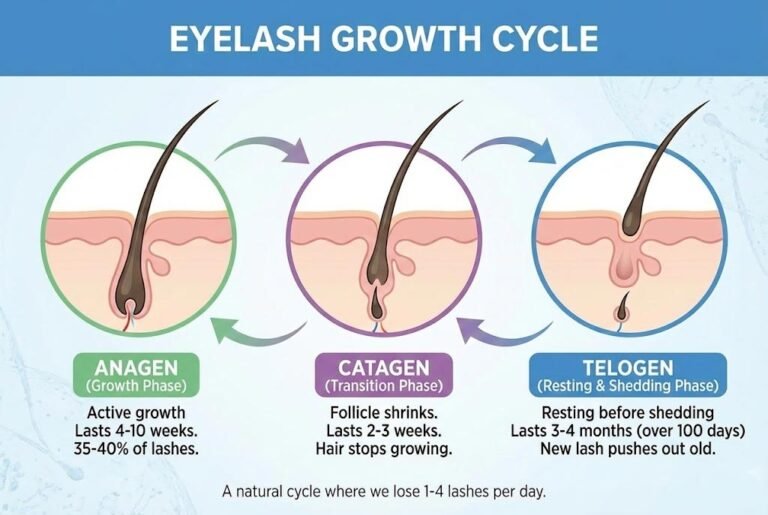
If you’ve ever watched a natural lash fall (with or without an extension attached), you’ve seen biology doing its job—not necessarily a “retention problem.” Eyelashes grow and shed on a cycle, so healthy loss usually looks random and gradual, not sudden or patchy.
If you’re wearing extensions, it can help to compare what you’re seeing against how a typical set behaves over time—and to check whether your products and routine match your lash condition (see our lash extension range here: Shop lash products).
Quick Answer: Is Lash Shedding Normal?
Yes—some daily lash loss is usually normal, because every eyelash is on its own growth-and-shed timeline. Healthy shedding tends to look scattered (single lashes) rather than sudden, patchy, or accompanied by irritation.
If you’re wearing extensions, a lash can fall with the extension attached because the natural lash it’s bonded to has finished its cycle. That can still be normal—especially if what you’re seeing is occasional, single-lash loss rather than clusters.
Next: Use the checklist below to confirm what’s normal, then read the growth-cycle stages to understand why it happens.
30-second “Is this normal?” checklist
Usually normal (keep monitoring):
- A few single lashes per day (sometimes with extensions attached)
- No pain, swelling, discharge, or heavy redness
- Lash line still looks mostly even after brushing
Not normal (pause + get help):
- Bald patches / clumps / sudden thinning
- Burning, itching, swollen lids, discharge, crusting, or “gritty” sensation (possible lid inflammation like blepharitis)
- Lash loss plus eyebrow/scalp hair loss or other systemic symptoms
If you’re unsure whether what you’re seeing is normal shedding or irritation, pause your set and get evaluated by a qualified professional. If you’re a salon/brand needing help reviewing retention variables (materials, mapping, or aftercare education), you can also reach our team here
How Many Eyelashes Fall Out a Day (What’s Normal)?
Many sources describe losing about 1–5 lashes per day as typical. With extensions, some of those shed lashes may have an extension attached—this can still be normal if it’s scattered.
What “normal” looks like in real life
- You don’t lose the same number every day (it’s not a metronome).
- Some days you notice none; other days you find a few on your cheek, pillowcase, or cleansing pad.
- If you’re in extensions, “one lash + one extension” can look dramatic, even when it’s just one follicle completing its cycle.
Why daily loss varies so much
Even when you’re doing everything right, lash shedding can fluctuate due to:
- Mechanical friction (sleeping face-down, rubbing, tight sleep masks, frequent towel-drying)
- Makeup removal habits (pulling at the lash line)
- Lid hygiene + inflammation (oily debris, blepharitis, allergies)
- Hormones/health/medications (your body prioritizes what it needs most)
Practical expectation-setting (for clients):
If your lash line looks generally even and you’re seeing single lashes rather than clusters, you’re usually in the “normal” zone.
When Lash Shedding Isn’t Normal (Red Flags)
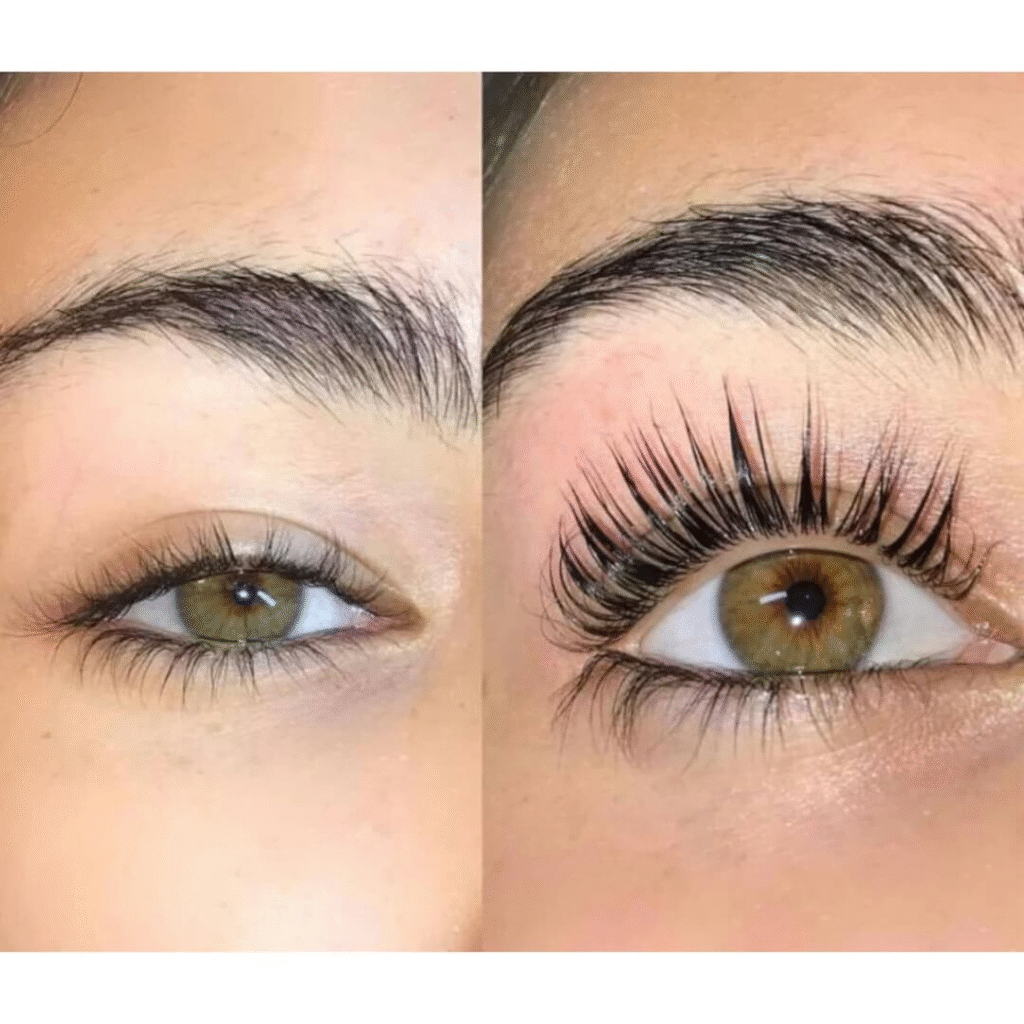
If any of the patterns below show up, it’s wise to pause extensions and check in with a qualified professional (eye care professional, dermatologist, or your lash artist for a safety assessment—medical concerns should go to medical providers).
Red flags to take seriously
- Bald patches, obvious gaps that appear quickly, or clumps of lashes coming out
- Burning, itching, swollen lids, heavy redness, discharge, or crusting around lashes (can be consistent with lid inflammation like blepharitis)
- Lash loss happening alongside eyebrow/scalp hair loss or other symptoms (possible systemic causes)
What to do immediately (client-friendly)
- Stop rubbing and avoid aggressive cleansing at the lash line
- Switch to a gentle cleansing routine and avoid new/irritating cosmetics
- If there’s discomfort, redness, or crusting: book an eye exam (don’t “wait it out”)
If you’re a studio or brand team documenting repeated “retention complaints” and want a structured checklist (materials + environment + aftercare messaging), reach out here.
Eyelash Growth Cycle Stages (Anagen, Catagen, Telogen, Exogen)
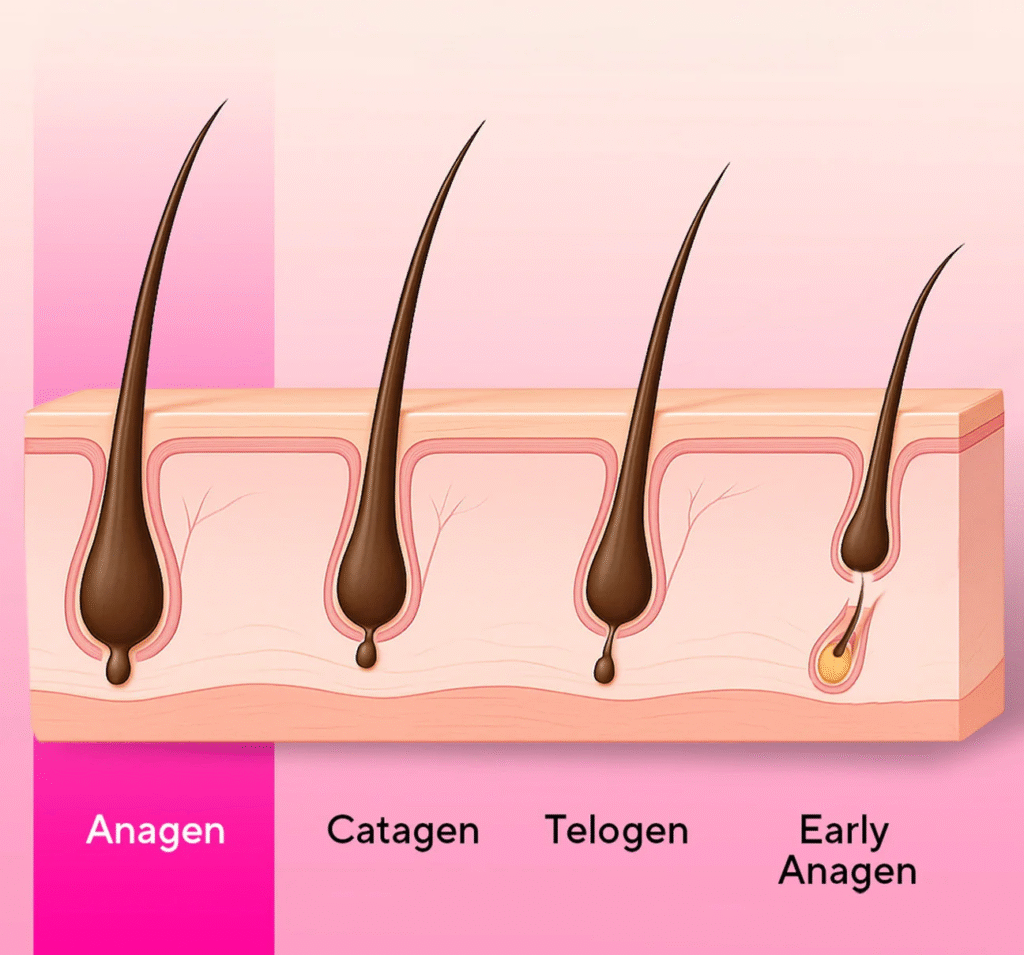
To understand why shedding is normal (and why extensions sometimes fall with a natural lash), here’s the eyelash growth cycle in plain language. Timing varies by person, but the pattern is consistent: grow → transition → rest → release.
Here’s the cycle in a practical, copy-ready format:
| Phase | What’s happening biologically | Typical timing (ranges vary by person) | What clients notice | What lash artists should do |
|---|---|---|---|---|
| Anagen (growth) | The follicle is actively producing a lash; the lash is still “maturing.” | ~4–10 weeks; growth rate ~0.12–0.14 mm/day | Lashes may look shorter/finer in spots as new ones come in | Great time to build a balanced set—avoid overloading very young, fragile lashes |
| Catagen (transition) | Growth stops; the follicle shrinks and detaches from active blood supply | ~15 days | Usually nothing obvious | Conservative styling helps (weight/length choices matter most here) |
| Telogen (rest) | The lash is fully formed and “resting” until it releases | ~4–9 months | Extensions can “pop off” with a natural lash when telogen ends | Manage expectations: some loss is timing, not technique |
| Exogen (release/shedding) (sometimes separated) | The lash releases from the follicle; a new lash begins its cycle | Described as a distinct shedding step in hair cycling research | A single lash + extension may fall together | Reassure: this is normal if it’s scattered, not clumped |
Key point for retention education: Even with perfect application and aftercare, you can’t “out-glue” the lash cycle. When a natural lash is ready to release, the extension attached to it will leave too.
Why Extensions Fall Out: The 4 Most Common Scenarios
Clients often ask: “Is this shedding…or bad retention?” Here’s a clear way to tell.
1. Natural shedding (healthy)
What you see: one natural lash with an extension attached, scattered across days.
What it means: that lash completed its cycle.
What to do: nothing—refills exist for a reason.
2. Slip-off (often technique or environment)
What you see: extension falls off, but the natural lash is not attached.
Common drivers: bond issues, oil contamination, humidity/curing mismatch, heavy water exposure early on.
What to do: artists audit isolation + prep; clients review aftercare.
3. Breakage (often mechanical or overload)
What you see: shorter broken natural lashes, rough ends, uneven lash line.
Common drivers: rubbing, picking, harsh makeup removal, or styling that’s too heavy for lash health.
What to do: reduce friction + reassess weight/length mapping.
4. Irritation/inflammation (stop and assess)
What you see: itch, burn, swelling, crusting, redness, watery eyes.
What it means: could be allergy/irritation or lid inflammation (blepharitis, etc.).
What to do: pause and seek medical guidance if symptoms persist or are significant.
How Long Do Eyelashes Take to Grow Back?
This is where people get confused—because “grow back” can mean two different things:
- Visible turnover / replacement cycle: The American Academy of Ophthalmology notes lashes grow, fall out, and replace themselves in a cycle around every 6–10 weeks.
- Full recovery after damage or widespread shedding: If lashes were broken or stressed, it can take longer to look “full” again—often measured in months depending on the cause and how many follicles were affected (and how quickly new lashes mature).
Retention reality (why one client looks “fresh” longer than another)
- If many lashes are closer to releasing, you’ll see more natural turnover during your wear period (even with perfect work).
- If many lashes are in active growth/mid-cycle, the set can look stable longer.
This is why “perfect retention for 4–6 weeks” isn’t a reliable promise—biology isn’t uniform across clients.
How Many Lashes Do We Have? (And Why It Matters)
People commonly cite approximate ranges like ~90–160 lashes on the upper lid and ~75–80 on the lower lid, often across multiple rows. (Exact counts vary by individual, age, and measurement method.)
Why this matters in real life:
- Density expectations: not everyone can safely wear the same fullness
- Mapping decisions: gaps are often “new growth,” not “bad work”
- Refill cadence: more natural lashes = more total shed events you’ll notice over time
Retention by Phase (For Lash Artists)
Best for: Lash artists (application + styling decisions).
Goal: Pre-frame refills as biology + maintenance, not “failure,” while protecting lash health.
Phase-by-phase playbook
Anagen (growth): protect new growth
What’s happening: lashes are actively developing and can be finer/less stable.
Do:
- Choose conservative diameters/weights on very young lashes to reduce traction risk.
- Prioritize clean isolation and directional placement (young lashes are more easily pulled off-axis).
- Document “high new-growth sets” so refill expectations are set early.
Avoid:
- Over-lengthening or overloading baby lashes to “force density.”
Catagen (transition): stabilize
What’s happening: growth is slowing; follicles are shifting.
Do:
- Keep styling balanced—this is where “just a little heavier” can tip into premature shedding/breakage.
- Watch for direction changes; correct with placement and mapping rather than adding weight.
Telogen (rest): expectations + distribution
What’s happening: lashes are resting and closer to release.
Do:
- Expect more “extension + natural lash” fallouts (normal cycle completion).
- Focus on even distribution and symmetry—not “saving” sparse areas with heavier fans.
- Consider a slightly shorter refill window for telogen-heavy clients (helps aesthetics without stressing lashes).
Exogen (release): normal vs abnormal
Normal: scattered single-lash losses across both eyes
Not normal: clusters, one-sided patterns, or symptoms (itch/redness/crusting)
- If symptomatic: advise pause + medical evaluation when appropriate
Pro audit checklist (reduces “retention blame loops”)
- Are fallouts with natural lashes (shedding) or without (bond issue)?
- Any signs of inflammation (red lids/crusting/itch)?
- Weight and length appropriate by zone and lash maturity?
- Aftercare education delivered + documented?
- Refill schedule aligned with the client’s cycle and lifestyle?
Some daily loss is normal—lashes shed on a cycle. If you see single lashes, that’s usually healthy turnover. If you ever see clumps, gaps, or irritation, tell me right away so we can pause and protect lash health.
Brand Builder Notes (OEM / Private Label)
Best for: Lash brands, educators, and OEM/private label teams.
Business goal: Reduce complaints, protect reviews, increase reorder confidence—by setting expectations clearly and safely.If you’d like to review available styles/specs before discussing OEM, you can browse the current catalog here: Shop lash products.
What to include in aftercare inserts (copy you can reuse)
Front (client-friendly):
- “It’s normal to lose 1–5 lashes/day as part of the natural lash cycle.”
- “With extensions, a shed lash may fall with the extension attached—this can be normal if it’s scattered.”
- “Clumps, bald patches, pain, or heavy redness aren’t normal—pause and check in.”
Back (what this prevents):
- Unrealistic “6-week perfect set” expectations (refund pressure)
- Misattribution of natural shedding to adhesive quality
- Late reporting of irritation (risk + reputation)
Mini training outline for your team (15–20 minutes)
- The lash cycle in one slide: grow → transition → rest → release
- Normal vs not normal: single-lash loss vs clusters + symptoms
- Retention language: “biology + maintenance” framing (reduces conflict)
- Safety escalation: when to refer out (protects clients and your brand)
Packaging + claims compliance notes (keep it safe)
- Avoid medical claims (“treats blepharitis,” “cures hair loss,” etc.).
- If discussing growth serums or medications, clearly state: prescription / doctor guidance required.
- For bimatoprost: it’s discussed in medical literature as affecting lash growth via anagen changes; this is clinical territory.
Quick Takeaways (for skim readers)
- Losing 1–5 eyelashes per day is commonly described as normal.
- Healthy shedding is random single-lash loss, not clumps or painful irritation.
- The hair cycle is commonly described as anagen → catagen → telogen, and many sources also describe exogen as the shedding phase.
- If you have redness, swelling, discharge, or crusting at the lash line, consider evaluation for eyelid inflammation (e.g., blepharitis).
FAQs: Natural lash growth cycle
Do eyelash extensions stop natural lashes from growing?
Extensions don’t “turn off” growth by themselves. What matters is weight, isolation, adhesive control, and aftercare—because irritation, traction, or poor hygiene can contribute to breakage or inflammation. If lashes are shedding in clumps or the lids are irritated, it’s time to pause and evaluate.
Why do I lose extensions even when I’m careful?
Because an extension is attached to a natural lash—and when that natural lash reaches the end of its cycle, it releases. Lash cycles are staggered across the lash line, so the loss looks random and ongoing.
Can anything change the lash growth cycle?
Some medications can influence lash growth. For example, bimatoprost (prescription treatment for eyelash hypotrichosis) is discussed in medical literature as increasing the percentage of follicles in anagen. This is medical territory—clients should discuss risks/benefits with a clinician.
References
American Academy of Ophthalmology. Why Are My Eyelashes Falling Out?
Milner, Y., Kashgarian, M., Sudnik, J., Filippi, M., Kizoulis, M., & Stenn, K. (2002). Exogen, Shedding Phase of the Hair Growth Cycle: Characterization of a Mouse Model. Journal of Investigative Dermatology, 119(3), 639–644.
Higgins, C. A., Westgate, G. E., & Jahoda, C. A. B. (2009). From Telogen to Exogen: Mechanisms Underlying Formation and Subsequent Loss of the Hair Club Fiber. Journal of Investigative Dermatology, 129(9), 2100–2108.
Stenn, K. (2005). Exogen is an active, separately controlled phase of the hair growth cycle. Journal of the American Academy of Dermatology, 52(2), 374–375.
Han, J., Xie, Z., Zhu, X., Ruan, W., Lin, M., Xu, Z., Miao, L., Zhong, J., Lu, F., & Hu, L. (2024). The effects of eyelash extensions on the ocular surface. Contact Lens and Anterior Eye, 47(2), 102109.