
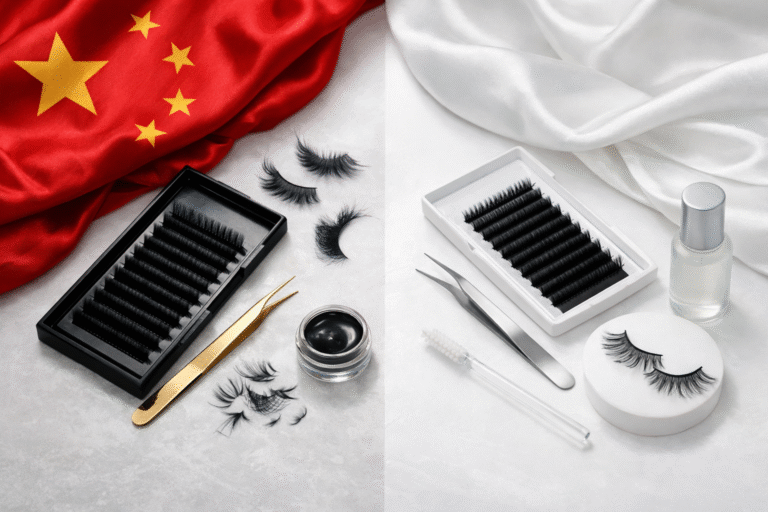
When launching or scaling an eyelash extension brand, finding the right manufacturing partner is arguably the most critical decision you will make. For decades, the global lash industry has been dominated by two major production hubs: China and South Korea. If you are a lash brand owner, you have likely found yourself caught in the debate of China vs Korea lash manufacturers. Which one offers the best quality? Which one provides better pricing? And most importantly, which one is the right fit for your specific business model?
The truth is that neither country is universally “better” than the other. Instead, they operate on fundamentally different manufacturing models, each with its own set of advantages, limitations, and ideal use cases. Korean factories are globally renowned for pioneering premium synthetic fibers and maintaining strict domestic quality control. Chinese factories, on the other hand, are the undisputed leaders in global export, offering unmatched scalability, comprehensive OEM (Original Equipment Manufacturer) services, and flexible minimum order quantities (MOQs).
In this comprehensive guide, we will break down the differences between Chinese lash factories and Korean lash suppliers across six key factors: product quality, pricing, MOQ, customization capabilities, lead times, and quality control. By the end of this article, you will have a clear understanding of how to choose the right manufacturing partner to launch and grow your eyelash brand successfully.
Understanding the Two Manufacturing Models
Before diving into the head-to-head comparison, it is essential to understand the broader context of how the eyelash manufacturing industries in China and South Korea have evolved. These historical and economic backgrounds directly impact the type of service and product you receive as a buyer.
The Korean Manufacturing Model: Premium Domestic Focus
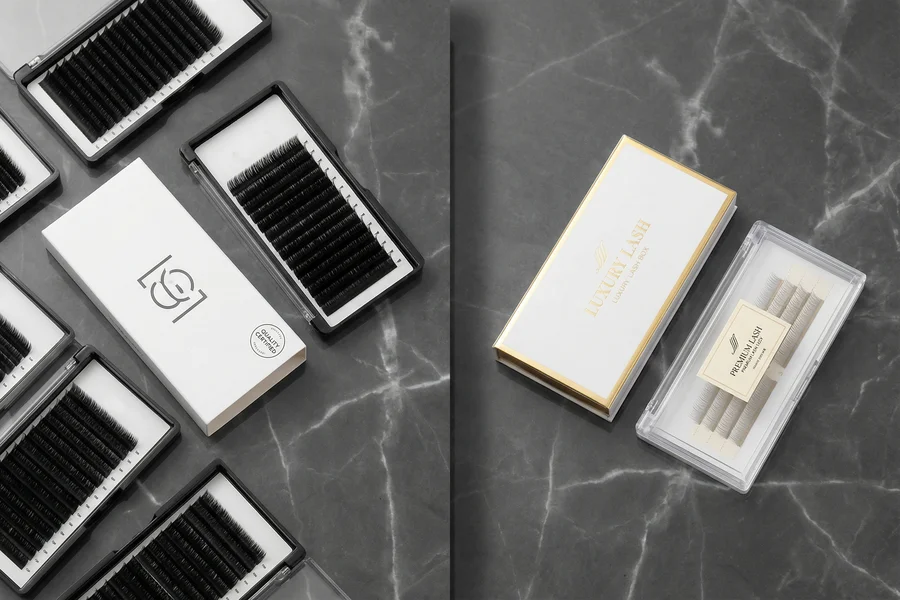
South Korea is widely considered the birthplace of modern eyelash extensions. The country’s beauty industry (K-Beauty) places a massive emphasis on innovation, safety, and premium materials. Korean manufacturers were the first to develop high-grade Polybutylene Terephthalate (PBT) fiber, which remains the gold standard for soft, flexible, and natural-looking lash extensions today [1].
However, the Korean manufacturing model is primarily designed to serve its own robust domestic market and established premium brands. Because labor costs in South Korea are relatively high, factories there operate with higher overheads. Consequently, they tend to focus on high-volume, high-margin production runs rather than catering to international startups or small-to-medium enterprises (SMEs) that require flexibility.
The Chinese Manufacturing Model: Global Export and Flexibility
China is the undisputed powerhouse of global eyelash production, manufacturing an estimated 70% to 80% of the world’s false eyelashes [2]. Over the past two decades, Chinese factories have built massive, highly efficient supply chains specifically designed for international export.
Unlike the Korean model, the Chinese manufacturing ecosystem is built on flexibility and scale. Chinese factories have mastered the art of OEM and ODM (Original Design Manufacturer) services, allowing brands from the US, Europe, and Australia to create fully customized product lines with custom packaging. Furthermore, the best Chinese factories have adapted to the demand for premium quality by directly importing raw materials—such as Korean PBT fiber—to combine top-tier materials with efficient, cost-effective production.
Head-to-Head Comparison: 6 Key Factors
To help you make an informed decision, let us compare China vs Korea lash manufacturers across the six most important factors for brand owners.
1. Product Quality and Materials
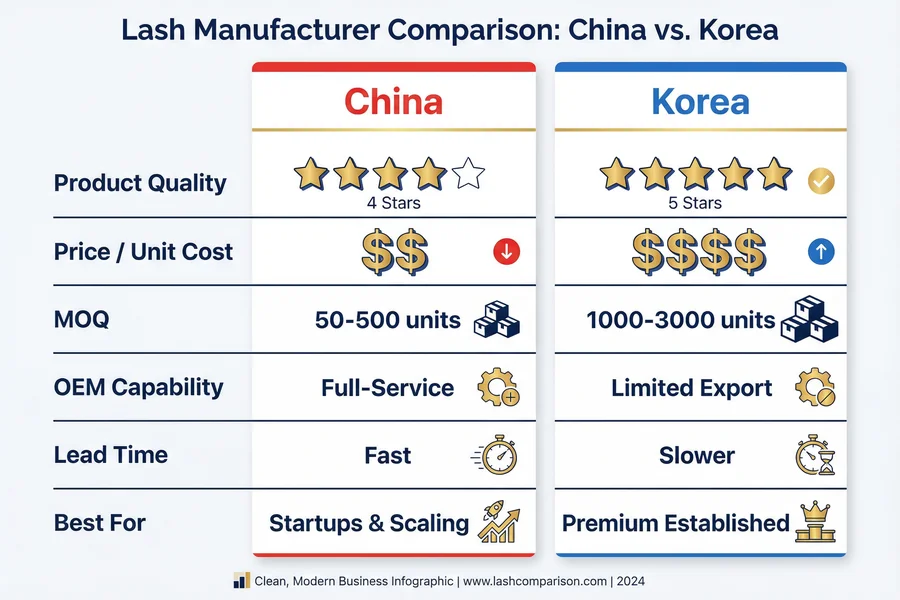
When discussing eyelash extension quality, the conversation almost always centers around the raw material. The highest quality lash extensions are made from Korean PBT fiber, a synthetic thermoplastic polymer that is exceptionally soft, holds its curl perfectly, and is hypoallergenic [3].
Historically, Korean factories held a monopoly on premium quality because they exclusively used this superior fiber, while many older Chinese factories relied on cheaper, stiffer domestic plastics or real mink fur. However, the industry landscape has shifted dramatically. Today, the quality gap between a top-tier Chinese factory and a Korean factory is virtually non-existent, provided you choose the right partner.
Leading Chinese lash manufacturers now import raw Korean PBT fiber directly from South Korea and process it in their own facilities. This means you can source premium eyelash extensions that feature the exact same softness, matte finish, and curl retention as Korean-made lashes. The key is to specifically ask your Chinese supplier if they use imported Korean PBT fiber. If they use cheap domestic fiber, the quality will suffer; if they use Korean fiber, you get world-class quality.
2. Pricing and Cost Structure
Pricing is where the differences between the two countries become starkly apparent. South Korea has a significantly higher cost of living and higher minimum wages compared to China. This economic reality translates directly into higher manufacturing costs. When you purchase lashes manufactured entirely in Korea, you are paying a premium for the labor involved in hand-arranging the lash strips and applying the adhesive bases.
Chinese factories benefit from a highly optimized supply chain, localized packaging production, and a more balanced labor cost. This allows them to offer highly competitive unit prices without sacrificing the quality of the raw materials. For a growing lash brand, the lower unit cost from a Chinese manufacturer directly translates to a higher gross profit margin—often allowing brands to achieve the 70% to 80% margins necessary for sustainable retail success.
3. Minimum Order Quantity (MOQ)
Minimum Order Quantity (MOQ) is often the biggest hurdle for new lash brands, and it is a critical differentiator between Chinese and Korean suppliers.
Korean factories generally require very high MOQs. Because their production lines are set up for large, established brands, it is common to see MOQs of 1,000 to 3,000 trays per style, and packaging MOQs exceeding 3,000 units. For a startup brand looking to test multiple curls, lengths, and diameters, this requires a massive upfront capital investment and carries a high risk of dead inventory.
In contrast, Chinese factories are incredibly startup-friendly. A typical Chinese manufacturer will offer MOQs as low as 50 to 100 trays per style. More importantly, Chinese factories have deeply integrated packaging supply chains. This allows them to offer custom lash packaging with MOQs as low as 500 boxes. This flexibility allows brand owners to launch a diverse product line, test market demand, and scale their orders gradually.
4. OEM/ODM and Customization Capabilities
Building a brand is about more than just selling lashes; it is about creating a cohesive, memorable unboxing experience. OEM (manufacturing your specific designs) and ODM (designing products for you) capabilities are essential for brand differentiation.
Chinese manufacturers excel in full-service OEM and ODM. They are structured to be “one-stop shops.” When you work with a top Chinese factory, they can handle everything from customizing the foil backing on the lash strips to providing professional lash packaging design services. They can easily accommodate mixed styles, custom branding, and unique box structures (like magnetic closures or holographic prints).
Korean factories, while producing excellent products, are often more rigid. They are less likely to accommodate complex, low-volume custom packaging requests for export clients. Their focus is primarily on producing the lashes themselves, leaving the brand owner to figure out complex packaging logistics separately.
5. Communication and Lead Times
Effective communication is the backbone of any successful manufacturing partnership. Because Chinese factories have spent decades focusing on global export, they have dedicated international sales teams that are highly proficient in English. They understand Western market trends, use communication tools like WhatsApp and email efficiently, and can guide you through the entire OEM and ODM service process smoothly.
Additionally, lead times in China are generally faster. From sampling to mass production, a well-oiled Chinese factory can turn around an order in 3 to 4 weeks.
Sourcing directly from a Korean factory can sometimes present language barriers, as their primary focus is domestic. Unless you are a massive buyer, you may find that communication is slower, and export lead times can stretch significantly longer due to limited export capacity.
6. Certifications and Quality Control
Both countries are capable of maintaining high quality control standards, but the approach differs. Korean brands have a deeply ingrained culture of domestic quality control, driven by strict national beauty regulations.
However, professional Chinese factories have adopted international standards to serve global markets. Reputable Chinese manufacturers are ISO 9001 certified, meaning they adhere to internationally recognized quality management systems. They implement rigorous multi-step quality control processes, ensuring that every lash tray is inspected for curl consistency, length accuracy, and adhesive residue before it is shipped. When vetting a Chinese factory, always ask for their quality certifications and standard operating procedures.
The “Best of Both Worlds” Approach: Chinese Factory + Korean Materials
After analyzing the data, a clear winning strategy emerges for the vast majority of lash brand owners: combining the superior materials of Korea with the manufacturing efficiency of China.
You do not have to choose between high quality and reasonable MOQs. By partnering with a premium Chinese manufacturer that explicitly uses imported Korean PBT fiber, you achieve the “best of both worlds.” This hybrid approach delivers the ultra-soft, dark matte, long-lasting lashes that professional lash artists demand, while providing you with the low MOQs, custom packaging, and competitive pricing required to run a profitable business.
At Lashvee, this is precisely our model. With over 15 years of experience as a specialized eyelash factory, we source 100% premium Korean PBT fiber for our extensions. We are an ISO 9001 certified facility serving over 300 global brands, providing world-class quality with the flexibility and comprehensive OEM services that brand owners need to thrive.
Which Manufacturer Is Right for Your Brand Stage?
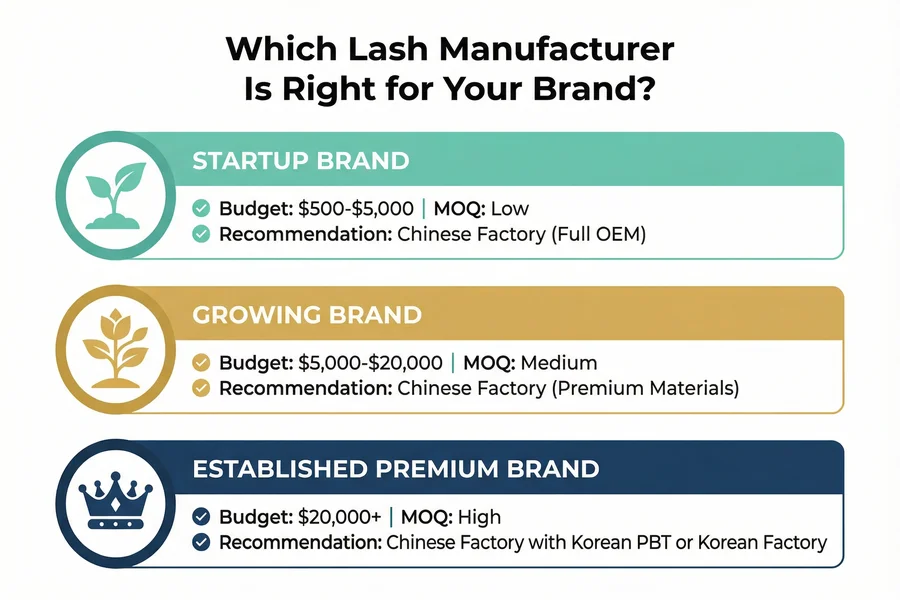
To simplify your sourcing decision, we have created a decision matrix based on your current business stage and budget.
| Brand Stage | Typical Budget | Ideal Manufacturer Profile | Why It Fits |
|---|---|---|---|
| Startup Brand | $500 – $5,000 | Chinese Factory (Full OEM) | You need low MOQs to test the market, affordable custom packaging to build brand identity, and guidance through the manufacturing process. |
| Growing Brand | $5,000 – $20,000 | Chinese Factory (Korean PBT Focus) | You have proven sales and need to maximize profit margins while ensuring top-tier quality (Korean PBT) to retain loyal customers. |
| Established Premium Brand | $20,000+ | Chinese Factory (Korean PBT) OR Korean Factory | You have the capital for high MOQs. A Korean factory is viable, but a top-tier Chinese factory still offers better packaging integration and scalability. |
Red Flags to Watch for When Sourcing
Whether you ultimately choose a supplier in China or Korea, the industry is unfortunately filled with middlemen and subpar operations. Watch out for these critical red flags during your sourcing process:
- Trading Companies Posing as Factories: Many suppliers on platforms like Alibaba are trading companies, not actual factories. They buy from factories and mark up the price, limiting your customization options and increasing costs. Always ask for video tours of the production floor or ISO certifications to verify they are a true manufacturer.
- Refusal to Send Samples: A legitimate factory will always encourage you to test their quality before placing a bulk order. If a supplier pressures you into a large order without allowing you to purchase a sample pack first, walk away immediately.
- Vague Material Descriptions: If a supplier simply says their lashes are “synthetic” or “silk” without specifying the origin of the fiber (e.g., Korean PBT), they are likely using cheap, stiff domestic plastics. Demand transparency regarding raw materials.
Conclusion
The debate between China vs Korea lash manufacturers is not about one country being inherently superior; it is about finding the right operational fit for your brand. While Korean factories produce excellent materials, their high costs and rigid MOQs make them inaccessible for most growing businesses.
For the modern lash brand owner, partnering with a high-end Chinese factory that utilizes imported Korean PBT fiber is the most strategic choice. It offers the perfect intersection of world-class product quality, scalable MOQs, beautiful custom packaging, and healthy profit margins.
If you are ready to build a lash brand that stands out in a competitive market without compromising on quality or tying up all your capital in inventory, we are here to help. Contact Lashvee today to discuss your vision, request premium Korean PBT lash samples, and discover how our OEM services can bring your brand to life.
Frequently Asked Questions (FAQ)
1. Is Chinese lash quality as good as Korean lash quality?
Yes, but it depends entirely on the factory and the materials they use. A reputable Chinese factory that imports premium Korean PBT fiber will produce lash extensions that are identical in quality, softness, and durability to those manufactured in South Korea.
2. Why do Chinese lash factories use Korean PBT fiber?
Korean PBT (Polybutylene Terephthalate) is globally recognized as the highest quality synthetic fiber for eyelash extensions. It is hypoallergenic, incredibly soft, and retains its curl better than standard plastics. Top Chinese factories import this material to meet the high-quality demands of Western beauty markets while keeping assembly costs efficient.
3. What is the typical MOQ for Korean lash manufacturers?
Korean factories typically require very high Minimum Order Quantities, often ranging from 1,000 to 3,000 trays per specific style (curl/length/thickness combination), and 3,000 or more units for custom packaging. This makes them difficult for startup brands to work with.
4. How do I verify if a Chinese lash supplier is a real factory and not a trading company?
To verify a factory, ask for their ISO 9001 certification, request a live video call to see the production floor, and check if they offer comprehensive OEM services like in-house packaging design. Trading companies usually have limited customization options and higher unit costs.
5. Can I get custom packaging from a Chinese lash manufacturer?
Yes, one of the biggest advantages of Chinese manufacturers is their integrated supply chain. Factories like Lashvee offer full custom packaging services, including design, printing, and unique box structures, often with very reasonable MOQs starting around 500 boxes.
References
[1] LaviLash. “Why LAVILASH Uses Korean PBT Materials for Their Lashes.” LaviLash Wholesale.
[2] Grand View Research. “False Eyelashes Market Size, Share & Trends Analysis Report.” Grand View Research, Inc.
[3] Heymebeauty. “Eyelashes Factory MOQ Comparison: China vs Vietnam vs Korea.” Heymebeauty Blog.