

The beauty industry is booming, and the global false eyelashes market is a prime example. Valued at approximately $1.9 billion in recent years, it is projected to reach over $3 billion by 2034, fueled by an impressive compound annual growth rate (CAGR) of nearly 7%. With such massive market growth, a common question arises among aspiring entrepreneurs and beauty professionals: is selling lashes profitable?
The short answer is yes, selling lashes can be highly profitable. However, the true profit margins depend heavily on your business model, your sourcing strategy, and your brand positioning. Unlike service-based lash artists who trade time for money, launching a product-based lash brand offers scalable revenue. But to succeed, you need a clear understanding of your cost structure and profit margins.
In this comprehensive guide, we will break down the real numbers behind running a lash brand. We will explore wholesale costs, retail pricing strategies, gross margin benchmarks, and actionable steps to maximize your profitability. Whether you are launching a lean startup or scaling a premium brand, understanding these metrics is your first step toward building a successful eyelash business. For more foundational advice, you can explore our comprehensive guide on launching an eyelash brand.

The Short Answer: Yes — But Margins Vary Widely
When asking if selling lashes is profitable, it is crucial to distinguish between a service-based lash business and a product-based lash brand. A lash artist applying extensions can generate significant income, but their revenue is capped by the number of hours they can work. In contrast, a product-based lash brand sells physical goods—like lash trays, adhesives, and accessories—to consumers or other lash artists.
The product model is uniquely scalable. Once you establish a reliable supply chain and a strong brand identity, you can sell hundreds or thousands of units per month without a proportional increase in labor. The profit margin for a lash brand is the difference between the retail price of your products and the total cost to produce, package, and deliver them.
While the beauty industry standard targets a 60% to 70% gross margin, lash brands can sometimes achieve even higher margins if they source directly from an OEM and ODM manufacturer rather than a middleman trading company. However, achieving these margins requires meticulous cost management and strategic pricing.
Understanding Your Cost Structure
To determine if selling lashes is profitable for your specific business plan, you must first dissect your costs. Your expenses will fall into two main categories: Cost of Goods Sold (COGS) and Operating Costs.
Cost of Goods Sold (COGS) — What You Pay Per Unit
COGS represents the direct costs associated with producing your lash products. This includes the raw materials, manufacturing labor, packaging, and the cost of shipping the products from the factory to your facility.
Here is a realistic breakdown of the COGS for a standard tray of premium 3D mink or high-quality PBT faux mink lashes:
- Wholesale / OEM Unit Cost: Sourcing high-quality lashes directly from a reputable factory typically costs between $1.50 and $5.00 per tray, depending on the material, style complexity (e.g., premade fans vs. classic), and order volume.
- Custom Packaging: Your packaging is your silent salesperson. Simple, entry-level packaging might add $0.50 to $1.00 per unit, while premium magnetic rigid boxes with foil stamping can cost $1.50 to $3.00+ per unit. Investing in professional custom lash packaging is essential for brand differentiation.
- Landed Cost (Shipping & Customs): Importing your products involves freight shipping and customs duties. When ordering in bulk, this typically adds $0.30 to $0.80 per unit.
Total Landed COGS: When you add these factors together, your total landed cost per unit will generally range from $2.30 (for a budget-friendly, high-volume order) to $8.80 (for a premium, low-volume order with luxury packaging).
Operating Costs to Factor In
Beyond the physical product, running a lash brand incurs ongoing operating expenses. These must be factored into your pricing strategy to ensure true profitability.
- E-commerce Platform Fees: Subscriptions for platforms like Shopify, plus transaction fees (typically 2-3% per sale).
- Marketing & Advertising: Social media ads, influencer partnerships, and content creation. This is often the largest operating expense for new brands.
- Branding & Photography: High-quality product photos and lifestyle imagery are non-negotiable in the beauty industry. Utilizing a professional lash packaging design service can streamline your branding efforts.
- Storage & Fulfillment: Warehousing costs, shipping materials (mailers, bubble wrap), and the labor to pack and ship orders to your customers.
Retail Pricing & Gross Margin Analysis
Your gross margin is the percentage of total sales revenue that you retain after incurring the direct costs associated with producing the goods. To calculate your gross margin percentage: ((Retail Price - COGS) / Retail Price) * 100.
The retail price for a high-quality tray of lash extensions typically ranges from $15.00 to $35.00, while luxury or specialty lashes can retail for up to $50.00.
Let’s look at three pricing tiers and their corresponding gross margins.
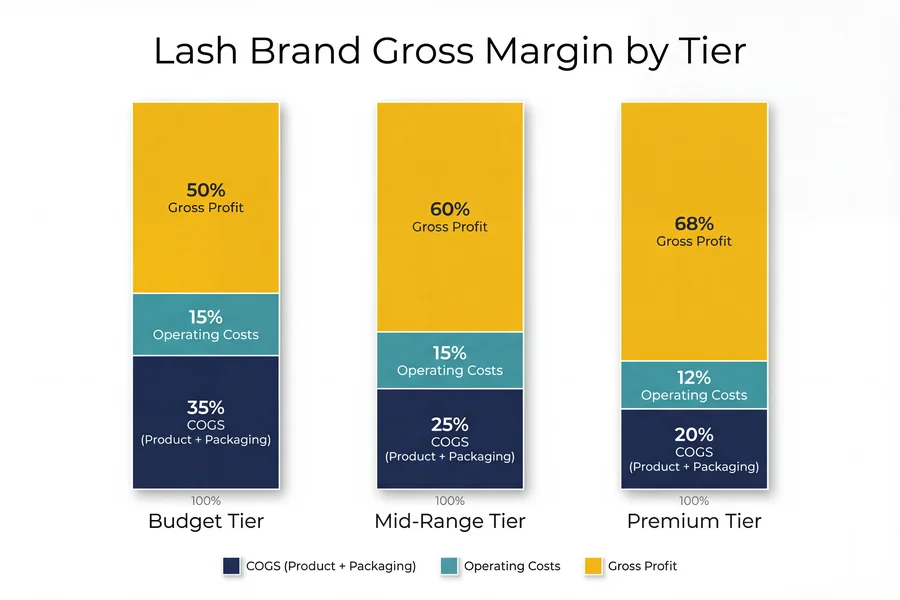
- Budget Tier (Targeting Price-Sensitive Buyers)
- Retail Price: $15.00
- Landed COGS: $3.50
- Gross Profit: $11.50
- Gross Margin: 76%
- Note: While the percentage is high, the absolute dollar profit is lower, meaning you must sell a high volume to generate substantial income.
- Mid-Range Tier (The Sweet Spot for Most Brands)
- Retail Price: $22.00
- Landed COGS: $4.50 (Includes better packaging)
- Gross Profit: $17.50
- Gross Margin: 79%
- Note: This tier offers a strong balance of accessibility for buyers and healthy profit margins for the brand owner.
- Premium Tier (Luxury Positioning)
- Retail Price: $35.00
- Landed COGS: $7.50 (Premium materials, custom magnetic boxes)
- Gross Profit: $27.50
- Gross Margin: 78%
- Note: Premium brands require significant investment in marketing and brand perception to justify the higher price point, but the dollar profit per unit is exceptional.
As these scenarios demonstrate, the gross margins in the lash industry are incredibly strong, frequently exceeding the 60-70% beauty industry benchmark. This robust margin provides the necessary cushion to cover operating expenses and reinvest in growth.
Revenue Scenarios — What Can a Lash Brand Actually Earn?
Understanding margins is important, but visualizing total revenue helps answer the question: is selling lashes profitable enough to replace a full-time income? Let’s examine three growth stages for a lash brand.
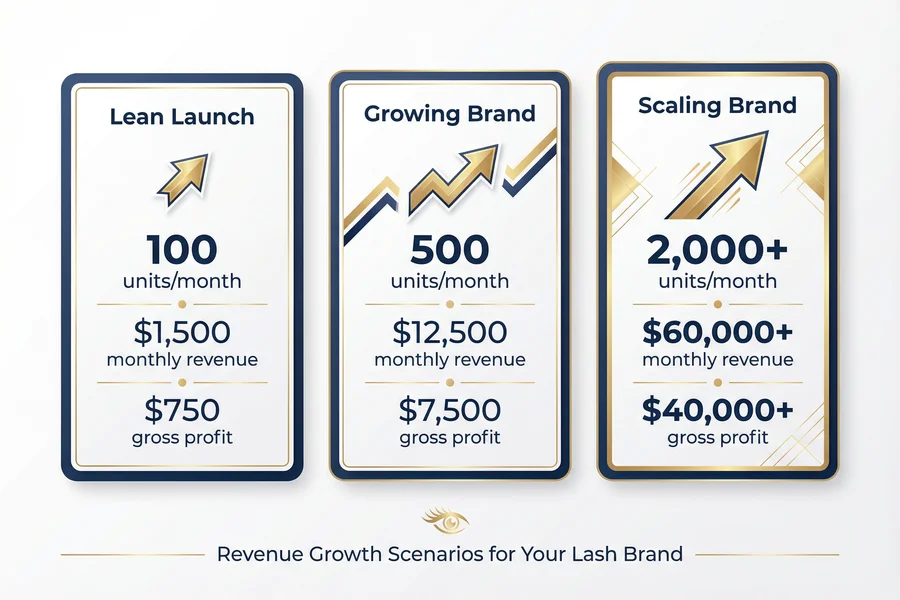
Scenario 1: The Lean Launch (Side Hustle)
- Sales Volume: 100 units per month
- Average Order Value (AOV): $30 (e.g., 1-2 trays + adhesive)
- Monthly Revenue: $3,000
- Estimated Gross Profit (75% margin): $2,250
- Takeaway: A realistic starting point for a solo entrepreneur or a lash artist selling retail to their existing client base. It provides a solid supplementary income.
Scenario 2: The Growing Brand (Full-Time Focus)
- Sales Volume: 500 units per month
- Average Order Value (AOV): $45 (e.g., 2-3 trays, tweezers, cleanser)
- Monthly Revenue: $22,500
- Estimated Gross Profit (75% margin): $16,875
- Takeaway: At this stage, the brand is gaining traction through social media and consistent marketing. The business generates enough profit to support a full-time founder and reinvest in larger inventory orders.
Scenario 3: The Scaling Brand (Established Enterprise)
- Sales Volume: 2,000+ units per month
- Average Order Value (AOV): $60 (Larger bundles, wholesale orders to salons)
- Monthly Revenue: $120,000+
- Estimated Gross Profit (75% margin): $90,000+
- Takeaway: This represents a mature brand with strong brand equity, high customer retention, and potentially a B2B wholesale channel. The profitability is substantial, allowing for team expansion and product line diversification.
What Separates Profitable Lash Brands from Those That Struggle
While the math shows that selling lashes is profitable, not every brand succeeds. The difference between a thriving business and a struggling one often comes down to execution in a few key areas.
First, supplier quality and consistency are paramount. If you source cheap, inconsistent lashes from a middleman, your customers will not return. Partnering directly with an experienced factory ensures stable quality and better wholesale pricing, protecting your margins.
Second, brand differentiation is critical in a crowded market. You cannot simply slap a generic logo on a stock box and expect to charge premium prices. Investing in unique custom packaging and a cohesive brand aesthetic elevates your perceived value.
Finally, the most profitable brands focus heavily on customer retention. Acquiring a new customer is expensive. Profitable brands cultivate loyalty through exceptional customer service, high-quality products, and strategic email marketing, encouraging buyers to return every few weeks to restock their supplies.
How to Maximize Your Lash Brand’s Profit Margin
If you are ready to launch or scale your business, here are actionable strategies to maximize your profitability:
- Source Directly from a Manufacturer: Bypass trading companies and source your products directly from an established OEM/ODM factory like Lashvee. This eliminates middleman markups and gives you direct control over product customization.
- Optimize Your Order Volume: Minimum Order Quantities (MOQs) dictate your unit cost. As your business grows, ordering in larger quantities will significantly reduce your per-unit cost and increase your gross margin.
- Focus on Average Order Value (AOV): Encourage customers to spend more per transaction by offering bundles (e.g., a “Volume Lash Starter Kit”), volume discounts, or free shipping thresholds. A higher AOV dilutes the cost of shipping and acquisition.
- Build a Subscription Model: If you sell essential supplies like adhesives and lash cleansers, consider offering a “subscribe and save” option. This guarantees recurring revenue and improves your customer lifetime value (LTV).
Quick Reference Summary Table
For a quick overview of the lash brand profitability landscape, refer to this summary table:
| Metric / Feature | Industry Benchmark / Estimate |
|---|---|
| Global Market Growth | ~7% CAGR, reaching over $3 Billion by 2034 |
| Wholesale Cost (COGS) | $1.50 – $5.00 per standard tray |
| Retail Price Range | $15.00 – $35.00+ per standard tray |
| Target Gross Margin | 70% – 80% (Highly favorable compared to other retail sectors) |
| Key Profitability Driver | Direct factory sourcing, custom packaging, and high customer retention |
Conclusion
So, is selling lashes profitable? The data clearly indicates that it is an exceptionally lucrative business model, provided you approach it with a strategic mindset. With gross margins routinely exceeding 70%, lash brand owners have ample room to cover operating costs, invest in aggressive marketing, and generate substantial net profit.
The key to unlocking this profitability lies in treating your brand like a professional enterprise from day one. This means prioritizing high-quality materials, investing in distinctive custom packaging, and partnering with a reliable manufacturing partner who can scale with you.
At Lashvee, we have over 15 years of experience helping entrepreneurs turn their vision into highly profitable reality. As a specialized, ISO 9001 certified eyelash extension factory, we provide premium Korean PBT fiber products, transparent OEM/ODM services, and expert packaging design to over 300 global brands.
Ready to build a profitable lash brand with margins that make sense? Contact Lashvee today for a custom wholesale quote and let our experts guide you through the process.
Frequently Asked Questions
1. What is a good profit margin for a lash brand?
A healthy gross profit margin for a lash brand is typically between 70% and 80%. This means if you sell a lash tray for $20, your total landed cost (product, packaging, and shipping) should be around $4 to $6. This high gross margin is necessary to cover your operating expenses, marketing costs, and still leave a strong net profit.
2. How much does it cost to start a lash brand?
The startup cost for a lash brand varies widely based on your strategy. A “Lean Launch” testing a few styles can start between $500 and $1,500. A more professional launch with custom packaging and a wider product range typically requires $1,500 to $5,000. Premium brands aiming for a large-scale launch may invest $5,000 to $15,000 or more.
3. How much can you make selling lashes online?
Your earning potential is directly tied to your sales volume and margins. A small side hustle selling 100 units a month can generate $1,000 to $2,000 in profit. A growing full-time brand selling 500+ units can generate $10,000+ in monthly profit. Highly successful, scaled brands can easily generate six or seven figures in annual revenue.
4. Is private label lashes more profitable than wholesale?
Yes, private label (OEM) is generally more profitable in the long run. While buying basic wholesale lashes might be cheaper initially, private labeling allows you to build brand equity, differentiate your products with custom packaging, and command a higher retail price. This ultimately leads to stronger profit margins and better customer loyalty.
5. How do I price my lashes for maximum profit?
To price your lashes effectively, use a “cost-plus” and “value-based” approach. First, calculate your total landed COGS. Then, research your competitors to understand the market rate. Aim to price your products to achieve at least a 70% gross margin, but ensure your branding, packaging, and product quality justify the price point you choose.
References
[1] Grand View Research. (2024). False Eyelashes Market Size, Share & Trends Analysis Report. Retrieved from https://www.grandviewresearch.com/industry-analysis/false-eyelashes-market
[2] Fortune Business Insights. (2024). False Eyelashes Market Size, Share & Industry Analysis. Retrieved from https://www.fortunebusinessinsights.com/false-eyelashes-market-106573
[3] American Lash Association. (2025). The Lash Artist’s Guide to Boosting Income with Retail Sales. Retrieved from https://americanlashassociation.org/the-lash-artists-guide-to-boosting-income-with-retail-sales/