
Choosing a manufacturing partner is one of the most critical decisions you’ll make when building your lash brand. This partnership is the foundation of your product quality, supply chain reliability, and ultimately, your brand’s reputation. A great manufacturer can be a strategic asset that helps you scale, while a poor one can lead to production delays, inconsistent quality, and unhappy customers.
Yet, many new brand owners—and even experienced ones—don’t know what to ask. They often focus solely on the unit price, missing the crucial details about quality control, customization capabilities, and compliance that separate a transactional supplier from a true long-term partner. Asking the right questions upfront is the key to building a resilient business and a brand that customers trust.
This guide provides a comprehensive checklist of 20 essential questions, organized into five key categories, to help you vet potential lash manufacturers with confidence. Think of this as your framework for a successful partnership, ensuring you find a supplier that aligns with your brand’s vision and quality standards. This process is a vital part of the overall journey, which we cover in our complete guide to launching a lash brand.
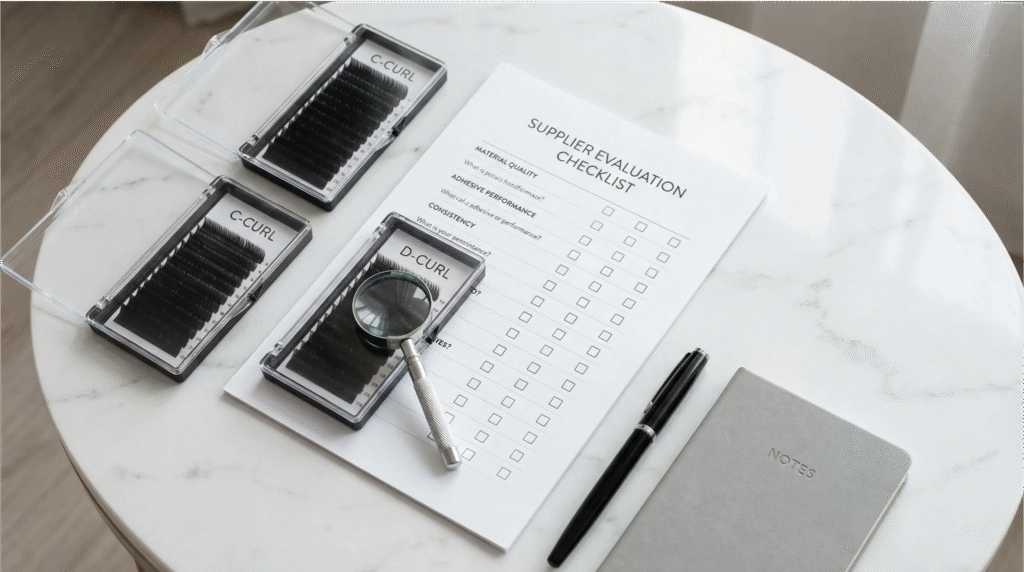
20 questions to ask lash manufacturer
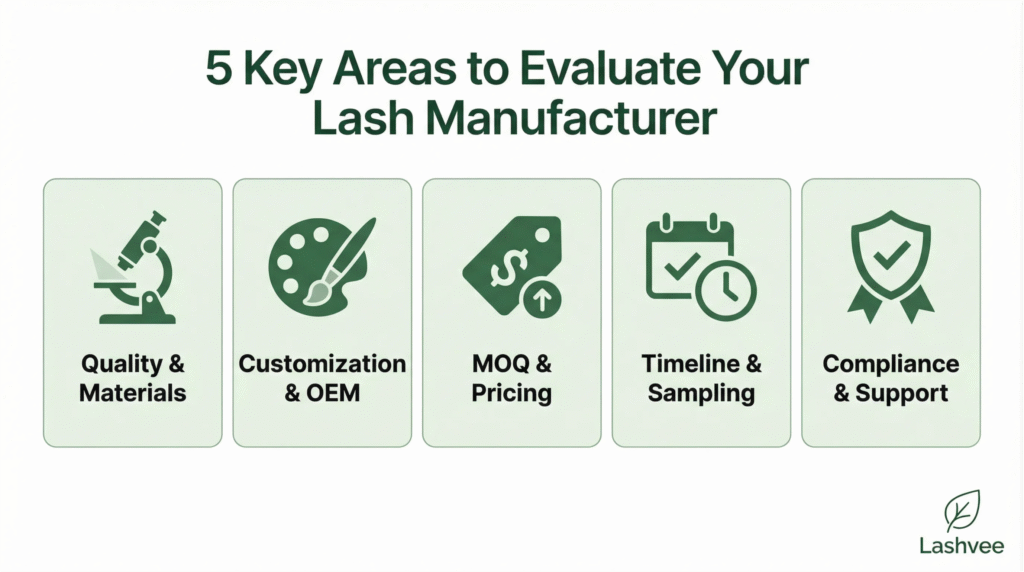
To help you structure your conversations, we’ve grouped the questions into the five most important areas of evaluation.
Part 1: Quality Control & Materials
Product quality is the ultimate promise you make to your customers. For lash brands, this means consistent curls, comfortable bands, and durable fibers. These questions are designed to verify a manufacturer’s commitment to using high-quality raw materials and maintaining rigorous quality control (QC) standards.
1. What specific raw material do you use for your lash extensions, and why is it superior?
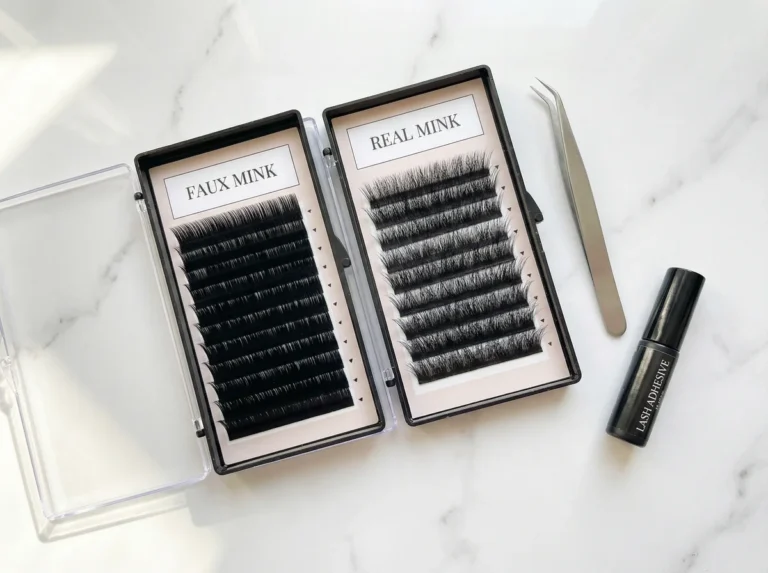
A professional manufacturer should be able to answer this instantly. The industry gold standard is Korean PBT (Polybutylene Terephthalate). Ask why they use it. The correct answer should mention its key attributes: it’s heat-resistant (maintaining its curl), lightweight, flexible, and has a natural-looking, semi-matte finish. A manufacturer who can’t explain their material choice may be using a cheaper, lower-grade alternative.
2. What is your quality control (QC) process during and after production?
Look for a multi-stage QC process. A reliable factory doesn’t just inspect the final product; they check for quality at every step. This should include:
- Raw Material Inspection: Verifying the quality of the PBT fiber before it enters production.
- In-Process Checks: Technicians monitoring for curl consistency, lash alignment, and band integrity during manufacturing.
- Final Inspection: A dedicated QC team that inspects 100% of finished products for defects before they are packaged.
3. How do you ensure curl, length, and thickness consistency across different batches?
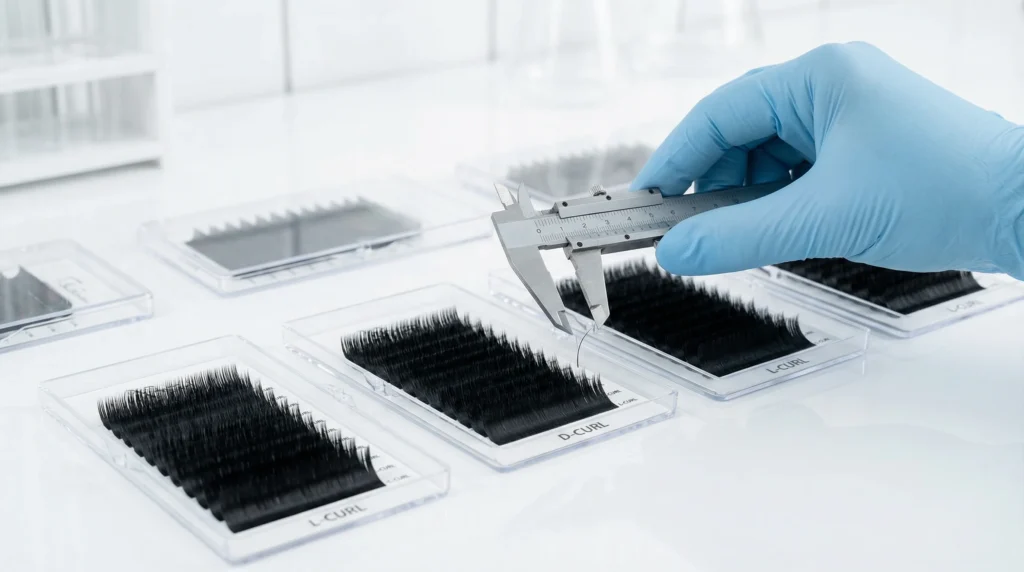
This is a critical question for brand owners who need reliable reorders. Inconsistent curls are a common complaint from lash artists. A top-tier manufacturer will use standardized temperature and timing controls for curling, precision cutting tools for length, and digital calipers for thickness verification. They should have a documented process for ensuring that an order placed in June is identical to one placed in December.
4. Are your lash adhesives (if applicable) compliant with regulations in my target market?
If you plan to sell lash glue or pre-glued lashes, this is non-negotiable. Adhesives are subject to strict regulations that vary by region (e.g., EU regulations, FDA guidelines in the US, Health Canada). Your manufacturer must be able to provide safety data sheets (SDS) and proof of compliance for the specific markets you intend to sell in. Failure to do so can result in legal issues and product recalls.
Part 2: Customization & OEM/ODM Capabilities
Your ability to create a unique product is what sets your brand apart. A true OEM/ODM partner offers deep customization options that go far beyond simply putting your logo on a generic box. These questions explore their capacity to act as a creative partner in your brand’s development.
5. What aspects of the lashes can I customize?
A good manufacturer should offer a comprehensive menu of options. This isn’t just about length. Ask specifically about:
- Curls: Beyond standard C, D, and L curls, can they produce specialty curls like M, LC, or LD? Can they develop a custom curl for your brand?
- Thickness/Diameter: What is their range (e.g., from 0.03mm for mega volume to 0.20mm for classic)?
- Color: Can they produce colored lashes, brown lashes, or two-tone ombre lashes?
- Finish: Do they offer options for matte, semi-matte, or glossy finishes?
6. Can you help me develop a unique or signature lash style for my brand?
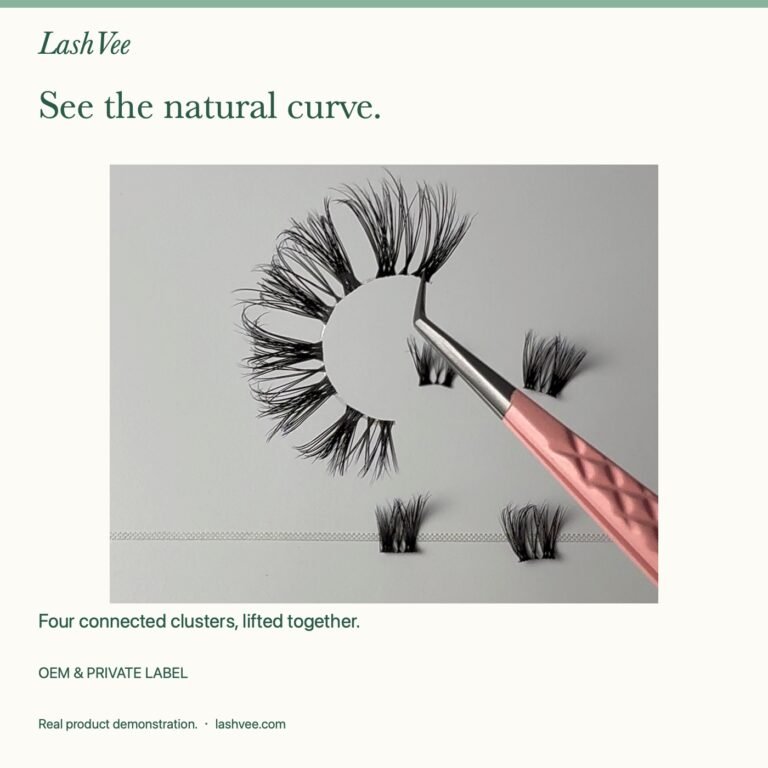
This question separates a basic supplier from a strategic OEM/ODM partner. If you have a vision for a specific wispy, spiky, or textured look, can their R&D team help you create it? A strong partner will be able to provide feedback on your concept, create prototypes, and help you engineer a proprietary lash map that becomes your signature.
7. What are my options for custom lash packaging?
Packaging is a critical part of your brand identity. A capable manufacturer should offer a full suite of packaging solutions. Ask about:
- Outer Boxes: Folding cartons, drawer boxes, magnetic closure boxes, etc.
- Lash Tray Cards: Can you print custom backgrounds, logos, and line indicators on the cards inside the box?
- Finishes: Do they support matte/gloss lamination, foil stamping, embossing, or spot UV?
For a complete overview of what’s possible, our Custom Lash Packaging Guide is a great resource to review before your conversation.
8. Do you offer a packaging design service, or do I need to provide my own print-ready files?
This is a practical question that impacts your workflow. Many full-service manufacturers, like Lashvee, have an in-house design team that can create professional packaging designs for you based on your brand guidelines. Others will require you to provide your own dielines and print-ready artwork from a graphic designer. Knowing this upfront helps you budget for design costs if needed.
Part 3: MOQ, Pricing & Payment Terms
This part of the conversation is about the financial health of your business. Clear, transparent answers here are crucial for budgeting, managing cash flow, and ensuring profitability. Any hesitation or vagueness from a manufacturer on these questions should be a red flag.
9. What is your Minimum Order Quantity (MOQ) for private label lashes and custom packaging?
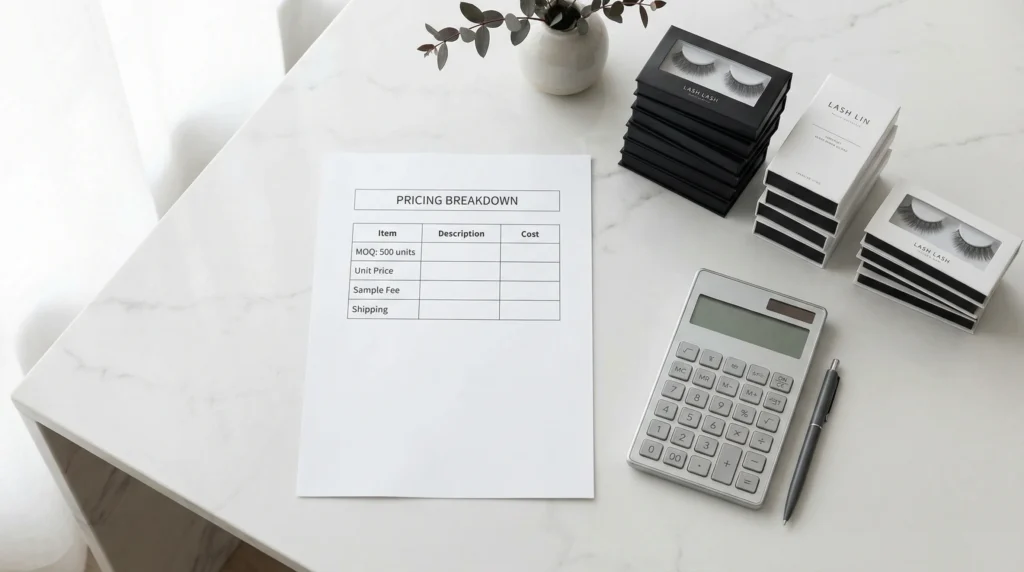
Ask for the MOQ for both lashes and packaging separately, as they are often different. For example, the MOQ for lashes might be 500 trays, while the MOQ for custom-printed boxes might be 1,000 units. Understanding this helps you plan your inventory and initial investment. A manufacturer with a very high MOQ may not be suitable for a new brand, while an extremely low one might indicate a trading company, not a factory.
10. Do you offer tiered pricing based on volume? At what quantities do price breaks occur?
A standard practice for manufacturers is to offer lower unit prices for larger orders. Ask for their price list or rate card that clearly shows the price breaks. For example: 500-999 units, 1000-1999 units, 2000+ units. This helps you understand your potential for better margins as you scale.
11. What are your payment terms?
The most common payment structure for custom manufacturing is a 50% deposit upfront to cover raw materials and a 50% balance payment due upon completion, before the goods are shipped. Be wary of any manufacturer demanding 100% upfront, as it gives you little leverage if issues arise. Conversely, a manufacturer offering unusually flexible terms may be factoring that risk into your price.
12. Are there any hidden costs I should be aware of?
Transparency is key. Ask directly about any potential costs beyond the per-unit price. This could include:
- Sample Fees: Are samples free, or is there a cost? Is this cost deducted from your first bulk order?
- Design Fees: If you use their in-house design service.
- Mold Fees: For creating custom lash curls or unique packaging shapes.
- Setup Fees: For printing plates used in custom packaging.
A reputable manufacturer will be upfront about all potential charges.
Part 4: Production, Sampling & Lead Time
This set of questions focuses on the operational timeline and logistics. Understanding the production process and lead times is essential for planning your launch, managing inventory, and keeping your promises to customers.
13. What is the lead time for a physical sample, and what is the lead time for mass production after sample approval?
These are two different timelines. Sample production might take 7-14 days, while mass production can take 3-5 weeks. Get clear estimates for both. The clock for mass production should only start after you have formally approved the physical sample, not before.
14. What is your process for sample feedback and revisions?
Getting the sample right is crucial. What happens if the first sample isn’t perfect? A good partner will have a clear, collaborative process for feedback. You should be able to provide specific notes for changes, and they should be able to produce a revised sample. Ask if there are costs associated with revisions.
15. How do you handle potential production delays or quality issues discovered during production?
No factory is perfect, and delays can happen. What matters is how they are handled. A transparent partner will communicate proactively about any potential delays and have a clear plan to resolve them. For quality issues, they should have a policy for re-running or correcting defective products at their own cost.
16. What are my shipping options, and can you provide estimated shipping times and costs to my location?
Most manufacturers offer several shipping options, typically via air express (like DHL or FedEx) or sea freight. Air is faster (5-10 days) but more expensive, while sea is slower (30-45 days) but more cost-effective for large orders. Your manufacturer should be able to provide estimated quotes and transit times for both options to help you make an informed decision.
Part 5: Compliance, Certifications & Support
These final questions are about establishing the manufacturer’s legitimacy, ethical standards, and potential as a long-term partner. A professional manufacturer will be proud to share their certifications and have clear processes for customer support.
17. What certifications does your factory hold?
Certifications are third-party verifications of a factory’s quality management and safety standards. Look for internationally recognized certifications such as:
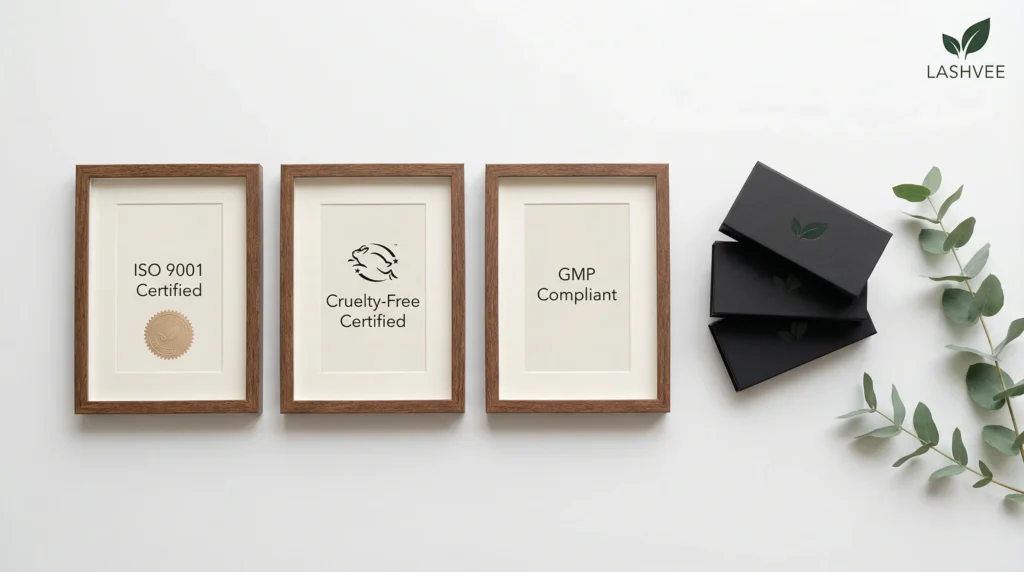
- ISO 9001: A standard for quality management systems, indicating a commitment to consistency and customer satisfaction.
- ISO 22716 (GMP): Good Manufacturing Practices for the cosmetics industry, which is essential for ensuring product safety and hygiene.
18. Can you confirm your products are cruelty-free and provide documentation?
For most beauty brands today, being cruelty-free is a core value. Your manufacturer must be able to confirm that neither their finished products nor the raw materials they source are tested on animals. Ask if they are certified by programs like PETA or Leaping Bunny and if they can provide documentation to support their claim.
19. Who will be my main point of contact, and what is your team’s communication process?
A dedicated account manager or sales representative is a sign of a professional operation. You should have a single point of contact who understands your brand and can answer your questions promptly. Ask about their standard response time and the primary channels for communication (e.g., Email, WhatsApp). Clear and consistent communication is the bedrock of a good manufacturing partnership.
20. What kind of after-sales support do you offer if I encounter issues with an order I’ve received?
A manufacturer’s responsibility doesn’t end when the goods are shipped. What happens if you discover a quality issue after you’ve received your order? A reliable partner will have a clear policy for investigating the issue and offering a solution, which could include a partial refund, a credit toward a future order, or a replacement of the defective goods.
Choosing a Partner, Not Just a Supplier
Choosing a lash manufacturer is a strategic decision that goes far beyond a simple price comparison. It’s about finding a partner who is invested in your brand’s quality, growth, and long-term success. By asking these 20 questions, you arm yourself with the information needed to build a strong, transparent, and reliable relationship with your manufacturer.
At Lashvee, we are built on the principle of partnership. With over 15 years of experience serving 300+ global brands, we pride ourselves on transparency and quality. We are an ISO 9001 certified factory using premium Korean PBT fiber, offering extensive OEM/ODM customization, and providing dedicated support to every client. Our goal is to be the manufacturing backbone that allows your brand to thrive.
Ready to build a lash brand with a partner you can trust? Contact us today to discuss your project. We’re happy to answer all 20 of these questions—and any others you may have.
Frequently Asked Questions
What is the difference between a white label and a private label lash manufacturer?
White label involves applying your brand to a manufacturer’s existing, ready-made products. It’s faster and usually has a lower MOQ. Private label involves creating a unique product to your specifications, including custom lashes, unique packaging, and branded components. It offers greater differentiation but typically requires a higher MOQ and a longer lead time.
Why is Korean PBT fiber considered the best material for lash extensions?
Korean PBT (Polybutylene Terephthalate) is a high-performance thermoplastic polymer that is ideal for false eyelashes. It is prized for its excellent curl retention (it doesn’t straighten over time), its lightweight and soft texture (making it comfortable to wear), and its ability to be tapered to a fine point, mimicking the look of a natural lash.
How much should I budget for my first private label lash order?
This varies widely based on your MOQ for both lashes and packaging, the complexity of your packaging design, and your chosen shipping method. A typical starting budget for a small private label launch can range from $2,000 to $5,000+. It’s essential to get a detailed quote from your manufacturer that includes the cost of samples, products, packaging, and shipping.
Why is ISO 9001 certification important for a lash manufacturer?
ISO 9001 is an internationally recognized standard for Quality Management Systems (QMS). For a lash brand, a manufacturer with ISO 9001 certification provides assurance that they have robust, repeatable processes in place to ensure product quality, consistency, and customer satisfaction. It demonstrates a serious commitment to professionalism and reliability.
References
[1] GEP. (2023, May 30). 7 Supplier Vetting Best Practices You Should Know About. Retrieved from https://www.gep.com/blog/strategy/supplier-vetting-best-practices-you-should-know
[2] NIST. (2023, May 30). 8 Ways to Improve Your Supplier Selection Process. National Institute of Standards and Technology. Retrieved from https://www.nist.gov/blogs/manufacturing-innovation-blog/8-ways-improve-your-supplier-selection-process