
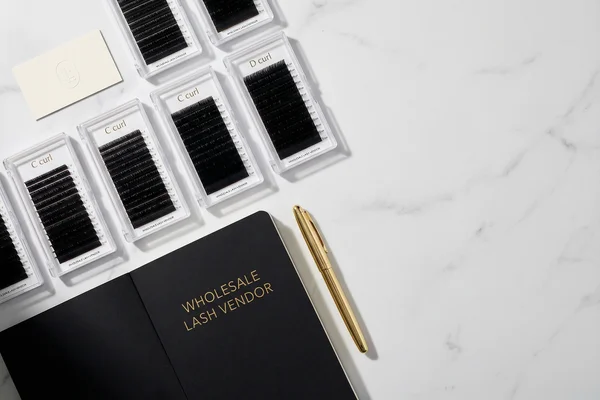
The global false eyelash market is projected to surpass $1.9 billion by 2028, and the professionals driving that growth — lash technicians, salon owners, and beauty retailers — all need one thing: a reliable wholesale lash vendor they can trust. If you’re looking to enter this market on the supply side, the opportunity is real and the path is more structured than most people expect.
Becoming a wholesale lash vendor means positioning yourself between the manufacturer and the end buyer. You source product from a factory, brand it under your own label, and sell it in bulk to salons, lash studios, beauty supply stores, and independent technicians. Unlike direct-to-consumer retail, this is a relationship-driven, volume-based business where consistency and reliability matter far more than novelty.
This guide walks you through every stage of building a wholesale lash business — from the legal groundwork to landing your first accounts.
What a Wholesale Lash Vendor Actually Does
Before diving into the how, it helps to be precise about the role. A wholesale lash vendor sits between the manufacturer and the end retailer or professional user. You source product from a factory, apply your branding, and sell in bulk at prices that allow your buyers to mark up profitably.
The key distinction from retail is the margin and volume structure. Wholesale buyers expect to pay 40–60% less than the retail price in exchange for buying in larger quantities. Your profitability depends on sourcing at a low enough landed cost to offer competitive wholesale pricing while maintaining a healthy margin for your own business.
Most successful wholesale lash vendors also offer private label services — supplying product under a buyer’s brand name rather than their own. This is a significant value-add that commands premium pricing and builds stickier, longer-term account relationships. If you’re interested in the full scope of what private label manufacturing involves, our OEM & ODM Service overview explains the process from inquiry to delivery.
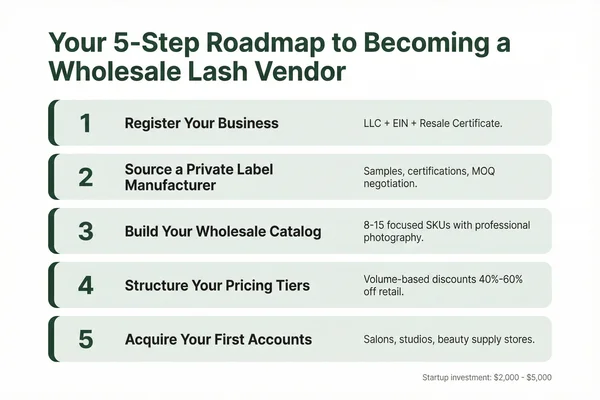
Step 1: Register Your Business and Get the Right Documents
Operating as a wholesale vendor requires a properly structured business entity. In the United States, an LLC (Limited Liability Company) is the standard choice — it provides personal liability protection and is straightforward to set up, typically costing $50–$150 depending on your state.
Beyond the LLC, you’ll need three key documents before you can operate as a legitimate wholesale business. An EIN (Employer Identification Number) from the IRS is your business’s tax identification number — free, quick to obtain online, and required for opening a business bank account. A resale certificate (also called a seller’s permit) allows you to purchase inventory from manufacturers without paying sales tax, since you’ll collect it when you sell to your customers. Finally, check whether your city or county requires a general wholesale business license before you start operating.
Step 2: Source from a Private Label Lash Manufacturer
Your manufacturer is the most critical variable in your entire business. The quality, consistency, and reliability of your product directly determines your reputation with wholesale accounts — and in B2B beauty, reputation is everything.
When evaluating manufacturers, the most important distinction is factory-direct versus trading company. A factory-direct manufacturer controls production quality and can respond to issues directly. A trading company adds cost and a layer of communication delay. For wholesale volumes, factory-direct is almost always the better choice.
Certifications and compliance are non-negotiable for professional accounts and retail chains. For products sold in the US or EU, look for SGS testing certificates, MSDS (Material Safety Data Sheets) for adhesives and fibers, and cruelty-free certification if your target market values it.
MOQ flexibility matters enormously when you’re starting out. Look for a manufacturer who can work with you at lower initial quantities — typically 100–300 pairs per style — while you build your account base, with the ability to scale as your volumes grow. At LashVee, we work with emerging wholesale vendors at flexible MOQs and offer a structured brand launch process that takes you from first inquiry to first shipment with clear timelines at every stage.
Never commit to bulk production without sampling. A reputable manufacturer will provide samples — typically at a nominal cost of $50–$150 — so you can evaluate curl consistency, fiber quality, band durability, and packaging before placing a bulk order.

Step 3: Build Your Wholesale Catalog
A well-structured catalog is your primary sales tool for acquiring wholesale accounts. For a new wholesale vendor, a focused range of 8–15 SKUs is more effective than a sprawling assortment. Professional buyers want to quickly identify products that fit their needs and understand the pricing — not wade through 50 options.
Your catalog should include, for each product: a clear style code and name, high-quality product photography (flat lay and on-eye), key specifications (material, curl type, length, band type, tray count), wholesale price at each tier, MOQ per style, and available packaging options.
One of the most important decisions at this stage is your product line composition. The right mix of classic, volume, and specialty lash styles determines which account types you can serve. Our Custom Lash Styles & Product Line Build Guide is a practical resource for understanding which styles perform best in different market segments and how to structure a catalog that converts.
Make your catalog available as a downloadable PDF and, ideally, as a digital catalog with embedded inquiry forms. Wholesale buyers increasingly expect to browse and inquire online rather than waiting for a physical catalog.
Step 4: Set Your Wholesale Pricing Tiers
Wholesale pricing is a tiered structure that rewards larger orders with better pricing. This incentivizes accounts to consolidate their purchasing with you rather than splitting orders across multiple vendors.
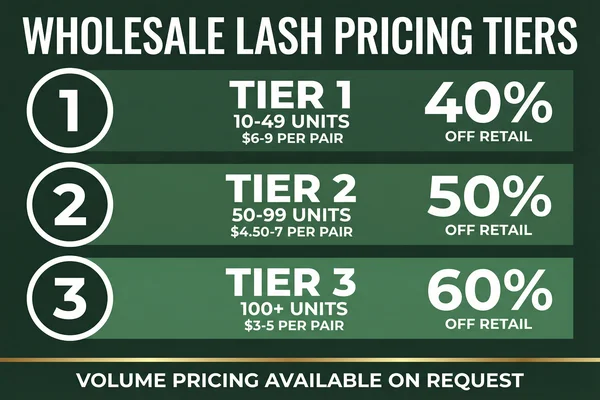
| Tier | Order Quantity | Discount off Retail | Typical Unit Price Range |
| Tier 1 | 10–49 units | 40% off retail | $6–9 per pair |
| Tier 2 | 50–99 units | 50% off retail | $4.50–7 per pair |
| Tier 3 | 100+ units | 60% off retail | $3–5 per pair |
When setting your retail price, work backward from your landed cost. If your cost per pair (product + packaging + shipping to you) is $2.50, a retail price of $15–$18 gives you a healthy margin at all wholesale tiers. Be careful not to undercut your own DTC pricing when setting wholesale prices — if your retail customers realize they’re overpaying relative to your wholesale buyers, your DTC channel will suffer.
Step 5: Acquire Your First Wholesale Accounts
With your business registered, product sourced, catalog built, and pricing set, the final step is getting product into the hands of paying accounts. B2B sales requires a fundamentally different approach than consumer marketing.
Target the right account types first. The easiest first accounts for a new wholesale lash vendor are independent lash technicians and small lash studios. They buy regularly, are open to new suppliers, and are reachable through Instagram and lash-specific Facebook groups. Larger accounts — beauty supply chains, salon groups — require more formal processes and longer sales cycles.
Lead with samples. In B2B beauty, the sample is your most powerful sales tool. Offer a curated sample kit of 3–5 of your best-selling styles at cost or free to qualified accounts. A buyer who has used your product and loves it is far more likely to place a bulk order than one who’s only seen photos.
Build a B2B inquiry page on your website. Your website should have a dedicated wholesale page that clearly explains your minimum order requirements, pricing tiers, lead times, and how to apply for a wholesale account. Include a simple inquiry form that captures the buyer’s business name, location, and estimated monthly volume.
Attend industry trade shows. Events like Cosmoprof North America and the International Beauty Show are excellent venues for meeting wholesale buyers in person. A well-designed booth with product samples and a clear pricing sheet can generate more qualified leads in two days than months of cold outreach.
The Packaging Question: Don’t Overlook It
One of the most common mistakes new wholesale vendors make is treating packaging as an afterthought. Your packaging is a direct extension of your brand credibility — and for accounts considering private label services, it’s often the deciding factor.
Whether you’re starting with stock packaging and a custom label or investing in fully custom boxes with foil stamping and magnetic closures, the quality of your presentation signals the quality of your product. Our Lash Packaging Design Service helps wholesale vendors create packaging that stands out on salon shelves and supports premium pricing — from dieline development through print-ready artwork.
For a comprehensive overview of packaging options, materials, and what each level of customization costs, the Eyelash Packaging Guide is the most detailed resource we’ve published on the topic.
What to Expect in Your First Year
Most new wholesale vendors acquire their first 3–5 accounts within 60–90 days of launching and reach consistent monthly revenue within 6–12 months. The accounts that matter most are not the largest ones — they’re the most reliable ones. A salon that orders 50 pairs every month is more valuable than one that orders 200 pairs once and never reorders.
Focus your energy in the first year on product consistency, fast fulfillment, and responsive customer service. These three factors drive reorders more than any marketing tactic. When your accounts trust that they’ll receive the right product, on time, every time, they’ll consolidate their purchasing with you and refer other buyers.
Ready to build your wholesale lash business? LashVee works with wholesale vendors at every stage — from first sample order to high-volume private label supply. Contact our team to discuss your requirements and get a quote within 24 hours.
Frequently Asked Questions
How much does it cost to start a wholesale lash business?
A minimum viable wholesale lash business requires approximately $2,000–$5,000 for initial inventory (100–300 pairs across 5–10 styles), basic packaging, business registration, and a simple website. Scaling to a full catalog with custom packaging typically requires $8,000–$15,000.
Do I need a wholesale license to sell lashes?
Requirements vary by state and country. In the US, you typically need a registered business entity (LLC or sole proprietorship), an EIN, and a resale certificate. Some states also require a general business license. Lash products are regulated as cosmetics by the FDA, so your products must comply with cosmetic labeling requirements.
What is the difference between wholesale and private label lashes?
Wholesale means selling existing products in bulk at discounted prices. Private label means selling products manufactured by a third party under your own brand name. Most successful wholesale lash vendors offer both: they sell their branded products wholesale to accounts, and also offer private label manufacturing services to brands that want to create their own labeled products.
How do I find wholesale lash accounts?
The most effective channels are Instagram (targeting lash technicians and studio owners), industry trade shows, lash-specific Facebook groups and communities, and cold outreach to local salons and beauty supply stores. A referral from an existing satisfied account is the highest-quality lead source.
What MOQ should I require from my wholesale accounts?
For a new vendor, keeping your minimum low (10–24 pairs) makes it easier to acquire first accounts. As your business grows and your manufacturing costs decrease with larger orders, you can gradually raise your minimum to 50–100 pairs to filter for more serious buyers.
How do I compete with large wholesale lash distributors?
Large distributors compete on price and breadth of range. As a smaller vendor, you compete on specialization, service, and relationships. Niche positioning — focusing exclusively on lash extension supplies for professional technicians, or on vegan and cruelty-free products — allows you to command premium pricing and build loyal accounts that larger distributors can’t serve as well.
Reference List
1.U.S. Internal Revenue Service. (2024). Employer Identification Number. Retrieved from https://www.irs.gov/businesses/small-businesses-self-employed/employer-id-numbers
2.U.S. Small Business Administration. (2024 ). Apply for Licenses and Permits. Retrieved from https://www.sba.gov/business-guide/launch-your-business/apply-for-licenses-and-permits
3.U.S. Food and Drug Administration. (2023 ). Cosmetics Labeling Guide. Retrieved from https://www.fda.gov/cosmetics/cosmetics-labeling/cosmetics-labeling-guide
4.Grand View Research. (2024 ). Eyelash Extension Market Size, Share & Trends Analysis Report, 2024–2030. Retrieved from https://www.grandviewresearch.com/industry-analysis/eyelash-extension-market
5.Cosmoprof North America. (2024 ). Trade Show Overview. Retrieved from https://www.cosmoprofnorthamerica.com
6.IMARC Group. (2024 ). False Eyelashes Market: Global Industry Trends, Share, Size, Growth, Opportunity and Forecast 2024–2032. Retrieved from https://www.imarcgroup.com/false-eyelashes-market