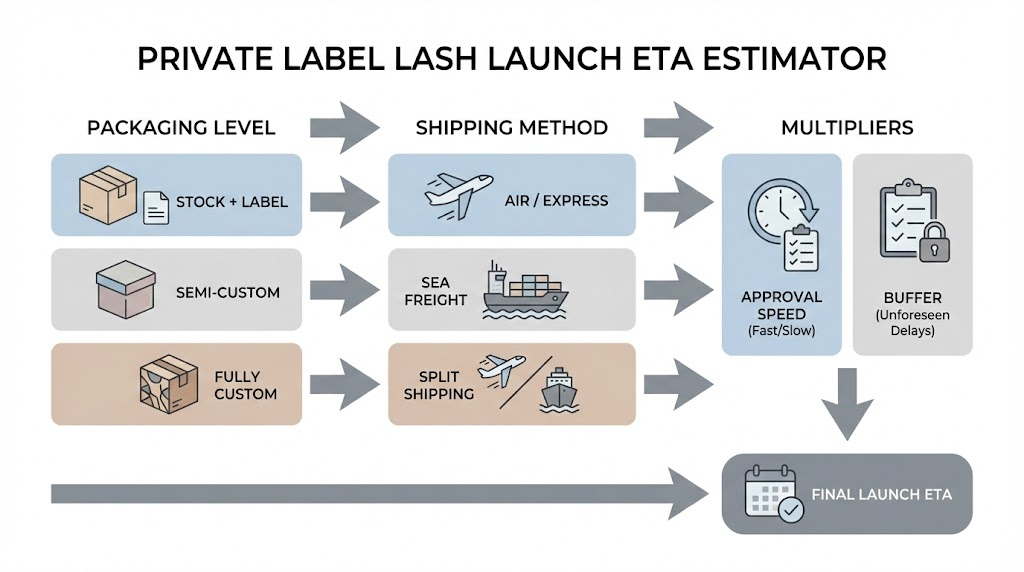
B. Pick your shipping method (biggest delivery swing):
Express / Air → faster, higher cost
Sea → slower, cheapest, more schedule risk
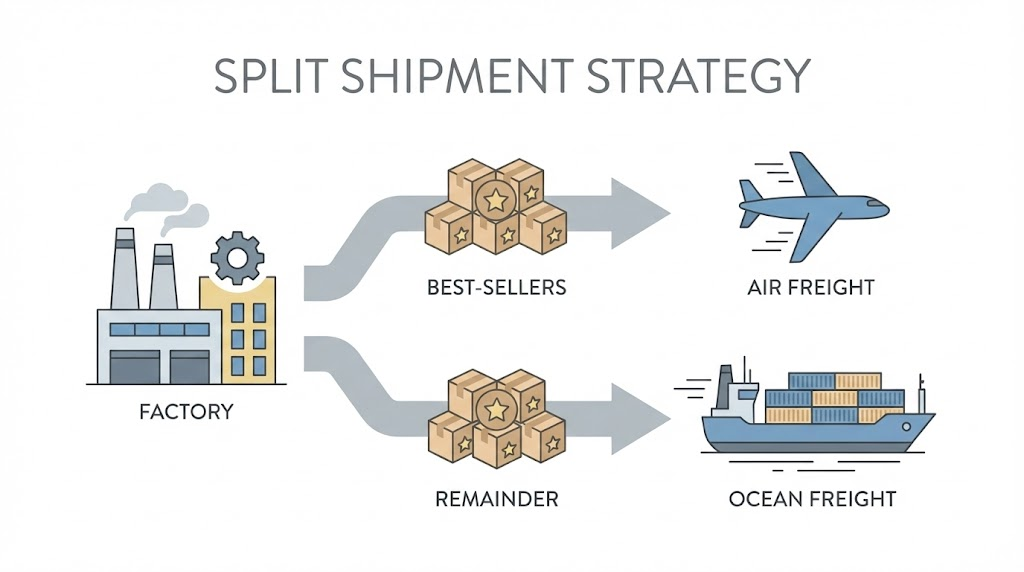
Split shipment → air best sellers first, sea the rest
C. Add two reality multipliers (these cause “silent waiting”):
Approvals: each round you delay by 24–72 hours compounds fast
Buffer: plan receiving, labeling, fulfillment, and “oops time”
Rule of thumb: If your date is tight, simplify packaging first and reduce approval rounds before touching QC.
Quick Answer
Delivery dates move because production and shipping/customs move independently.
Custom packaging is usually the #1 timeline extender (proofing → printing → assembly).
Approvals create silent waiting; slow feedback can add days or weeks.
Small components (inserts, trays, magnets, glue dots) can bottleneck final assembly.
QC protects your brand, but rework adds time (especially if packaging needs reprint).
Shipping choice can change delivery by weeks (air vs sea vs express).
Lead Time vs Production Time vs Delivery Date (definitions that prevent confusion)
Direct answer: For launch planning, treat production lead time and shipping/customs time as two separate clocks. If you combine them into one number, you’ll almost always misjudge your latest safe launch date.
Sampling time: Making a sample set (or pre-production confirmation) so you can approve curl/length/finish/packaging.
Production lead time: Material prep → lash making → tray/box packing → final QC.
Dispatch date (ship-out date): When cartons leave the factory.
Transit time: Carrier movement + handovers + local delivery.
Customs/clearance time: Can happen during transit or at arrival, depending on method and destination.
Citable statement: A reliable delivery plan separates production lead time from transit + customs time; combining them into one number is the fastest way to miss a launch window.
Step-by-Step: A Typical Private Label Lash Production Timeline
Direct answer: The timing varies, but the sequence is predictable: specs → sampling/confirmation → approvals → packaging/materials → production → QC gates → packing/assembly → final QC → dispatch.
Curl/length checks, symmetry, shedding, band inspection
Stable specs
Rework if deviations
7) Packing + assembly
Tray set, boxing, shrink wrap, carton
Pre-approved dielines
Late artwork, print errors
8) Final QC + carton drop test
Final count, appearance, pack integrity
Standard QC criteria
Extra inspections, re-packing
9) Dispatch + shipping
Export docs, handover to carrier
Correct paperwork first time
Missing HS code, incorrect consignee
Timeline ranges by scenario (the fastest way to estimate a realistic launch window)
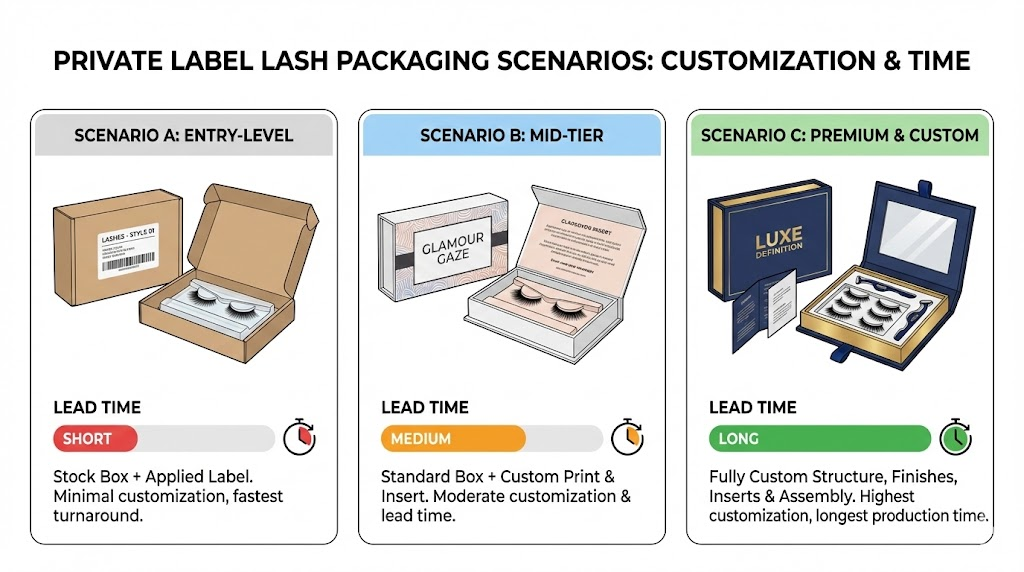
Different buyers mean different timelines. The steps are similar, but packaging complexity changes how many handoffs, proofs, supplier queues, and assembly gates you have—so your delivery window changes even if the lashes themselves are simple.
Use this as a planning model: pick the scenario that matches your packaging level, then add shipping and buffer. Ocean freight commonly ranges ~20–45 days depending on route and season, and door-to-door can take longer once you include documentation and handling steps.
Scenario timeline ranges (planning windows)
Scenario
What’s included
Where time usually goes
Best for
A) Stock packaging + custom label (fastest)
Existing box/tray style + label/sticker or minimal print
Custom box structure (dieline), special finishes (foil/emboss/spot UV), magnetic closures, multiple inserts
Dielines + sampling + multiple proofs + longer supplier lead time + higher rework risk
Premium launches, retail-ready unboxing
Planning ranges you can actually use (how to read them)
Total timeline = (Packaging work + approvals) + production/QC + transit/customs + your receiving buffer.
Your biggest swing factor is packaging: custom packaging timelines are strongly affected by sampling and artwork revisions (each round adds waiting time), and some approvals (like certification logo usage) can add about a week by themselves.
Use the “range” approach below:
Scenario A (stock + label): packaging steps are short and predictable; most variance comes from approval speed + shipping choice.
Scenario B (semi-custom): expect more variance from print proofs + insert availability.
Scenario C (fully custom): expect the most variance from dielines/samples, supplier queue, and any packaging rework/reprint.
Shipping adds a separate clock (don’t mix it into “lead time”)
Once you dispatch, shipping time depends on method:
Express parcels (when applicable) can be “a few business days” for many lanes; carrier tables quote typical transit times in working days and note extra time for remote areas and other conditions.
Air courier/air services (common for time-sensitive shipments) are often in the “days” range; for example, UPS Worldwide Expedited is marketed as 2–5 business days (service dependent).
Ocean freight often plans in weeks, with typical global ranges commonly stated around 20–45 days (before adding door-to-door steps).
Citable statement: If you need to buy back a week, reduce approval rounds and packaging complexity first—those two steps usually create more delay than lash-making itself.
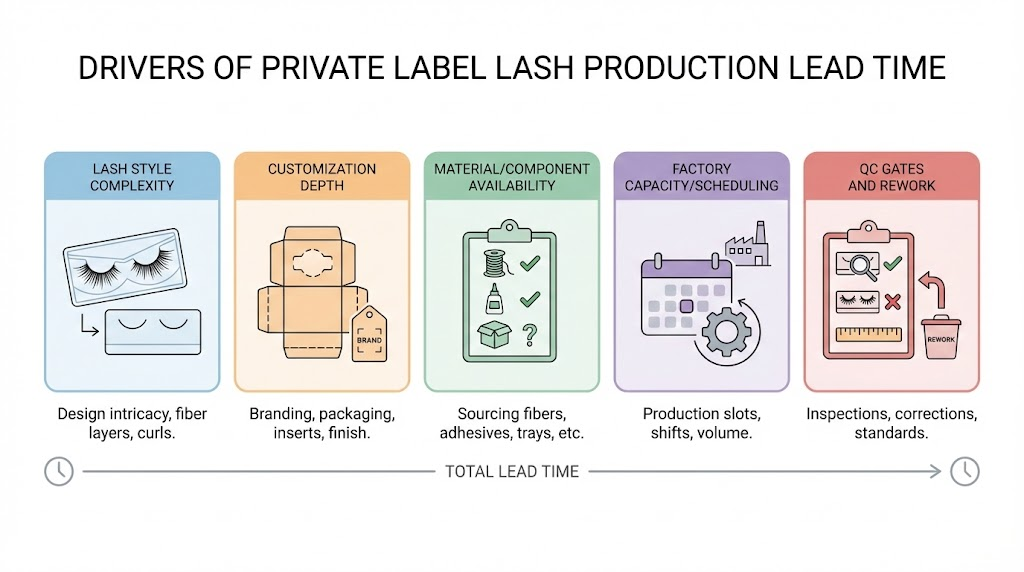
1) Lash style complexity (fiber, curl, mapping, special effects)
Direct answer: The more complex the design and tolerances, the more checkpoints and consistency controls you need—so production time and rework risk go up.
Some designs naturally take longer to produce consistently, especially when you combine:
multiple lengths in one tray with strict symmetry requirements
tighter curl tolerances (curl consistency checks become more frequent)
Factory insight (info gain): On our QC line, curl retention consistency is one of the first things we verify across batches—small variance can change the look dramatically on the eye, so tighter specs mean more checkpoints.
2) Customization depth (the “MOQ vs customization” tradeoff)
Low MOQ is great for testing new SKUs—but heavy customization at low volumes can be slower because setup time doesn’t shrink much:
custom box structures require dielines and proof cycles
special finishes (foil, emboss, spot UV) add supplier steps
mixed SKUs increase line changeovers
We often recommend starting with a semi-custom approach for faster launches: custom label + standard box, then upgrade packaging once your best-sellers are clear.
3) Material availability (it’s not just lash fiber)
Direct answer: final assembly often waits on one small component (inserts/magnets/trays), not lash fiber.
Even when fiber is ready, small items can bottleneck:
trays and tray sleeves
glue dots / holding adhesives
inserts (cards, care guides)
magnets (for magnetic closure boxes)
printing paper stock
Factory insight (info gain): Packaging delays are frequently caused by one missing component (like inserts) that prevents final assembly, even if lash trays are finished.
4) Capacity and scheduling (especially during peak months)
Direct answer: peak months constrain line capacity; confirmed specs/deposit get scheduled first.
Factories schedule by:
confirmed orders (approved specs + deposit)
complexity and labor time
production line availability
If you’re ordering around high-demand periods, you can reduce risk by locking specs earlier and keeping the first run simpler.
5) QC standard and rework rate (the quality-protecting “buffer”)
QC isn’t a checkbox—it’s a set of inspections that catch:
length/curl deviation
lash direction inconsistency
shedding or weak bonding
tray alignment issues
packaging scuffs, print misregistration
Factory insight (info gain): Strong QC reduces returns and brand damage, but it can add time if we detect issues that require rework—especially on custom packaging where reprinting may be necessary.
What Affects Shipping and Final Delivery Dates?
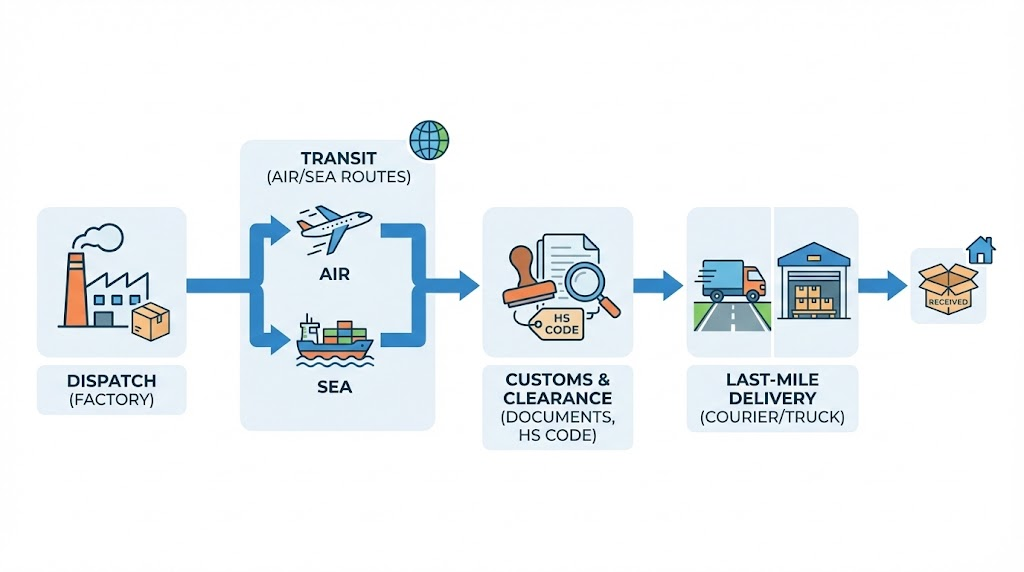
Direct answer: After cartons leave the factory, delivery dates are mainly driven by (1) shipping method + routing, (2) who is responsible for freight and clearance under your Incoterms, and (3) customs readiness (document accuracy and classification).
Customs may not release goods until required entry documents (like a compliant commercial invoice) are provided, so small paperwork errors can create real delays even when transport is fast.
Delivery date = Dispatch (ship-out) date + Transit time + Customs/clearance time + Last-mile delivery.
Citable takeaway: Treat transit and customs release as separate timeline risks—speeding up transport doesn’t fix missing/incorrect documents.
1) Shipping method and routing (speed vs reliability vs cost)
In general:
Express courier / air = fastest, usually best for launch-critical SKUs, but higher cost.
Ocean (sea freight) = economical for larger volumes, but slower and more exposed to schedule changes, port congestion, and transshipment delays.
Multimodal (air + local courier, ocean + truck/rail) varies by country and route complexity (each handoff adds variability).
Routing details that change your ETA (even with the same “air” or “sea” label):
Direct vs transshipment (extra handoffs increase variability)
Port pair / airport pair choice (some lanes clog more often)
Consolidation timing (waiting to build a consolidated load can shift departure dates)
Citable takeaway: “Air vs sea” is only half the answer—routing and handoffs often explain why two “air shipments” arrive days apart.
2) Incoterms and responsibility (who books freight, who clears customs, who provides which documents)
Incoterms® 2020 are standardized trade terms that clarify who is responsible for arranging carriage, handling export/import clearance responsibilities, and allocating costs/risks across the shipment journey.
Why this matters for delivery dates:
If you control freight (e.g., using your forwarder), you may gain cost control—but you also own the coordination risk: booking timing, document handoff, and clearance readiness.
If the seller controls more of the movement (depending on the term), you may reduce coordination work—but still need to supply accurate consignee/tax details and confirm what “delivered” actually means for your address.
Practical operator tip: Put the Incoterm and named place in writing (example: “DAP Los Angeles, CA” or “DDP [your full address]”). That single line prevents most “I thought you handled customs” surprises.
3) Customs and documentation quality (the #1 avoidable delay after ship-out)
Customs delays are often document-driven, not product-driven. In the U.S., for example, the commercial invoice must be furnished with entry and before release is authorized, and it must include essentials like adequate description, quantities, and values. More broadly, a commercial invoice is a core document used by customs to assess duties/taxes and clear goods.
Common clearance delay triggers (and what to do instead):
Inconsistent consignee details → keep name/address/phone/tax ID consistent across invoice, packing list, and shipping label.
Vague product descriptions → use a clear description (what it is + material + use), not just “cosmetics” or “lashes.”
HS code mismatches → HS is a global product classification system developed by the World Customs Organization; misclassification can trigger queries/holds.
Incomplete invoice/packing list → confirm quantities, unit values, totals, and carton counts match exactly.
Destination-specific compliance → some markets require extra statements/labels; confirm with your broker/forwarder before dispatch.
Citable takeaway: Customs release is often gated by invoice quality + correct classification—a shipment can arrive physically “on time” and still miss your launch if clearance documents are incomplete or inconsistent.
4) Seasonal logistics and disruption risk (holidays, major sale events, congestion)
Even if production is on schedule, logistics networks can slow down due to:
Peak season capacity constraints (carriers add aircraft, add shifts, or apply peak surcharges to manage spikes).
Port congestion and knock-on delays that disrupt sailing schedules and container availability; international reporting highlights port congestion as a recurring driver of volatility.
Citable takeaway: During peak periods, delivery risk increases from both capacity limits (air networks) and congestion/schedule volatility (ocean networks)—build buffer time if your launch date is fixed.
How to Lock In Reliable Dates (without stressful last-minute rushing)
Direct answer:
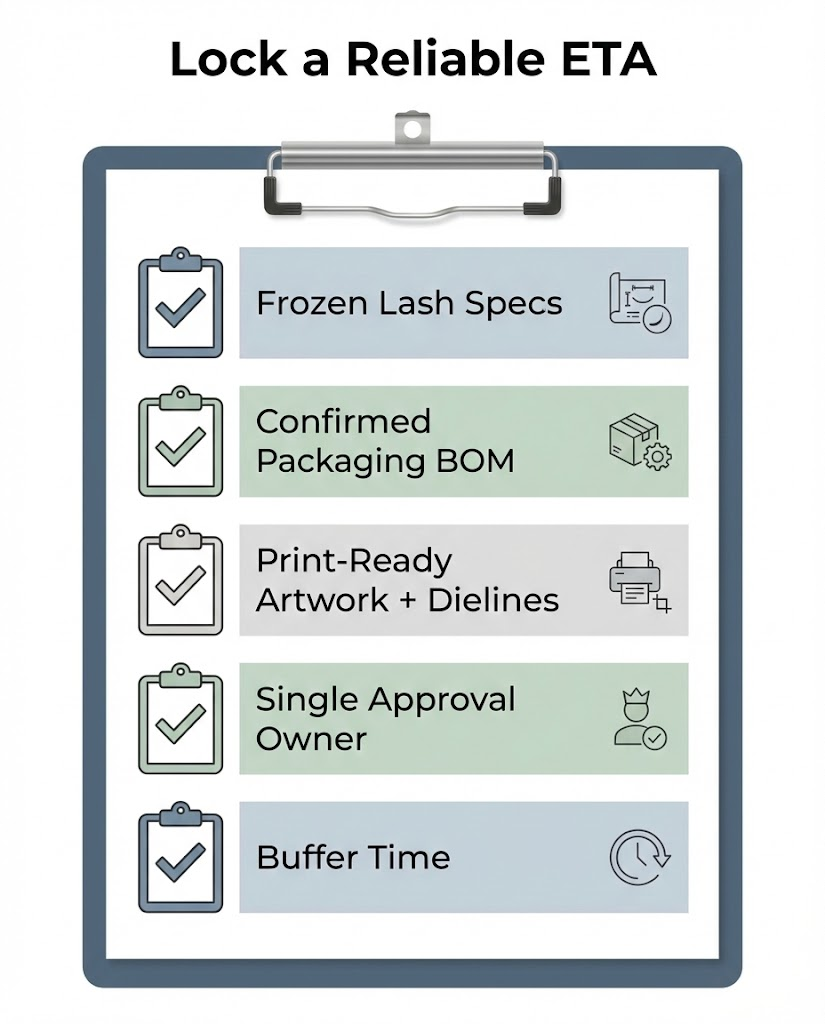
A reliable private-label lash ETA comes from frozen specs + confirmed packaging BOM + print-ready artwork (incl. dielines) + one approval owner, plus a time buffer for receiving and fulfillment. If any of those inputs are still moving, your ship date is still a draft.
The 5 inputs that make an ETA “real” (in order)
Frozen lash specs (spec sheet)
Lock curl/length/diameter, mapping, tray count, band style, and tolerance notes into one spec sheet.
Why it matters: professional production systems treat midstream changes as controlled events (they must be reviewed/controlled and documented), so “small tweaks” often create real rescheduling and rework.
Confirmed packaging BOM (Bill of Materials)
List every component needed for final assembly: tray, sleeve, box, insert/care card, label, shrink, carton, barcode sticker, magnets (if any), etc.
Definition of done: every part has a confirmed material, quantity, and supplier status (in stock / ordered / on proof / in transit).
Print-ready artwork (designed to print, not just to view)
Ask for PDF/X export for print handoff where possible; PDF/X standards are explicitly intended for a complete, print-ready exchange of CMYK printing data.
Include bleed and printer’s marks (or whatever your printer requests). Bleed is specifically meant to protect trimming accuracy.
If you’re using PDF/X workflows, define/confirm the output intent / CMYK target to reduce color surprises.
If you print barcodes on packaging: reserve quiet zones and don’t arbitrarily resize barcode art (recreate it at the correct size).
One approval owner (and one backup)
Assign a single “final yes” approver for lash specs + packaging proofs so approvals don’t stall in multi-stakeholder loops. Clear roles/authorities are a core requirement in formal quality systems because ambiguity slows execution.
Buffer time (schedule margin) for your side
Put an explicit buffer between expected arrival and launch date (receiving, relabeling, kitting, inbound QA, fulfillment prep).
This is standard schedule risk practice: credible schedules include contingency/margin managed transparently, not “hidden” inside optimistic task durations.
Packaging layout check: label placement, logo clear space, ingredient/claims text, batch/lot area
Barcode check: quiet zones preserved; barcode not stretched/resized; scan test on a printed sample
Print readiness: bleed present; dieline version matches; fonts handled per printer requirements; output intent/CMYK target confirmed
C. Send truly print-ready files
Provide files that match the final dieline (not “close enough”).
If your printer asks for it, use PDF/X for a single, print-ready exchange format.
D. Stop changes once production starts
Treat any mid-production change as a formal change request (new proof cycle / rework risk / rescheduling). Controlled change is a real thing in production systems for a reason.
E. Add a launch buffer you won’t regret
Keep buffer visible (don’t bury it). Credible schedules track contingency explicitly and manage it as risk protection.
What we do on our side (factory best-practice production controls)
Confirm documented spec sheet + packaging BOM before scheduling the line (this becomes the baseline).
In-process QC gates before packing/assembly to catch drift early.
Final QC + release authorization (appearance, count, carton integrity) with evidence of conformity and authorized release.
Fast-Track Options (and the tradeoffs to know)
When you need a tighter deadline, the fastest “factory-safe” gains usually come from reducing packaging steps, reducing changeovers, and choosing a faster transport mode—not from skipping quality controls.
Fast-track lever #1: Use stock packaging + custom label (fastest launch path)
Why it works: You remove multiple packaging sub-steps (dielines, proof cycles, print queues, assembly dependencies).
Best for: First launches, MOQ tests, quick restocks.
Tradeoff: Less premium “shelf feel” than fully custom box structures/finishes.
Do it safely
Lock your label size + placement early (so packing doesn’t pause).
Reserve a clean barcode area (see troubleshooting section).
Fast-track lever #2: Limit SKU count in the first run (reduce changeovers)
Why it works: In high-mix production, each additional SKU tends to increase setup/changeover and QC complexity. Lean manufacturing literature (e.g., SMED) exists specifically because changeovers are a major time sink in multi-variant production environments.
Best for: Launching a hero set + 1–2 supporting styles.
Tradeoff: Less variety on day one.
Do it safely
Group similar specs together (same curl/diameter/band type) to reduce line switching.
Add variants later once your best-sellers are clear.
Fast-track lever #3: Choose simpler packaging finishes (avoid supplier queues)
Why it works: Specialty finishes (foil/emboss/spot UV/magnets) typically add supplier steps + proof risk.
Best for: Brands that care more about launch date than premium unboxing in the first run.
Tradeoff: Simpler branding presentation.
Do it safely
Treat finishes as “Phase 2.” Launch with clean print + upgrade later.
Fast-track lever #4: Split-shipment strategy (air best-sellers first, sea the rest)
Why it works: Air vs ocean choices can change arrival windows dramatically, and splitting lets you protect the launch date for your hero SKUs.
Best for: Launches with a hard date; large assortments.
Tradeoff: Two inbound receipts, two tracking workflows, and more coordination.
Do it safely
Confirm Incoterms and who is responsible for booking, documents, and clearance. Incoterms are published by the ICC and are used to define responsibilities/costs/risks in international trade contracts.
Make sure your documents are consistent across both shipments (same consignee details, product descriptions, and classification logic).
Citable statement (rush planning): The quickest safe rush strategy is usually simplify packaging + split shipment (air best-sellers first), rather than trying to skip QC steps. (Skipping QC increases defect risk and often backfires via rework/returns.)
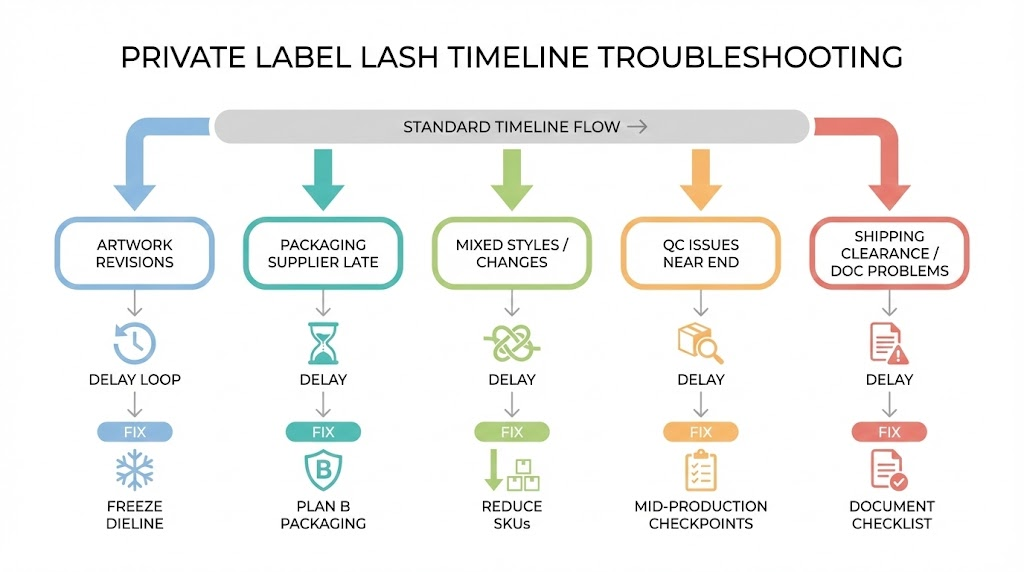
Common Delay Scenarios (Troubleshooting) and How We Fix Them
1) Delay: Artwork revisions keep looping
Typical root causes
Dieline isn’t frozen (design keeps shifting with structure).
Freeze the dieline first, then iterate design within the dieline.
Assign one decision owner + one backup (single-thread approvals).
Use a proof checklist:
logo position, barcode/quiet zone area, batch/lot code area, legal text, color expectations
Prevention
Submit print-ready files (CMYK, correct export settings) to reduce back-and-forth; Adobe itself emphasizes exporting print-ready PDFs with CMYK profiles for accurate printing.
Citable statement (artwork): Most packaging timeline “mystery delays” are approval-loop delays—each proof round adds waiting time even if the factory is ready to proceed. (A single decision owner + print-ready files reduces rounds.)
2) Delay: Packaging supplier is late
Typical root causes
One missing component blocks final assembly (insert card, magnet, tray sleeve).
Specialty finish queue or reprint due to proof mismatch.
Factory-side fix
Activate a pre-approved Plan B (simpler box + label) to keep assembly moving.
Switch to stock components where possible (standard trays/inserts).
Prevention
Confirm packaging BOM availability before you publish a launch date.
Reduce SKUs per batch; sequence similar specs together.
Lock a “v1 spec sheet” and treat changes as “v2.”
Why this is credible
Changeover reduction is a documented efficiency objective in SMED/lean manufacturing research because changeovers add time and interrupt flow in multi-variant production.
Quality control is the inspection/verification part of quality management—meant to confirm requirements are met, not an optional “extra.”
Acceptance sampling standards (e.g., ANSI/ASQ Z1.4) are explicitly designed for inspecting incoming/in-process/final product lots against acceptance criteria—highlighting that structured QC is normal practice for protecting outcomes.
Citable statement (quality): If you “rush” by removing QC gates, you often trade a short-term timeline win for defects, rework, and reprints, which can delay delivery even more.
Consignee details inconsistent across invoice/packing list.
Product description too vague for customs.
HS code mismatch or missing classification detail.
Missing destination-specific identifiers (e.g., tax ID where required).
Factory-side fix
Re-check invoice + packing list for consistency (consignee, address, phone, item descriptions, quantities, values).
Confirm HS classification logic with your broker/forwarder. The HS is the global nomenclature developed by the World Customs Organization (WCO).
What “good” looks like (US example, citable)
U.S. CBP notes that commercial invoices (or acceptable documentation) should include: adequate description, quantities, values, and the appropriate HTSUS 8-digit subheading.
The U.S. International Trade Administration explains the commercial invoice is a required document used by customs to assess duties/taxes during clearance.
Citable statement (customs): Clearance delays are commonly caused by incomplete or inconsistent documentation; a properly prepared commercial invoice is central to customs assessing duties/taxes and clearing the shipment.
Quick Checklist: How to Get a Realistic ETA You Can Trust
Destination details verified (consignee, address, phone, tax ID if needed)
Buffer time planned for receiving + local fulfillment
Key Points
Delivery dates depend on production + transit + customs, not one single number.
Custom packaging is the most common reason timelines extend.
Approvals can quietly add days or weeks—streamline decision-making.
Material availability includes small components (inserts, magnets, trays), not just fiber.
QC protects your brand; rework is a real (and sometimes necessary) time factor.
Shipping method changes delivery more than most people expect.
The fastest safe rush path is simplified packaging + partial air shipment.
A reliable ETA needs a confirmed spec sheet, packaging BOM, and finalized artwork.
Conclusion
If you’re planning a launch, the safest way to protect your delivery date is to run timeline planning like a mini project: freeze specs early, keep approval loops tight, and match packaging ambition to your schedule.
Most missed launch windows come from predictable causes—packaging proof cycles, missing components, peak capacity, QC rework, and avoidable paperwork errors (especially around shipment responsibilities and customs documentation).
Incoterms clarify who is responsible for which freight steps, and accurate HS classification plus complete invoice fields reduces clearance risk.
Ready to launch? Share (1) your target launch date and (2) your customization level (Stock / Semi-custom / Fully custom packaging) and we will map a realistic dispatch window + transit/customs window plus the safest acceleration levers (simplify packaging + split shipment) while keeping all brand-protecting QC gates in place.
At LashVee, we help lash brands and professional buyers avoid common sourcing mistakes—from inconsistent curl and fiber quality to unstable band bonding in mass production. Our work focuses on translating design intent into repeatable, production-ready lash styles.
If you’re evaluating suppliers, refining a lash design, or planning a private label order, we’re happy to share practical input or provide samples to support your decision.
At LashVee, we help lash brands and professional buyers avoid common sourcing mistakes—from inconsistent curl and fiber quality to unstable band bonding in mass production. Our work focuses on translating design intent into repeatable, production-ready lash styles.
If you’re evaluating suppliers, refining a lash design, or planning a private label order, we’re happy to share practical input or provide samples to support your decision.