
Buying lashes by “0.05” or “0.15” sounds simple, but wrong thickness choices cause poor retention, weak fans, or natural lash stress. This guide turns numbers into safe, repeatable selection rules.
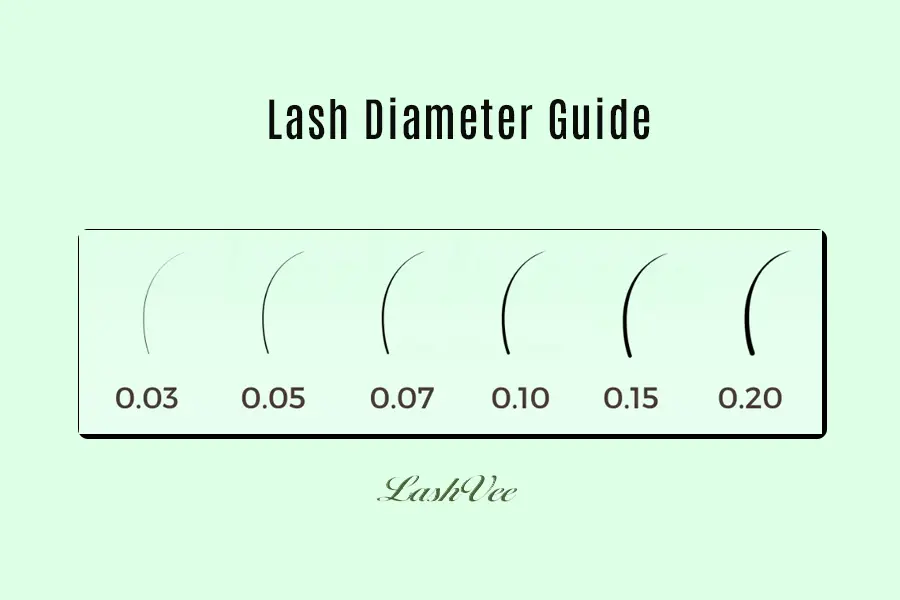
Eyelash extension thickness is the fiber diameter in millimetres (mm). Thinner diameters (0.03–0.07) reduce weight for volume fans and weaker natural lashes, while thicker diameters (0.10–0.20+) add visible definition for classic sets but increase load and require stricter lash health screening.
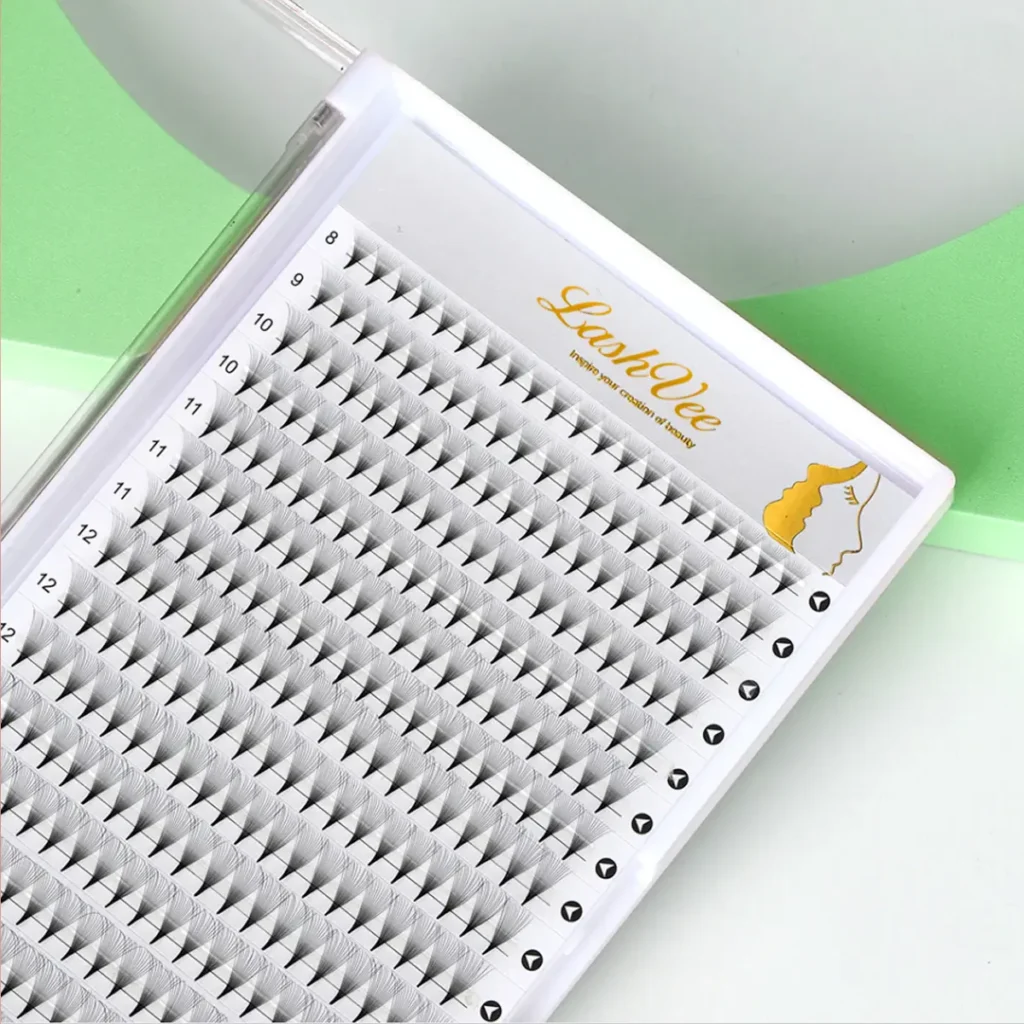
Thickness affects more than “look.” In factory production, diameter controls fibre stiffness, strip behaviour, fan stability, and how consistent a style stays across batches. For buyers, thickness also changes complaint rates, refill intervals, and the risk profile of a lash line.
What does “thickness (mm)” actually mean for lash performance?
A lot of buyers treat thickness as a visual choice only. That mistake leads to mismatched products: too stiff for fans, too heavy for fragile lashes, or too light to hold a crisp classic line. The solution is to link thickness to weight, stiffness, and set type.
Thickness is the fibre diameter, typically declared in mm (e.g., 0.05 mm). As thickness increases, the lash becomes stiffer and heavier per strand. Thin fibres create light, flexible fans; thicker fibres create bold, defined single-lash lines but require healthy natural lashes and correct isolation.
From a manufacturing view, “thickness” is not just a number printed on a box. It is a dimensional spec that depends on filament extrusion stability, drawing ratios, and post-processing tension control. Lash fibres are usually made from thermoplastic filaments (commonly PBT-based in the industry). If extrusion conditions drift, the fibre diameter can fluctuate. That fluctuation shows up downstream as inconsistent stiffness and different pickup behaviour on the strip. A lash that is “nominally 0.05” but varies across the spool can behave like mixed diameters, which makes fan building less predictable and increases training time for technicians.
In production, we control thickness by managing filament die conditions, cooling, and draw speed, then checking diameter with calibrated measurement tools. Buyers often assume that “0.05” is interchangeable across suppliers. It is not. Two fibres with the same measured diameter can still feel different because of polymer formulation, fibre cross-section, surface finish, and curl-setting temperature. That is why “0.05 from Supplier A” can fan cleanly while “0.05 from Supplier B” collapses or twists.
Here is a practical way I translate thickness to performance for evaluation:
- Thinner fibres (0.03–0.07): more flexible, lower load per strand, better for multi-lash applications and weak natural lashes. More sensitive to strip tack and humidity during use.
- Mid fibres (0.10–0.12): balanced stiffness and visibility. Often used for classic sets where the client wants definition without heavy weight.
- Thicker fibres (0.15–0.20+): strong definition and darker appearance per strand. Higher load and higher risk if lash health screening is weak or if mapping creates long lever arms.
For supplier evaluation, I recommend buyers request:
1) a diameter tolerance statement (not just one value),
2) batch-to-batch samples (at least 3 lots), and
3) a simple handling test: same tweezers, same adhesive, same humidity, compare pickup, curl memory, and visible thickness consistency.
A manufacturer-led approach reduces long-term risk because it ties product claims to process controls. Trend-driven suppliers can change fibre sources or settings quickly without updating specs, which is where inconsistency starts.
How do I choose the right thickness for Classic lash extensions?
Classic sets fail when the lash is too heavy or too stiff for the client’s natural lashes. That leads to premature shedding complaints, twisted classics, and a harsh base line. The solution is to match classic thickness to lash health and the desired definition.
For classic sets, common thicknesses are 0.10, 0.12, and 0.15 mm. Choose 0.10 for finer natural lashes and softer definition, 0.12 for an average lash line and balanced look, and 0.15 only for strong natural lashes when a bold, crisp line is required.
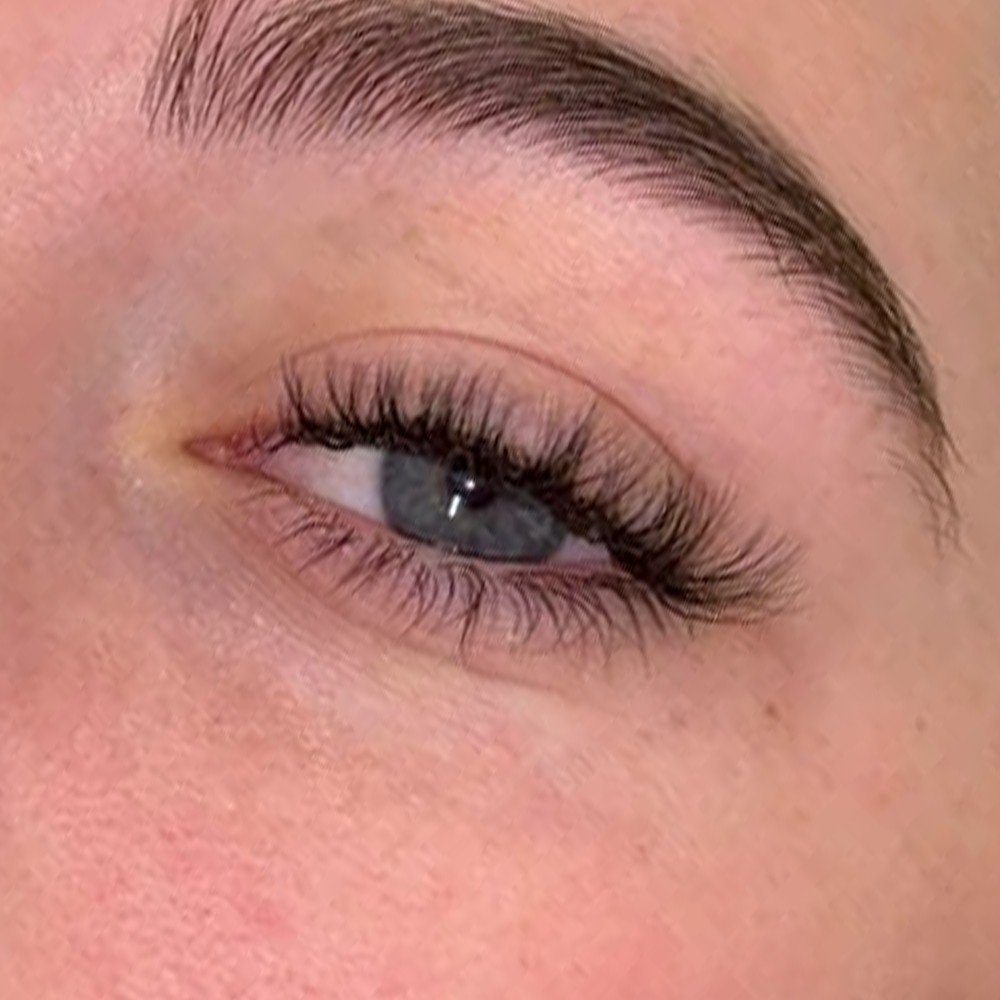
Thickness-by-Thickness Explanation for Classic Work
Below is how I explain each classic-relevant thickness in production and in salon performance terms. I use “classic” here as one extension to one natural lash.
0.10 mm (Soft Classic)
- What it looks like: defined but not heavy; good for “clean mascara” effect.
- Who it fits: fine-to-average natural lashes; clients who want comfort and a softer lash line.
- How it behaves: more flexible; can hide minor isolation imperfections better than thicker fibres.
- Common buyer mistake: assuming it is “too light” for retail. In reality, it reduces weight complaints and improves wear consistency for a wide client base.
0.12 mm (Standard Classic)
- What it looks like: noticeable definition; still natural-looking on many clients.
- Who it fits: average natural lashes; studios that want one reliable diameter for most classic bookings.
- How it behaves: stable pickup and placement; good balance of stiffness and control.
- Common buyer mistake: not separating 0.12 from “0.10/0.15 mixed” ranges in catalogues. Mixing reduces mapping control.
0.15 mm (Bold Classic)
- What it looks like: strong, dark line; more dramatic “mascara” density.
- Who it fits: strong natural lashes only; clients who prefer bold definition with fewer fibres.
- How it behaves: stiffer; placement must be precise to avoid twisting or directional inconsistencies.
- Common buyer mistake: using 0.15 as a default classic diameter. This increases overload risk on clients with finer lashes.
0.18–0.20 mm (Heavy Classic / Special Use)
- What it looks like: very bold, often too heavy for many clients.
- Who it fits: limited cases with strong natural lashes and conservative lengths.
- How it behaves: high stiffness; directional errors become obvious; can feel less comfortable.
- Common buyer mistake: selling these as “universal classics.” They are not universal, and they increase negative feedback if used without strict screening.
For classic diameters, consistency matters because clients notice uneven darkness along the lash line. If one tray’s 0.12 looks closer to 0.10, the finished set looks patchy. In production, we treat classic diameters as a high-visibility spec. I advise buyers to test three things:
1) Visual consistency across lengths: darker appearance should not change significantly from 9 mm to 13 mm at the same diameter.
2) Stiffness consistency: if fibres are overcooked during curl setting, the lash can become brittle and feel thicker than it is.
3) Strip release: classic placement speed depends on clean pickup. If the strip tack is inconsistent, technicians blame “thickness,” but the root cause is strip formulation.
When choosing a manufacturer, I look for process transparency: stated diameter tolerances, in-process QC records, and stable raw material sourcing. These controls reduce long-term returns and make reorders predictable.
Which thickness is best for Volume and Mega Volume fans?
Volume sets can look airy or dense, but the risk is always weight. Buyers often chase “darker” volume by increasing thickness, then get retention complaints or lash stress issues. The solution is to build density by fan design, not by heavy fibres.
For volume fans, typical thicknesses are 0.03, 0.05, and 0.07 mm. Use 0.03 for mega volume and very soft fans, 0.05 for most 3D–8D volume work, and 0.07 for lower-density volume (2D–4D) when the client has strong natural lashes and wants more definition.
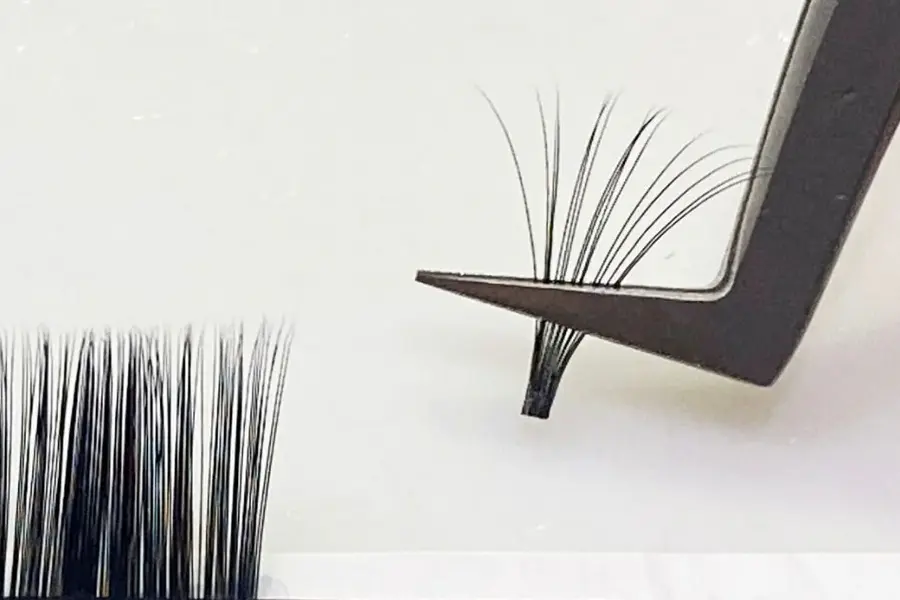
Thickness-by-Thickness Explanation for Volume Work
0.03 mm (Mega Volume / Ultra-Soft Texture)
- What it looks like: fluffy, light, high “fibre count” density without a heavy base.
- Best use: 8D–16D (or higher) fans, soft “cloud” volume, clients with finer natural lashes when lengths are controlled.
- Handling notes: fans can be extremely delicate. Strip tack and fibre finish matter more at 0.03. If the fibre has static issues, fans can close or cling.
- Buyer risk: inconsistent diameter makes fan symmetry impossible. A “0.03” that varies upward behaves like mixed fibres and increases rejected fans.
0.05 mm (Mainstream Volume Standard)
- What it looks like: balanced density and definition; versatile across many styling systems.
- Best use: 3D–8D fans, wet-look spikes (depending on technique), and most salon volume menus.
- Handling notes: stable fan base when fibre finish and strip tack are correct. Works well for both handmade fans and many pre-made/pro-made fan products.
- Buyer risk: confusing “0.05 for volume” with “0.05 for wet-look.” Wet-look needs controlled fan closure and strip design, not just thickness.
0.07 mm (Dense, Defined Volume / Hybrid-Friendly)
- What it looks like: more visible lines in each fan; can read darker at lower D.
- Best use: 2D–4D fans, hybrid sets where fans need to match classic definition, clients with stronger natural lashes.
- Handling notes: stiffer. If the fan base is too wide, it will sit higher and reduce retention. Lash artists need clean bases.
- Buyer risk: using high D with 0.07 to create “mega volume.” That increases load quickly and creates a higher complaint rate.
How manufacturing choices change fan behaviour
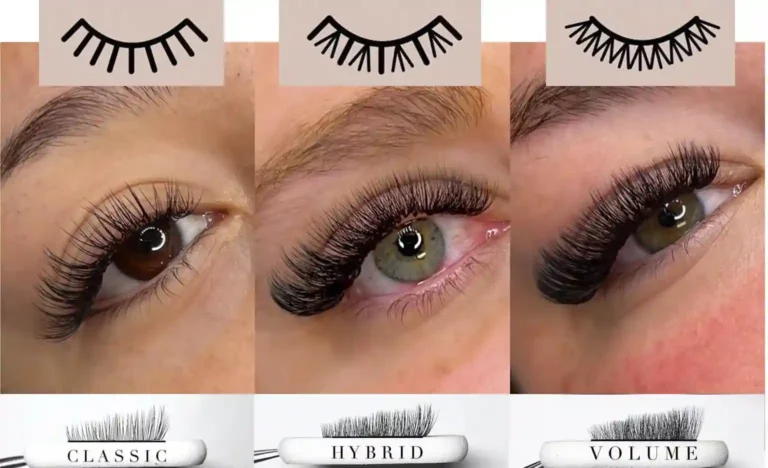
At thin diameters, minor process differences become major user experience differences. Fibre surface friction, static control, and curl-set uniformity determine whether a fan opens smoothly or fights the tweezer. Pre-made and pro-made fans add another layer: the bonding point. If the bonding is too bulky, it negates the benefit of thin fibres because the base becomes heavy and rigid.
For buyer evaluation, I recommend requesting:
- Fan base thickness samples (macro photos or physical sample),
- bonding-point weight and stiffness checks (does the base feel “hard”), and
- curl retention tests after storage under moderate heat for a short period (to simulate shipping and warehouse conditions).
Supplier selection matters here because volume products are sensitive to small process drift. A manufacturer-led supplier will document fibre lots, control fan bonding, and maintain repeatable strip tack. Trend-driven suppliers often change bonding chemistry or fibre lots to chase cost, which shows up as sudden “this tray fans differently” complaints.
What does each thickness (0.03–0.20+) mean in real sourcing terms?
Many catalogues list thickness options but do not explain what each one is for. That makes buyers overstock slow movers and miss the thicknesses studios reorder monthly. The solution is to connect each thickness to the set type, training level, and risk profile.
Each thickness corresponds to a predictable use range: 0.03–0.07 for volume, 0.10–0.15 for classic, and 0.18–0.20+ for limited heavy classic use. The “best” thickness depends on natural lash strength, desired definition, and the fan density or single-lash style being sold.
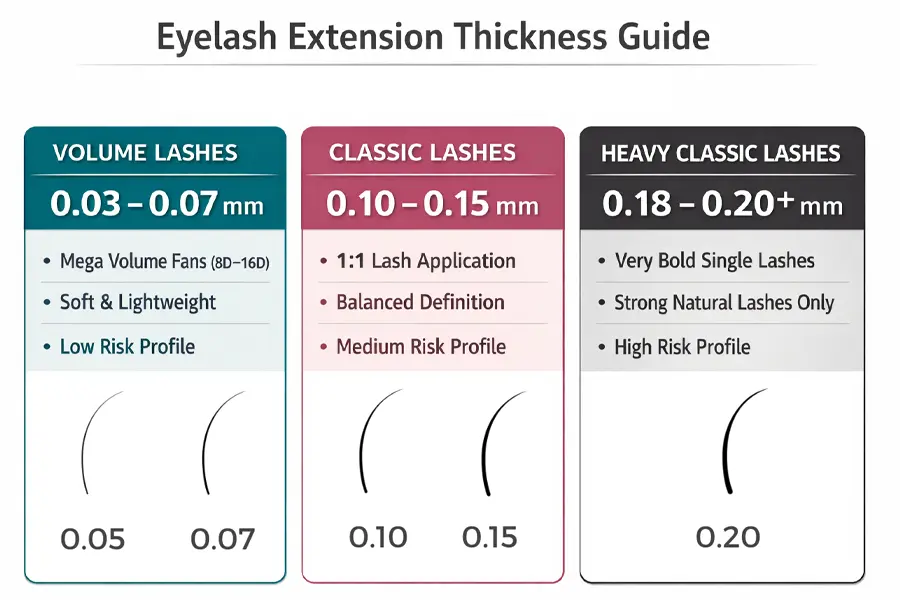
Quick Comparison Table
| Thickness (mm) | Typical Use | Visual Result | Handling Difficulty | Risk Profile |
|---|---|---|---|---|
| 0.03 | Mega volume fans | Ultra-soft, fluffy | Higher | Low per strand; higher process sensitivity |
| 0.05 | Volume fans / pro-made fans | Balanced, adaptable | Medium | Controlled if D and length are managed |
| 0.07 | Light volume / hybrid | More definition | Medium | Increases quickly with higher D |
| 0.10 | Soft classic | Clean, natural definition | Low | Low-to-medium, good default classic option |
| 0.12 | Standard classic | Noticeable definition | Low | Medium, depends on length and lash health |
| 0.15 | Bold classic | Dark lash line | Medium | Higher; requires strong natural lashes |
| 0.18–0.20+ | Heavy classic | Very bold | Medium | High; limited use cases |
Why buyers get thickness wrong in product planning
In B2B supply, thickness is a merchandising decision, not only a technical spec. If a distributor pushes 0.15 as “standard classic,” returns increase because most client bases include many fine natural lashes. If a brand only offers 0.03 and 0.05, classic-focused studios will not reorder because they need 0.10/0.12 as daily-use SKUs.
From a factory perspective, I plan thickness offerings by reorder logic:
- Fast reorders: 0.05, 0.07, 0.10, 0.12 (broad use).
- Specialised reorders: 0.03 (mega volume focused), 0.15 (bold classic focused).
- Limited distribution: 0.18–0.20+ (only where training and screening are strong).
For supplier evaluation, I recommend checking whether a manufacturer can keep the same “feel” for a thickness across time. That requires fibre material control, stable curl-setting processes, and repeatable strip adhesive. A manufacturer-led supplier will share QC checkpoints and can explain why a thickness behaves the way it does. That transparency is what protects a brand’s consistency over multiple seasons.
How can buyers verify thickness consistency and avoid “wrong diameter” batches?
When thickness is inconsistent, lash artists blame themselves first. Then they blame the adhesive. In reality, inconsistent diameter and stiffness drive most “this tray is different” complaints. The solution is to test thickness like a production spec, not like a marketing label.
To verify thickness consistency, buyers should test multiple trays from different lots, compare handling and visible definition at the same curl/length, and request documented tolerances from the manufacturer. The most reliable suppliers control fibre lots, measure diameter in-process, and keep strip tack and curl-setting stable.
Practical QC steps I use (and recommend to buyers)
1) Lot sampling: do not approve a thickness based on one tray. Request at least three production lots.
2) Controlled comparison: same curl, same length, same tweezer, same environment. Record pickup feel and fan stability.
3) Visual density check: compare finished practice sets under the same lighting. Inconsistent diameter shows up as uneven darkness.
4) Curl memory check: after several bends during handling, does the fibre spring back consistently?
5) Strip behaviour: if two “0.05” trays fan differently, the cause can be strip tack or fibre finish, not only diameter.
What truly matters when choosing an eyelash manufacturer
Thickness problems are rarely isolated. They usually come with other drift: curl inconsistency, strip changes, or packaging substitutions that affect humidity exposure in transit. That is why supplier selection is a risk management decision.
I prioritise:
- Process transparency: documented controls for fibre lots, curl-setting, and strip application.
- Measurable standards: tolerance ranges, not just a nominal mm value.
- Change control: the supplier should not substitute fibre sources or strip adhesives without notice.
- Traceability: lot codes that link trays to production records.
A manufacturer-led approach reduces long-term risk because it ties product claims to production controls. It also makes it easier to scale a lash line across multiple regions without “mystery changes” that disrupt reorders.
Conclusion
Thickness is a diameter spec that directly affects weight, stiffness, fan behaviour, and consistency across batches. I select 0.03–0.07 for volume based on desired D and softness, and 0.10–0.15 for classic based on natural lash strength and definition goals. For reliable B2B supply, thickness must be controlled as a production spec with tolerances, lot testing, and stable processes, not treated as a label.
FAQ About Eylash Extension Thickess
What do lash thickness numbers (0.03, 0.05, 0.07, 0.15) mean?
They are the fiber diameter in millimetres (mm). Smaller numbers are finer/lighter; larger numbers are thicker/heavier and usually look bolder per lash.
What’s the difference between 0.03 vs 0.05 vs 0.07 for volume?
In general: 0.03 = ultra-fine for mega volume; 0.05 = common “full volume” balance; 0.07 = often used for lighter volume/hybrid because it’s stiffer and heavier per strand.
Which thickness is best for classic lash extensions: 0.10, 0.12, or 0.15?
Most guidance groups 0.10–0.15 mm as classic-friendly diameters. 0.10 is softer/lighter, 0.12 is a common middle choice, and 0.15 is bolder and typically needs stronger natural lashes.
Can I mix different thicknesses in one set (or one tray lineup)?
Yes. Artists commonly mix diameters (for example, blending volume diameters for texture, or mixing classic + light volume in hybrid sets) as long as the lash health and total load are managed.
Are 0.18–0.20+ lashes safe, and who should use them?
Many diameter guides position 0.18–0.20 mm as thick/heavy classic options and recommend them only for clients with strong natural lashes, because load rises quickly with thickness and length.
References
- International Organization for Standardization. (2007). ISO 22716:2007 Cosmetics — Good Manufacturing Practices (GMP) — Guidelines on Good Manufacturing Practices. https://www.iso.org/standard/36437.html
- European Parliament & Council of the European Union. (2009). Regulation (EC) No 1223/2009 on cosmetic products. EUR-Lex. https://eur-lex.europa.eu/legal-content/EN/TXT/?uri=CELEX:32009R1223
- Milady. (2019). Milady Standard Esthetics: Fundamentals (12th ed.). Cengage Learning. https://www.cengage.com/c/milady-standard-esthetics-fundamentals-12e-milady/
- Celanese. (n.d.). PBT (Polybutylene terephthalate) product information and technical resources (Celanex® PBT). https://www.celanese.com/
- Occupational Safety and Health Administration. (n.d.). Hazard Communication Standard (29 CFR 1910.1200). https://www.osha.gov/hazcom