
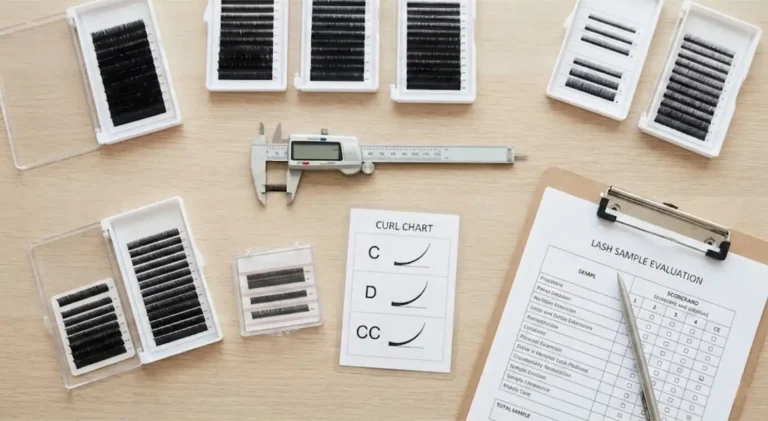
A practical, step-by-step way to request samples, test them consistently, and choose a supplier you can scale with.
Introduction
When buyers tell us “the photos looked perfect, but the batch didn’t match,” it’s almost never bad luck—it’s usually a missing process. Sampling isn’t just “try a few trays and decide.” A real buyer-style evaluation is a repeatable checklist + clear specs + proof of consistency.
In this guide, we’ll walk through how we (as a lash manufacturer team) recommend evaluating lash samples—whether you’re a salon owner, wholesaler, brand owner, or a high-intent consumer building your go-to set. You’ll learn what to request, what to measure, what to stress-test, and how to compare suppliers fairly—especially for OEM / private label projects where long-term consistency matters. Explore our OEM and ODM services for private label projects.
In 2 minutes: The Buyer Checklist
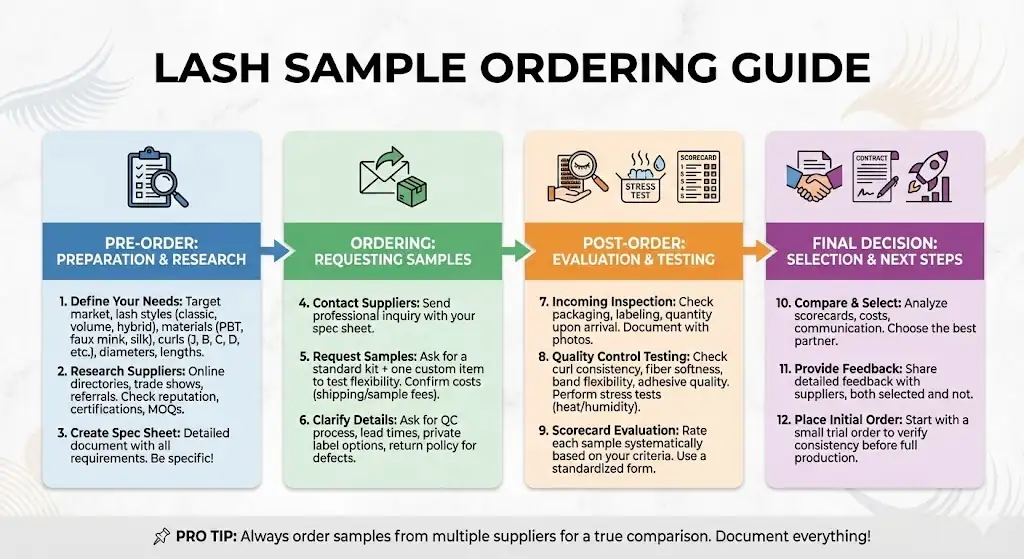
Use this exact sequence to compare suppliers fairly:
- Write a spec sheet (fiber, curl, diameter, length mix, finish, packaging + tolerances).
- Request samples like a pro: a standard set + one small customization + QC/lot/defect policy.
- Incoming inspection: labeling match, cleanliness, mixed lengths, kinks, shedding, glue/adhesive mess.
- Measure consistency: check 10 lashes per row/style for length + curl uniformity.
- Stress test durability: handling/tweezer test + heat/humidity comparison vs a control tray.
- Score each supplier using the same scorecard (accuracy, defects, handling, packaging, lead time, communication).
- Choose the supplier with repeatability (traceability + clear remake policy), not just the prettiest sample.
Who this guide is for
- Salon owners / lash artists who need consistent pickup, fan opening, and curl retention Why salons love hybrid lashes and supplier checklist
- Wholesalers / distributors who must reduce returns and batch issues Wholesale vs private label lashes: MOQ, packaging, and costs
- Brand owners (OEM/private label) who need stable production + packaging accuracy How to start your own lash brand: Step-by-step guide
- High-intent consumers who want reliable “go-to” lashes without trial-and-error
What you’ll walk away with
- A simple spec sheet structure suppliers can quote accurately
- An incoming inspection routine (unboxing → first look → photos)
- Measurement and stress tests you can repeat across suppliers
- A scorecard to decide on facts, not vibes
- A checklist of supplier green flags vs red flags
What “Quality” Really Means in Lash Buying
Before you test anything, define what quality means for your product line. In buying terms, “quality” includes:
1) Product performance
- Curl retention (especially for extensions)
- Consistent diameter/length
- Softness and rebound (not too stiff, not too limp)
- Minimal tangling/kinking
- Even taper and clean tips
2) Cosmetic consistency
- Color uniformity (deep black, brown, ombré—whatever you sell)
- Symmetry and density (strip lashes)
- Uniform fan opening (for pre-made fans, if applicable)
3) Manufacturing reliability
- Batch-to-batch stability
- Traceability (batch/lot labeling)
- Cleanliness and low defect rate
- Packaging and labeling accuracy Eyelash packaging guide: Create your own lash brand
4) Business fit
- Communication speed, sampling accuracy
- Lead times, shipping reliability
- Customization ability (curl/diameter/length mix, trays, boxes)
- MOQ flexibility (a low MOQ helps you launch or test faster)
- Pricing that remains stable as you scale (factory-direct pricing helps here)
If you don’t define these upfront, two suppliers can “look similar,” but one will be far easier to grow with.
Step 1: Build a Spec Sheet (So Two Suppliers Sample the Same Target)
Sampling fails most often because requests are vague. Your spec sheet doesn’t need to be fancy—it needs to be unambiguous.
What you’re testing
Sample accuracy to your target spec (not “general quality”).
Tools
A one-page spec template + a simple tolerance list.
Spec sheet (extensions trays)
Include:
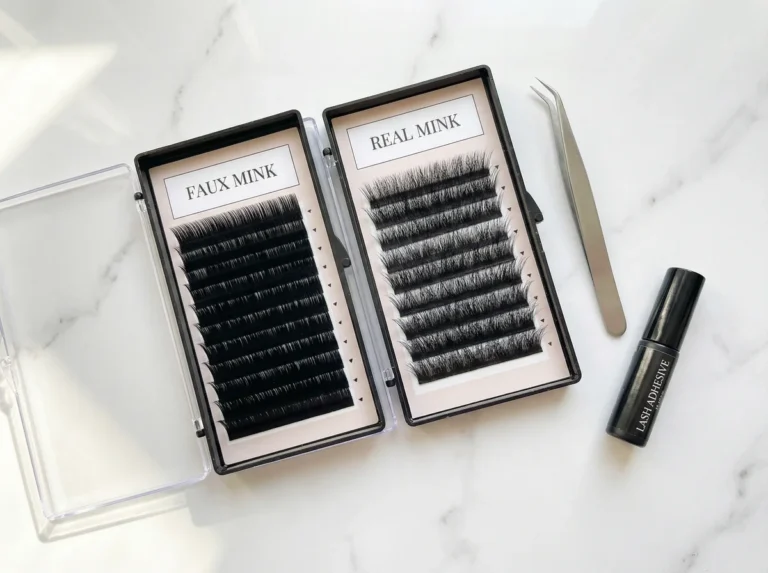
- Fiber: PBT (or finish name: faux-mink / matte / semi-matte / glossy)
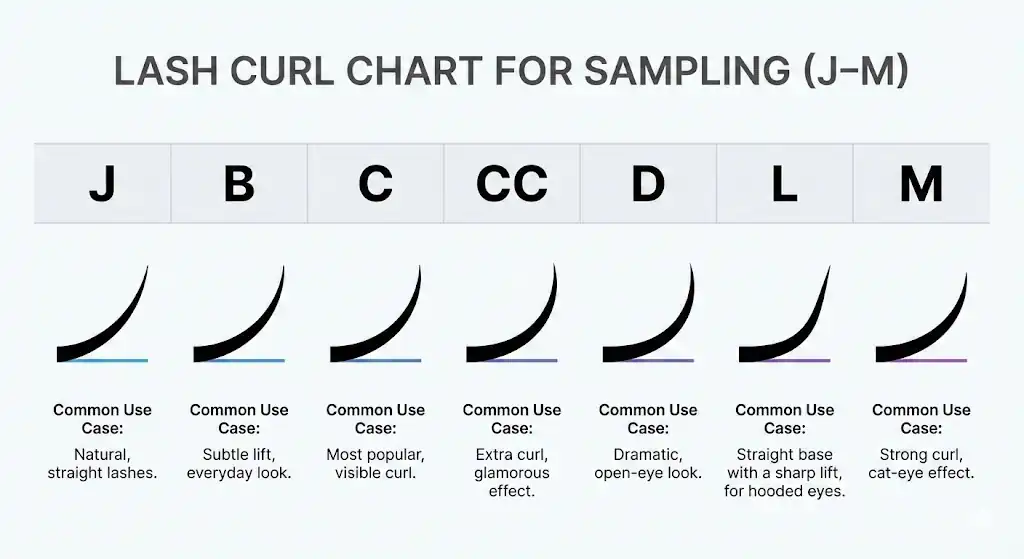
- Curl: choose 1–2 (e.g., C + CC)
- Diameter: e.g., 0.05 / 0.07
- Length mix: e.g., 8–15mm (or exact mapping)
- Backing preference: foil type + strip stickiness preference
- Packaging: tray size, label fields, barcodes (if used)
Tolerance defaults (edit for your tier):
- Length: ±0.5mm
- Row labeling: must match the row contents (no exceptions)
- Mixed lengths in a row: target 0; acceptable max defined in Step 3
Spec sheet (strip lashes)
Include:
- Style tier: natural / wispy / glam / manga What is wispy lash extensions and how to apply
- Band type: cotton / clear / black / ultra-thin
- Length profile: inner/middle/outer measurements
- Symmetry expectation: left/right must match within defined tolerance
- Packaging: box type, insert, label fields
Tolerance defaults (edit for your tier):
- Left/right profile difference: ≤ 1mm at any measured point
- Band defects: no cracking/tearing during normal handling
Pass/Fail criteria (for Step 1)
- PASS: Your spec sheet contains exact curl/diameter/length mix + packaging requirements + tolerances.
- FAIL: You’re still using phrases like “best quality,” “premium,” or “not too stiff” with no measurable target.
Step 2: Request Samples Like a Pro (Accuracy + Consistency Test)
Your sample request should test (1) spec accuracy and (2) process maturity.
What you’re testing
Can the supplier deliver exact specs and document how they keep batches consistent?
Minimum sample quantities (so tests are meaningful)
- Extensions: at least 2 trays per spec (so you can test handling + keep one as a control)
- Strips: at least 2 pairs per style (so you can test wear + cleanup)
- Packaging: at least 1 physical mock (or digital proof + one printed sample if possible)
What to ask for
A) Standard set (to test accuracy):
- 2–3 curls
- 2–3 diameters
- 2 length mixes (short-heavy + long-heavy)
- If strips: 3 styles in your target tier
B) One custom element (to test capability):
- Tray label layout OR
- Box finish/size OR
- Custom mapping (strips) OR
- Your exact length mix
C) Documentation package (to test reliability):
Request these in writing:
- Material description
- QC checkpoints (even a 1-page outline)
- Lot/batch ID method
- Defect/remake/credit policy
- Production lead time range (min/typical/max)
Pass/Fail criteria
FAIL: “No problem, top quality” without repeating your exact curl/diameter/length mix + no written defect policy.
PASS: Supplier confirms specs back in writing, provides at least a basic QC outline, and explains lot/batch identification.
Step 3: Incoming Inspection (Unboxing → First Look) With “Stop Conditions”
Many suppliers fail before you even measure anything. This step is designed to catch non-starters.
What you’re testing
Shipping damage, labeling accuracy, cleanliness, obvious defects.
Tools
Phone camera + white paper background + your spec sheet.
Method (15 minutes total)
A) Quick unboxing checks (5 min)
- Carton damage/compression
- Moisture signs
- Odor check (chemical/musty)
- Label match: curl/diameter/length vs what you ordered
B) Visual scan (10 min)
Extensions: check curl variation within same row, mixed lengths, kinks, stray fibers, adhesive backing mess
Strips: check glue residue, band cleanliness, symmetry, loose shedding
Pass/Fail criteria (objective thresholds)
Use these defaults (tighten/loosen by tier):
STOP / FAIL immediately if any of these occur:
- Label mismatch (row label doesn’t match contents)
- Moisture damage (wet packaging, moldy smell)
- Strong chemical odor that remains after 24 hours of airing out
- Visible contamination (dust/residue) on multiple trays/pairs
FAIL (quality issue) if defects exceed:
- Mixed lengths in a single row: > 1 defect per 5 rows inspected (extensions)
- Kinks/crimped fibers: visible in > 10% of rows inspected
- Stray fibers stuck across rows: seen on > 2 rows per tray
- Strip glue residue: visible clumps on > 1 pair out of 2
- Symmetry mismatch (strips): obvious left/right density or profile mismatch in any pair
Record (make comparison fair)
- Log defects as counts (not descriptions only)
- Take photos under the same lighting/angle each time:
- packaging + labels
- close-up of 2–3 rows (extensions) or band area (strips)
- any defects next to a ruler card
Step 4: Measure What Matters (Simple Tools, Clear Thresholds)
You don’t need a lab—but you do need consistent measurement rules.
What you’re testing
Length accuracy, curl consistency, handling performance, strip band behavior.
Tools
Digital caliper, lash ruler card, curl chart (printed), white background.
Extensions: Measurement rules
A) Length consistency
- Method: Pick 10 lashes from one row (or visually isolate 10 points).
- PASS: 9/10 match the labeled length within ±0.5mm.
- FAIL: 2+ “short sneaks” per 10 checks OR frequent mixed lengths visible in the row.
B) Handling consistency (proxy for diameter consistency)
If you don’t measure microns, use handling tests:
- Method: Do 10 pickup cycles with tweezers + 10 fan attempts (for volume).
- PASS: ≥ 8/10 pickups feel uniform + ≥ 8/10 fans open cleanly.
- FAIL: Fans collapse/stick in > 3/10 attempts OR fibers feel noticeably mixed stiffness.
C) Curl consistency + rebound
- Method: Compare 3 rows across the tray (top/middle/bottom). Flex gently and compare to curl chart.
- PASS: Rows visually match within one curl grade and rebound without permanent warping.
- FAIL: One row clearly weaker/stronger curl than others OR visible warping after gentle flex. YY lashes vs classic lashes: Beginners guide
Strip lashes: Measurement rules
A) Band flexibility
- Method: Wrap band around a brush handle for 10 seconds, release.
- PASS: Returns close to original curve with no permanent crease.
- FAIL: Creases, cracks, or stays sharply bent.
B) Symmetry
- Method: Place left/right side by side; measure inner/middle/outer points.
- PASS: Differences ≤ 1mm at any measured point.
- FAIL: Any point differs > 1mm or density/profile obviously mismatched.
C) Shedding
- Method: 20 gentle spoolie strokes.
- PASS: ≤ 3 fibers shed total (adjust by tier).
- FAIL: > 3 fibers shed or visible bald patches.
Record
Write results as numbers: Length pass 9/10, Fans open 8/10, Shedding 2 fibers.
Step 5: Stress Tests Buyers Use (Reveal Real-World Durability)
Stress tests aren’t about “indestructible.” They’re about whether the product survives the conditions your customers actually create.
What you’re testing
Stability under heat/humidity + handling wear + reuse/cleanup behavior.
Extensions stress tests
A) Humidity/heat exposure test
- Method: Keep one tray in a warm, humid bathroom area (no direct water) for 72 hours. Keep a control tray in a cool, dry place.
- PASS: After 72 hours, curl remains within one curl grade of control, and rows don’t show obvious droop/warping.
- FAIL: Curl visibly drops beyond one grade vs control or fibers warp noticeably.
B) Tweezer handling wear
- Method: 30 pickups from the same row section.
- PASS: Strip backing stays stable; fibers don’t deform or “dent” easily.
- FAIL: Backing deforms, fibers kink, or pickup becomes inconsistent quickly.
C) Fan success rate (volume)
- Method: Make 10 fans.
- PASS: ≥ 8/10 open cleanly and hold shape.
- FAIL: ≤ 6/10 open cleanly (or frequent sticking/collapse).
Strip lashes stress tests
A) Peel-off / reseat test
- Method: Remove from tray and reseat 3 times.
- PASS: Band retains shape; no cracking/crease line.
- FAIL: Permanent deformation or band damage.
B) Glue residue cleanup test
- Method: Apply a small glue line, let dry, remove.
- PASS: Band stays intact and cleans without tearing.
- FAIL: Band tears, separates, or remains gummy/dirty.
C) Reuse realism test
- Method: Wear simulation: handle + cleanup cycle 2 times (minimum).
- PASS: Lashes remain presentable for your tier after 2 cycles.
- FAIL: Visible shedding, band deformation, or shape collapse after 1–2 cycles.
Record
Log results as: Humidity test: pass (≤1 curl grade), Fan rate: 8/10, Reseat: pass.
Step 6: Score the Sample With Gates (So You Don’t Decide on Vibes)
Use a scorecard, but also define non-negotiables.
Gate rules (must-pass items)
If any occur, supplier is Rejected (no scoring debate):
- Label mismatch to contents
- No lot/batch identification method
- No written defect/remake policy
- Major defects beyond Step 3 thresholds
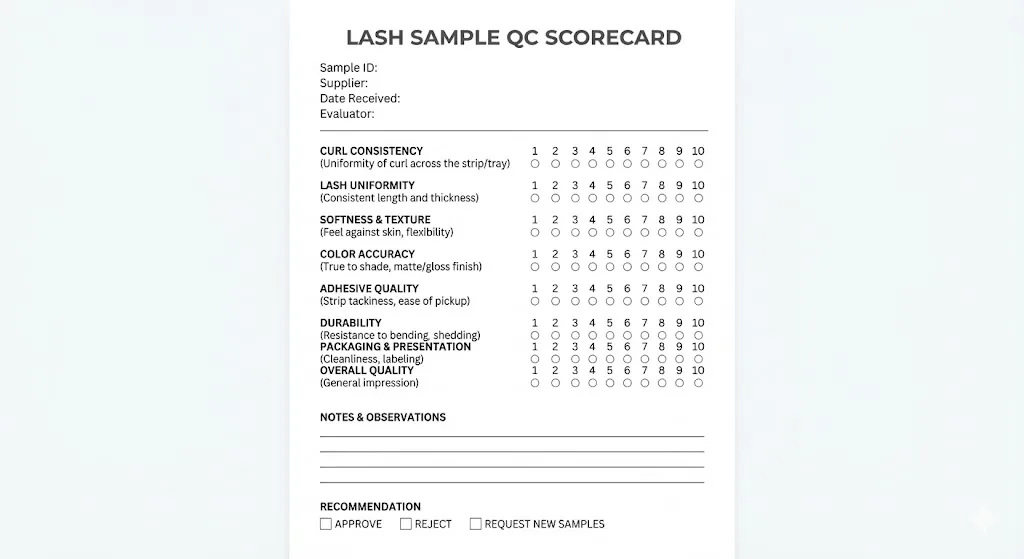
Scorecard (0–10 each)
- Accuracy to spec: /10
- Consistency within tray/style: /10
- Handling/application feel: /10
- Defect rate: /10
- Packaging + labeling accuracy: /10
- Communication + professionalism: /10
- Lead time reliability: /10
- Price vs tier fit: /10
Decision thresholds
- Borderline: 60–69 → request a repeat sample batch before any MOQ
- Shortlist: total ≥ 70/80 AND no gate failures
- Finalist: total ≥ 75/80 AND passes stress tests
Step 7: Evaluate the Supplier System (Consistency Is the Product)
Your biggest risk is not one imperfect tray—it’s unstable future batches.
What you’re testing
Does the supplier have a repeatable system: specs → QC → traceability → resolution?
Pass/Fail criteria (supplier reliability)
PASS if the supplier can provide (in writing):
- They repeat your specs back correctly
- QC checkpoints outline (even basic)
- Lot/batch coding method
- Defect policy (remake/credit terms)
- Lead time range with realistic variance
- OEM/private label capability details if needed
FAIL / high risk if any occur:
- Refuses to document QC or traceability
- Pushes large MOQ before validation
- Pricing changes unpredictably without explanation
- Won’t provide real production/QC evidence (photos/video snippets of process)
“Repeat-batch” consistency check (recommended)
- Method: Request a second sample of the same spec from a different production date.
- PASS: Results stay within your Step 3–5 thresholds.
- FAIL: Large drift between batches → supplier is unstable.
Record
Save all supplier confirmations in a single folder so your decision is auditable later.

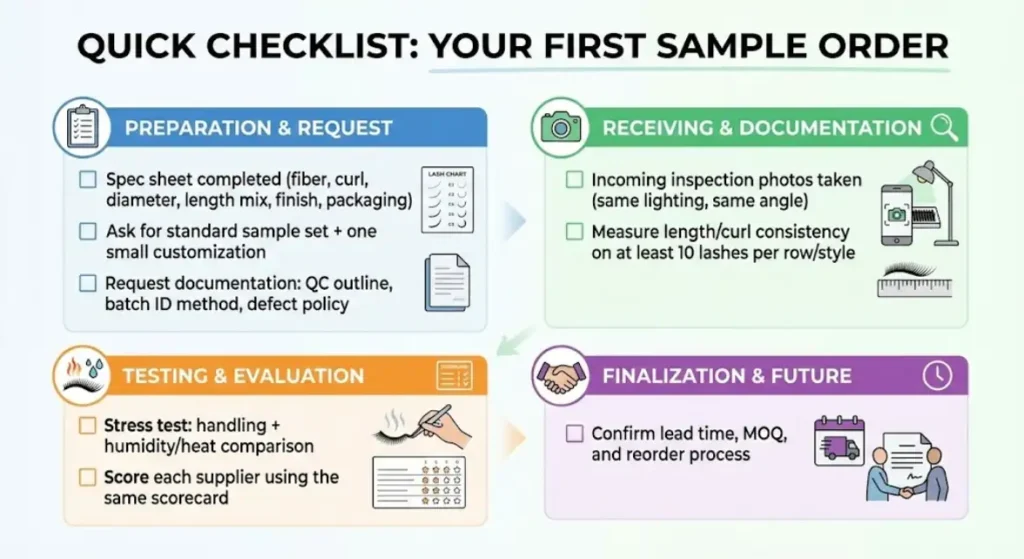
Quick Checklist: Your First Sample Order
- Spec sheet completed (fiber, curl, diameter, length mix, finish, packaging)
- Ask for standard sample set + one small customization
- Request documentation: QC outline, batch ID method, defect policy
- Incoming inspection photos taken (same lighting, same angle)
- Measure length/curl consistency on at least 10 lashes per row/style
- Stress test: handling + humidity/heat comparison
- Score each supplier using the same scorecard
- Confirm lead time, MOQ, and reorder process
If you’re launching a brand, starting with a low MOQ can protect your cash flow while you confirm your product-market fit—and then you can scale once consistency is proven.
Common Mistakes Lash Buyers Make (And How to Fix Them)
This section is written for salon owners, wholesalers, brand owners, and private label/OEM buyers who want fewer defects, fewer returns, and more consistent reorders. Use it as a quick “buyer sanity check” before you approve any supplier.
Quick takeaway
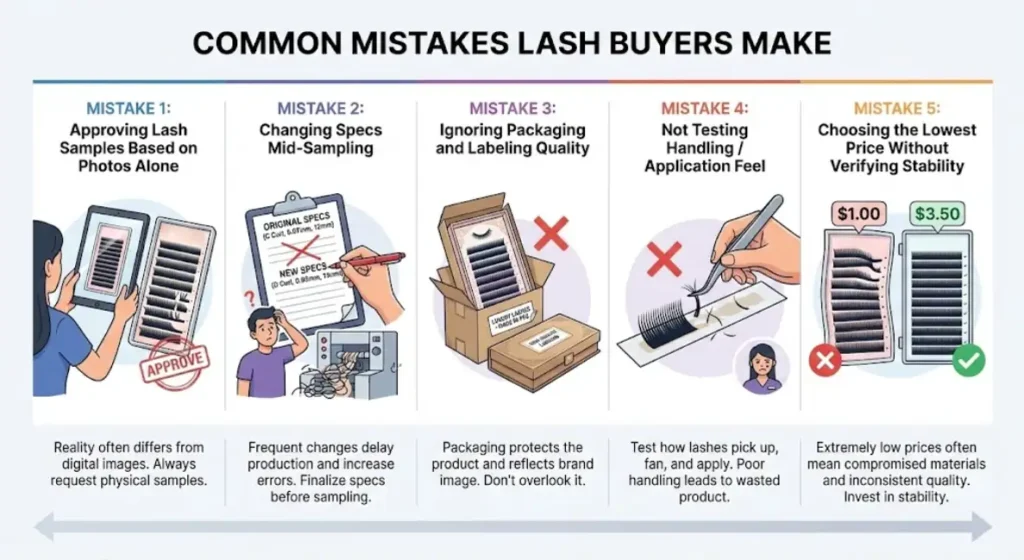
Most lash sourcing problems come from five avoidable gaps: trusting photos, changing specs, ignoring packaging, skipping handling tests, and chasing the lowest price without verifying batch stability.
Mistake 1: Approving Lash Samples Based on Photos Alone
Why it happens: Supplier photos show a “best tray,” perfect lighting, or a different production run. Photos can’t prove batch consistency.
What it costs you: You reorder—and the next batch has mixed lengths, curl drift, or different softness.
Fix (buyer rule): Run a repeat-batch check
- Request a repeat sample: same spec, different production date/lot
- Compare the two samples using the same inspection + measurement + stress tests
- Pass/Fail shortcut: If the second batch drifts beyond your tolerances (length, curl, defect rate), do not scale.
Pro tip for OEM/private label: Ask for lot/batch ID printed on the carton or on an internal label so you can trace issues later.
Mistake 2: Changing Specs Mid-Sampling
Why it happens: You see a new curl or finish and want to “test everything.” But then you’re not comparing suppliers—you’re comparing different products.
What it costs you: Confusing results, wasted shipping, and no clear decision.
Fix (buyer rule): Lock your spec before comparing suppliers
- Freeze your Version 1.0 spec sheet (fiber/finish, curl, diameter, length mix, packaging)
- Only change specs after you choose a supplier and finish consistency validation
Pass/Fail shortcut: If you can’t describe your target product in one page with tolerances, you’re not ready to sample.
Mistake 3: Ignoring Packaging and Labeling Quality
Why it happens: Buyers focus on lash appearance and treat packaging as “easy later.” In reality, packaging errors are one of the fastest ways to create returns.
What it costs you: Relabeling labor, wrong-SKU shipments, negative reviews, marketplace penalties (for brand owners).
Fix (buyer rule): Treat packaging accuracy as a quality gate
Check:
- Correct curl/diameter/length printed and matched to the tray/row
- Cleanliness: no dust, residue, loose fibers
- Print clarity + barcode readability (if applicable)
- Box fit/protection for shipping (crushed cartons = higher defect risk)
Pass/Fail shortcut: Any label mismatch is a hard fail. It predicts future order chaos.
Mistake 4: Not Testing Handling / Application Feel
Why it happens: Samples look great in the tray, but performance is revealed during pickup, fan making, placement, and cleanup.
What it costs you: Stylists complain, clients notice poor retention/comfort, and you get repeat purchase drop-off.
Fix (buyer rule): Run a standardized handling test
- Extensions: pickup test + fan-open rate (e.g., 10 attempts)
- Strips: band flexibility + wear/cleanup test (at least 2 cycles)
Pass/Fail shortcut (extensions): If fans collapse or stick too often, or pickup feels inconsistent across a tray, the “quality” won’t hold up in real work.
Mistake 5: Choosing the Lowest Price Without Verifying Stability
Why it happens: Price is easy to compare; systems (QC, traceability, remake policy) are harder—so they get skipped.
What it costs you: The cheapest supplier becomes the most expensive when batches drift, defects rise, and you absorb replacements.
Fix (buyer rule): Validate stability before you negotiate price
Ask for:
- Lot/batch traceability method
- QC checkpoints (even a simple outline)
- Defect/remake/credit policy in writing
- Lead time range (min/typical/max), not just “7–10 days”
Pass/Fail shortcut: If a supplier can’t document QC + traceability, they can’t reliably scale with you—no matter how attractive the quote looks.
FAQ
How many sample units should we test before placing a real order?
For most buyers, we recommend testing enough to cover your main variations (curl + diameter + length mix). If you’re doing private label, include packaging samples too. Consistency matters more than quantity.
Should we request a second sample batch?
If you’re planning to scale (especially B2B), yes. A second batch—same spec, different date—tells you far more about stability than a single “perfect” sample run.
What’s a reasonable defect rate?
It depends on the product type and tier. Instead of chasing a perfect zero, define what defects matter most (mixed lengths, curl inconsistency, shedding) and ensure the supplier’s remake/credit policy is clear.
What’s the best way to compare suppliers objectively?
Use one scorecard, one lighting setup, and the same tests. Keep notes. If you have multiple testers (tech + manager), average scores to reduce bias.
Can we customize lash styles and packaging without huge quantities?
Often, yes—this is where working with a manufacturer that supports OEM / private label and offers low MOQ options can help you test the market before going big. DIY cluster lashes wholesale and branding Key Points
Key Points
- We get the most reliable results when we treat sampling like a repeatable process—not a one-time impression.
- Start with a clear spec sheet (curl, diameter, length mix, finish, packaging).
- Inspect on arrival: labeling, cleanliness, curl/length mix errors, kinks, shedding.
- Measure basic consistency with simple tools (caliper, ruler, standardized photos).
- Run stress tests (handling + humidity/heat comparison) to reveal real-world durability.
- Score suppliers objectively using the same checklist every time.
- Evaluate the supplier’s systems (QC, traceability, remake policy), not just one sample.
- For scaling, prioritize stable quality, clear communication, and reliable lead times—then optimize cost with factory-direct pricing.
Reference
ISO 22716: Cosmetics — Good Manufacturing Practices (GMP) — Guidelines
FDA: Good Manufacturing Practice (GMP) Guidelines/Inspection Checklist for Cosmetics
ISO 9001:2015 — Quality management systems (QMS) — Requirements
ASQ overview: ANSI/ASQ Z1.4 (acceptance sampling plans)
European Commission: CosIng (Cosmetic Ingredient Database)
Personal Care Products Council (PCPC): INCI (International Nomenclature Cosmetic Ingredient)
GS1: Barcode standards (overview)
ICC: Incoterms® 2020 (official overview)