
Built for salon owners, lash artists, and B2B lash suppliers who want faster sets, higher ticket value, and repeatable results.
Hybrid lash extensions combine classic single lashes with volume fans in one set—creating a textured look that’s fuller than classic but softer and more customizable than full volume. For salons, hybrids typically win because they’re easy to personalize, solve sparse lash lines, and support premium pricing when the mapping is consistent.
This guide explains what hybrid lashes are, why clients request them, and—most importantly for professionals—how suppliers (like Lashvee) help salons deliver faster, repeatable hybrid sets with the right fans, fibers, and education.
Key takeaways (for pros)
- Hybrids sell because they balance natural texture + noticeable fullness without going “all volume.”
- The service is profitable when salons standardize ratios, mapping, and tray selection.
- Premade fans and specialty fibers can reduce set time and improve consistency across staff.
- Suppliers add value by providing reliable curl/diameter consistency, mapping guides, and business-ready product stacks.
What are hybrid lash extensions?
Hybrid lash extensions are a technique that combines classic single extensions with volume fans in the same set to create a textured, customizable finish—fuller than classic, but less uniform than full volume.
Hybrid vs classic vs volume (quick comparison)
Use this quick comparison when explaining services to clients or standardizing menu descriptions:
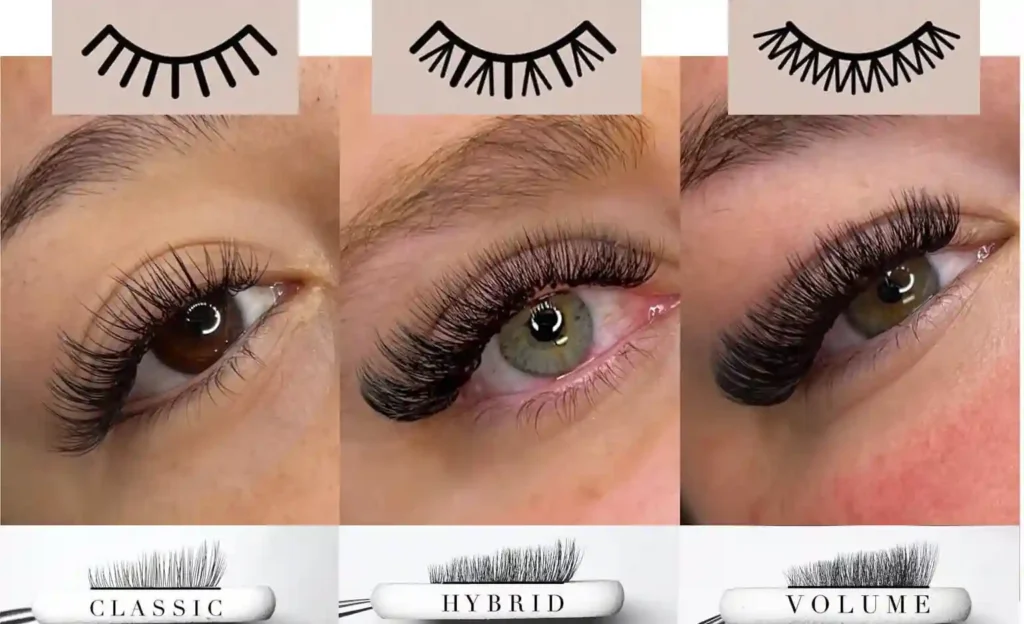
- Classic (1:1): One extension applied to one natural lash. Best for clean definition and clients with naturally dense lash lines.
- Volume: Multiple ultra-light extensions (a fan) applied to one natural lash for maximum density and softness.
- Hybrid: A strategic mix of singles + fans to create dimension (spikes + soft base) and to “fill in” sparse areas without going full volume.
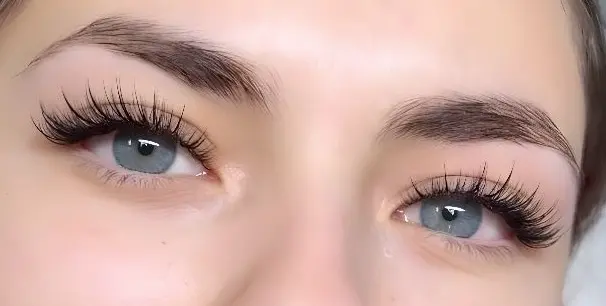
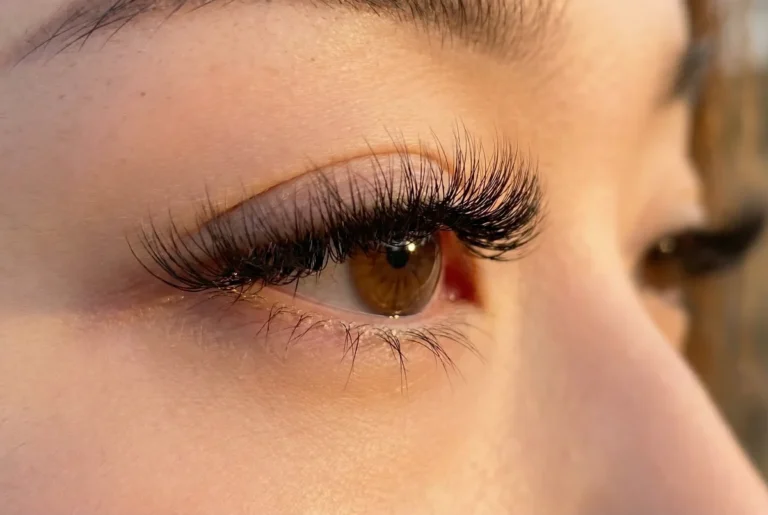
What hybrids look like: a broken, staggered lash line with more depth than classic and more natural variation than an evenly dense volume set.
Who hybrid sets are best for (salon client profiles)
From a salon perspective, hybrids are most useful for clients who want a noticeable upgrade—but still want flexibility and a natural-looking texture.
Hybrids are a strong fit for:
- Clients with uneven lash density (gaps or sparse zones you can blend with fans)
- Clients who want fullness without “dramatic volume”
- Clients transitioning from classic to volume (great “next step” service tier)
- Clients who prioritize a flattering grow-out between fills (texture tends to shed more gracefully)
B2B note (for owners/managers): Defining hybrids clearly on your service menu helps your team recommend the right tier faster and helps purchasing stay consistent (you’ll typically need reliable singles and fan options in the same curl family—start with a simplified lineup from the Lashvee Shop).
Why hybrids are a top-selling salon service
Hybrid lash extensions are popular because they deliver a “designed” look that’s easier to personalize than classics, but typically faster and more flexible than going full volume for every client. For salon owners, hybrids often become a core menu item because they support premium pricing and consistent outcomes when your team follows the same mapping rules.
Customization that fits more eye shapes and lash densities
Hybrids give artists more control during the consultation: singles create clean structure, while fans can be placed only where extra density is needed. That means you can tailor the set to uneven lash lines, different eye shapes, and mixed lash density without reinventing the entire design each time—reducing remakes and improving client confidence at checkout. (If you want more mapping and menu positioning guidance, pull examples from the Lashvee Blog.)
Solves sparse areas without going full volume
Many clients want a fuller look but don’t have the natural lash count for a classic set to read as “full.” Hybrids solve that by adding fans selectively through thin zones while keeping other areas lighter—so the result looks balanced instead of heavy. A simple way to explain it: “Hybrids add fullness where you need it and keep softness where you don’t.”
Premium pricing, retention, and fill-friendly grow-out (B2B lens)
Hybrids often sit in the strongest profit position on a lash menu: they’re perceived as more customized than classics, so clients accept a higher price, while appointment times can stay manageable when your team uses repeatable maps and reliable fans. Texture also helps grow-out look more natural between visits, supporting consistent fills and reducing mid-cycle dissatisfaction.
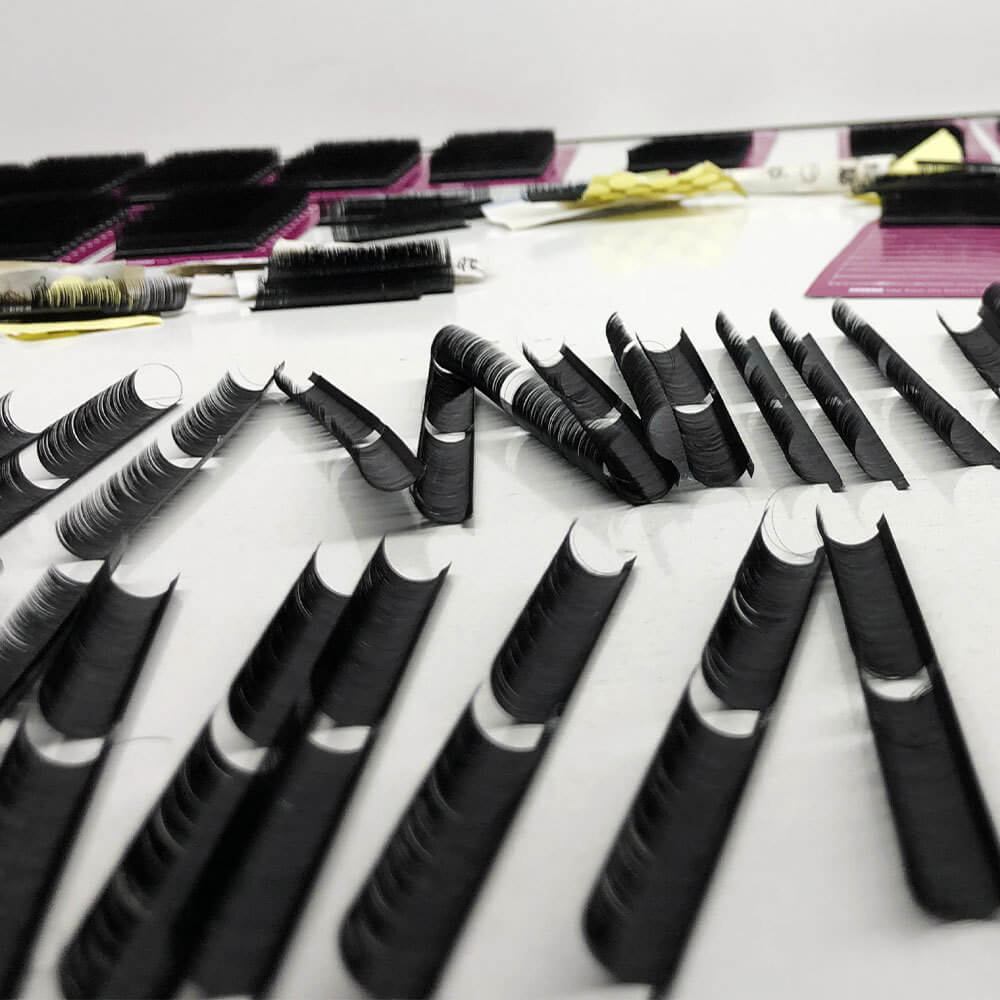
Hybrid mapping that stays consistent across artists
A repeatable hybrid ratio (your team’s default SOP)
- Default: 50/50 (about half singles, half fans) for balanced texture.
- More “natural”: 60/40 (more singles) for softer definition and lighter density.
- More “full”: 40/60 (more fans) for clients with sparse areas or those who want stronger darkness.
Consistency rule: decide your salon’s “default ratio” and train every artist to adjust from that baseline—not freestyle from scratch each time.
Placement rules that prevent uneven results
Use these mapping rules to keep results consistent across artists:
- Singles = structure + spikes
Use singles to create the “peaks” and define the lash line. - Fans = base + blending
Use fans to fill density, soften transitions, and hide gaps. - Mirror mapping rule (symmetry)
If you place a spike at “outer third” on one eye, mirror it on the other eye at the same zone. - Gap correction rule
If a client has thin areas, use fans in the sparse zones first, then add singles to keep texture.
salon-ready hybrid maps (fast training templates)
Map 1: Soft Natural Hybrid (brown-friendly)
- Goal: “born-with-it” fullness, soft definition
- Base: shorter fans for a light, even foundation
- Spikes: fewer spikes; keep peaks subtle
- Best for: clients new to extensions, mature clients, “natural” requests
- Common mistake: too many spikes = starts looking wispy/trendy instead of natural
Map 2: Wispy Hybrid (spikes + texture)
- Goal: airy texture with visible peaks
- Base: fans create a soft platform; don’t over-darken
- Spike rule: place spikes in a repeating pattern (e.g., every 3–5 lashes), not randomly
- Best for: clients asking for “wispy,” “Kim K,” “texture”
- Common mistake: spikes too dense or too long = messy silhouette + poor retention look during shed
Map 3: Cat Eye Hybrid (high-demand salon staple)
- Goal: elongated outer corner, lifted look
- Base: gradual length build from inner to outer third
- Spikes: concentrate spikes in the outer third (but keep them consistent)
- Best for: clients requesting lift/elongation
- Common mistake: outer corner too heavy = droops the eye and looks uneven after a week
Training tip: Store these 3 maps as your “core menu.” Train every new artist on these first before offering highly customized designs.
Common hybrid mapping mistakes (and how to prevent remakes)
Mistake: Fans too dense for the client’s natural lash strength
Fix: reduce fan density or shift ratio toward more singles.
Mistake: Spikes placed randomly
Fix: use a repeat pattern (every X lashes) and mirror both eyes.
Mistake: Texture looks great day 1 but collapses by day 7
Fix: ensure spikes aren’t overlong/heavy; use base fans to support the silhouette.
Mistake: Each artist produces a different “wispy” look
Fix: define your salon’s spike frequency + max spike length difference (e.g., spikes no more than +2 mm over base).
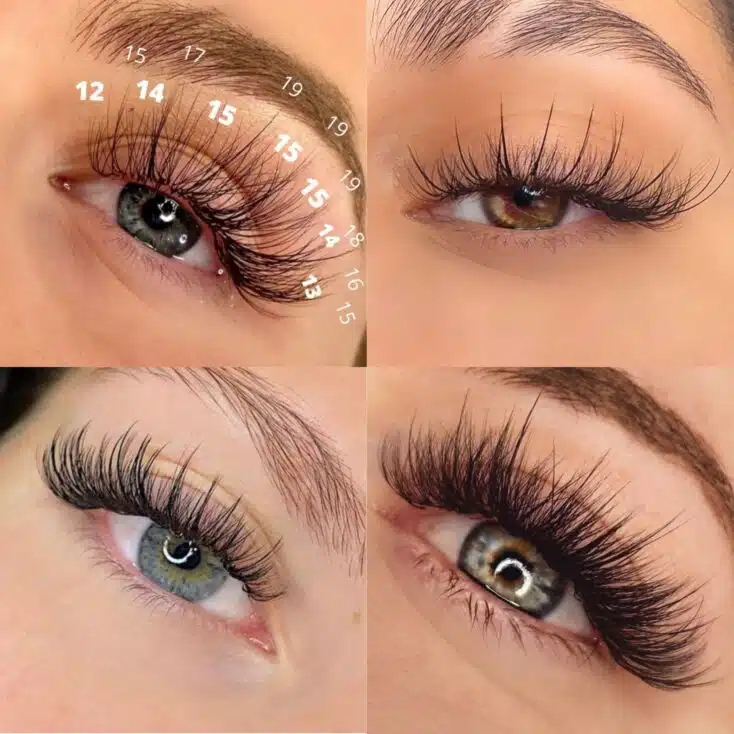
Hybrid lash mapping that stays consistent (ratios + 3 salon-ready maps)
Start with a repeatable ratio
- Balanced hybrid: ~50% singles / 50% fans
- Natural hybrid: more singles, fewer fans (softer density)
- Bold hybrid: more fans, fewer singles (still textured)
Map 1: Natural hybrid (soft, everyday)
- Singles on inner corner + mid-lash line
- Fans only where the lash line is sparse
- Shorter lengths, lighter diameters
Map 2: Wispy hybrid (spikes + texture)
- Add spikes using longer singles at set intervals
- Use fans to build a soft “base” under spikes
- Keep spikes consistent per eye for symmetry
Map 3: Cat-eye hybrid (retail-friendly request)
- Gradually increase length toward outer corner
- Fans on outer third for lift + fullness
- Avoid overloading the very last outer corner lashes
Salon ops tip: document these as your internal “service recipes” so every artist delivers the same result.
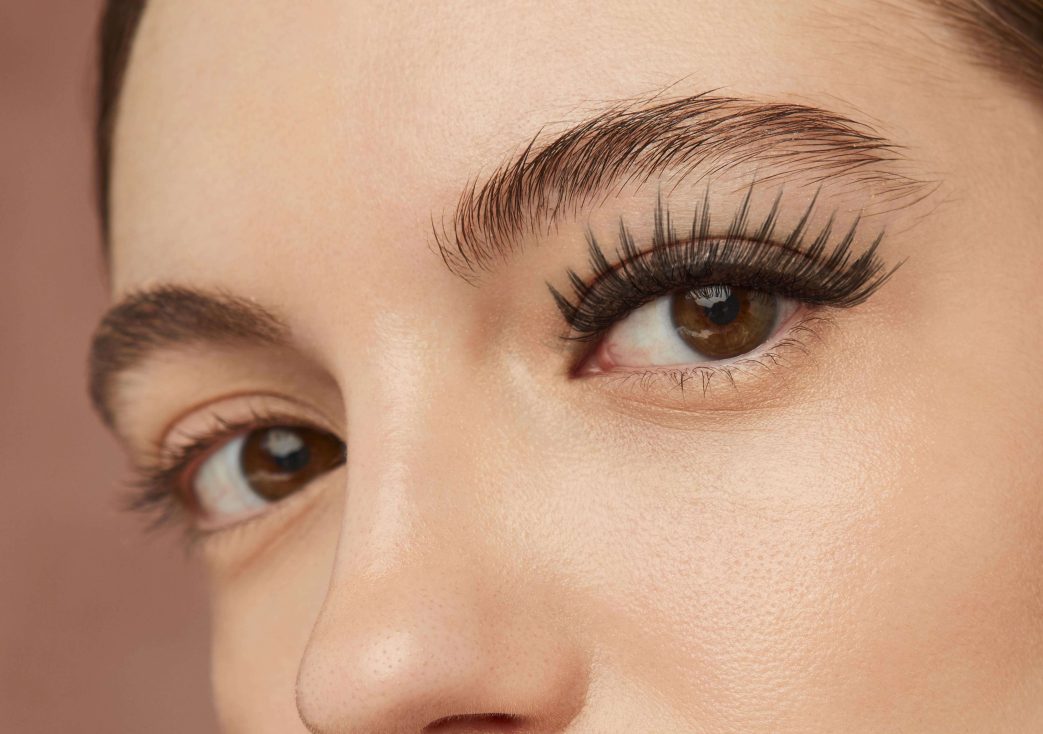
Mastering these eyelash extension techniques is what separates a good lash tech from a great one.
Supplier support that actually improves speed and margins (what to buy + what to ask)
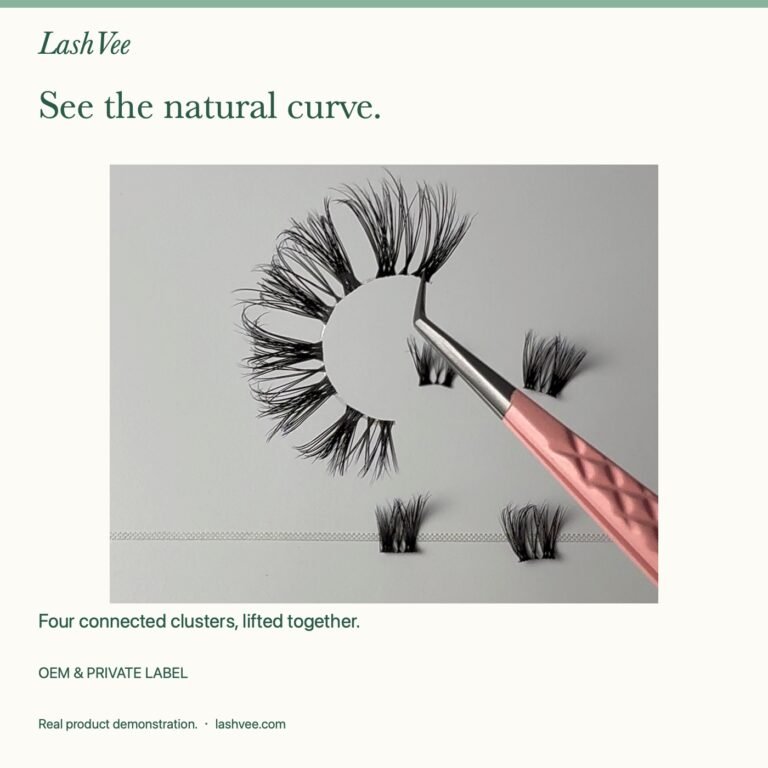
The rise of hybrid lashes wouldn’t be possible without the innovation of suppliers. In the past, creating a hybrid set meant an artist had to be a master at hand-making volume fans on the fly, which could take hours. Today, suppliers have streamlined the process.
What products reduce appointment time (without reducing quality)
- Premade fans: reduce on-the-spot fan making and improve timing consistency across staff (compare options in the Lashvee Shop)
- Specialty bases / shapes (if you carry them): simplify pickup and placement for newer artists
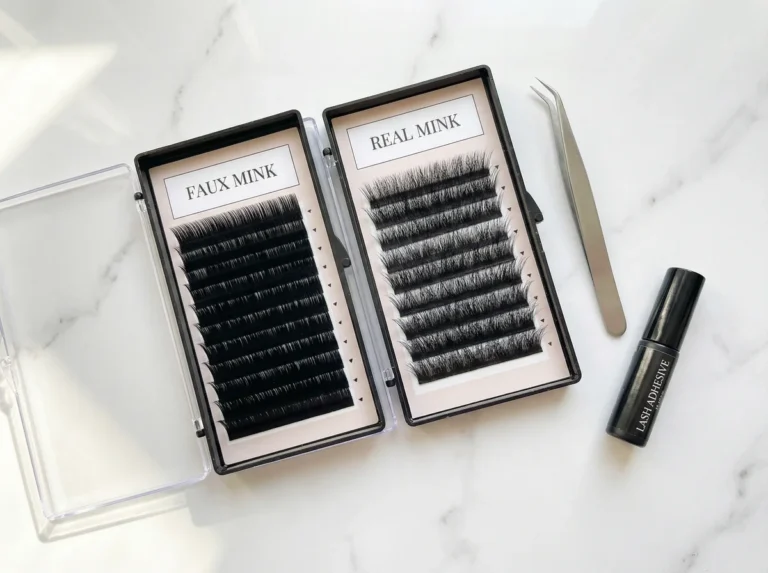
- Brown fibers: unlock “natural premium” sets that upsell well in certain markets
Supplier checklist (copy/paste for procurement)
When evaluating a lash supplier (or switching):
- Support for salon scaling (bundles, private label, custom trays if relevant)
- Curl consistency across trays and batches
- Base quality (clean base, minimal bulk, easy placement)
- Clear labeling (curl, diameter, length, row info) to reduce mistakes
- MOQ + lead times that match your reorder rhythm
- Sampling options (trial trays) before wholesale commitment
- Education assets (mapping guides, training materials) for faster staff onboarding
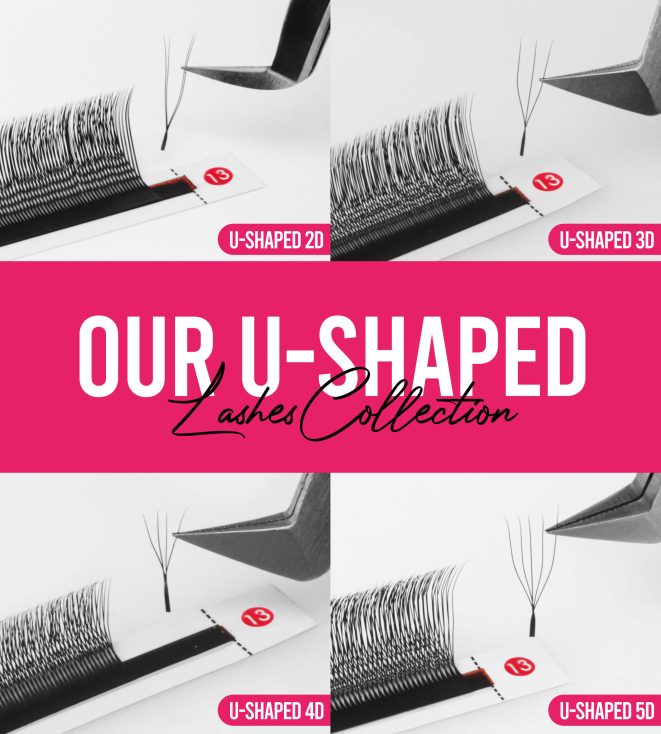
When discussing volume vs hybrid lashes with a client, it is helpful to have eyelash extension examples ready to show. Most clients don’t know the technical lash extension guide terms, but they know a beautiful photo when they see one.
The maintenance: How long do hybrid lashes last?
One of the most common questions from clients is “How long do hybrid lashes last?” Generally, because of the mixed application technique, hybrid lashes have excellent longevity.
The classic extensions provide a strong bond, while the volume fans “wrap” around the natural lash for extra security. Typically, a client will need a fill every 2 to 3 weeks. During a fill, the artist can easily assess which parts of the hybrid lash extensions have shed and replace them with either a fan or a single lash to maintain the perfect balance.
Aftercare checklist (paste-ready):
- Clean daily with a lash-safe cleanser (especially after workouts, skincare, or oily environments).
- Brush gently once per day with a clean spoolie to keep fans open and tidy.
- Avoid oil-based products around the lash line (oil can weaken adhesive bonds).
- No rubbing or picking—pressure causes premature shedding and twisting.
- Book fills before gaps appear (2–3 weeks for most clients).
What’s next for hybrids (trend + positioning)
Why hybrids will stay on menus (demand + operations)
Hybrid sets aren’t just a style trend—they match what modern clients ask for: custom results that still look soft and wearable. For salons, hybrids also solve an operations problem: they let you deliver visible fullness across a wide range of natural lash densities without pushing every client to full volume. As long as customization stays valuable, hybrids will remain a reliable “menu hero” service.
How salons can stay competitive (what to stock, train, and market)
Over the next 6–12 months, the salons that win with hybrids will focus on consistency + speed, not just new lash types. Prioritize:
- Standardized mapping templates so every artist can reproduce your signature hybrid looks.
- Time-saving fan options (premade fans/easy pickup designs) to protect appointment capacity.
- Softer finishes (including brown tones and lighter density choices) for clients who want a “born-with-it” look.
- Supplier alignment: consistent curl, clear tray labeling, reliable restocks, and education materials that support team training.
- Marketing assets: build a small library of before/after sets by style (soft natural, wispy texture, cat eye) so clients can choose quickly and book confidently.
Final thoughts (for salon owners & lash teams)
Quick recap
- Hybrids are a high-demand “menu hero” because they balance texture + fullness without committing every client to full volume.
- Repeatable mapping templates help you train faster and reduce remake risk across multiple artists.
- The right product stack (singles + consistent fans + optional softer shades like brown) improves speed and results.
- Supplier consistency matters—curl accuracy, fan base quality, and tray labeling protect outcomes and profitability.
- Aftercare + fill cadence (2–3 weeks) keeps retention high and client expectations clear.
Next steps: optimize your hybrid menu with the right supply plan
If you’re building hybrids into your core service menu, the fastest win is consistency—repeatable maps and predictable supplies.
Next step: request wholesale pricing and a sample tray recommendation based on your most-booked hybrid styles (natural, wispy, cat-eye) so your team can standardize results and reduce appointment time.
FAQ (Hybrid Lash Extensions for Salons & Pros)
What are hybrid lash extensions?
Hybrid lash extensions mix classic singles + volume fans in one set to create a textured finish. They’re often chosen when clients want more fullness than classic but a softer, more natural look than full volume. For salons, hybrids are a scalable “hero service” because density can be adjusted without redesigning the full menu.
Hybrid vs classic lashes — what’s the difference?
Classic sets apply one extension per natural lash for clean definition. Hybrid sets add fans strategically to increase density and camouflage gaps while still keeping texture. Salons typically position classic as entry-level and hybrids as a premium step-up that feels more customized.
Hybrid vs volume lashes — which should a salon recommend?
Hybrids suit clients who want fullness but still prefer separation and “spiky” texture. Full volume is better for clients who want maximum density and uniform darkness. Operationally, hybrids can reduce remake risk for mixed lash densities because you can “correct” sparse areas with fans.
How long do hybrid lash extensions last?
Most clients need a refill as lashes shed naturally; hybrids usually look more forgiving during grow-out because texture hides gaps better than a uniform set. Retention depends on aftercare, lash health, and adhesive conditions. In practice, salons often guide clients toward regular refill cycles rather than promising a fixed number of weeks.
How often should clients get hybrid lash fills?
A common refill cadence is every 2–3 weeks, depending on shedding and desired fullness. More frequent fills help keep the hybrid “balance” consistent and reduce appointment time compared with waiting too long. This cadence also stabilizes salon scheduling and rebooking.
Do premade fans reduce appointment time for hybrid sets?
Premade fans can speed up hybrids by removing the need to build fans during the service, especially for newer artists. For salon owners, the bigger benefit is repeatability: more consistent fan shape and pickup can help standardize results across the team. Quality varies—so sourcing and QC matter.
Are brown lashes good for a natural hybrid look?
Yes—brown fibers soften contrast and can make hybrids look more “born-with-it,” especially for lighter features or clients who dislike jet-black density. Many salons use brown fans for the base and darker singles for spikes to keep definition without harshness.
What should salons look for in a lash supplier for hybrid services?
Prioritize consistency and scalability: curl accuracy, tray labeling clarity, fan base quality, and predictable pickup matter more than having dozens of SKUs. Also check lead times, batch consistency, and whether the supplier supports education (maps, training resources). A reliable supplier reduces remakes and training friction.
References
Han, J., Xie, Z., Zhu, X., Ruan, W., Lin, M., Xu, Z., Miao, L., Zhong, J., Lu, F., & Hu, L. (2024). The effects of eyelash extensions on the ocular surface. Contact Lens and Anterior Eye, 47(2), 102109. (Prospective study; reports tear-film stability changes and short-term ocular surface effects after extensions.)
Grupcheva, C. N., Grupchev, D. I., Usheva, N., & Grupcheva, L. O. (2024). Beauty versus Health—How Eyelash Extensions May Affect Dry Eye Disease? Journal of Clinical Medicine, 13(11), 3101. (Study framing extensions and dry-eye signs/symptoms; useful for “monitoring + removal can improve symptoms” positioning.)
Sullivan, D. A., Da Costa, A. X., Del Duca, E., et al. (2023). TFOS Lifestyle: Impact of cosmetics on the ocular surface. The Ocular Surface, 29, 77–130. (High-authority consensus-style report; supports cosmetics/ocular surface risk context.)
Wolffsohn, J. S., et al. (2017). TFOS DEWS II Management and Therapy Report. The Ocular Surface. (Evidence-based management framework for dry eye; supports hygiene/management language when discussing irritation/dryness.)
Masud, M., Moshirfar, M., Shah, T. J., Gomez, A. T., Avila, M. R., & Ronquillo, Y. C. (2019). Eyelid Cosmetic Enhancements and Their Associated Ocular Adverse Effects. Medical Hypothesis, Discovery & Innovation in Ophthalmology, 8(2), 96–103. (Literature review; commonly cited adverse effects for lash extensions.)