

If you’re reading this, you’re probably in one of two places:
- You’re building (or scaling) a lash brand and you need a manufacturer you can trust—because one “bad batch” can undo months of marketing.
- You’re a lash lover or lash artist who’s learned the hard way that “pretty on Instagram” doesn’t always mean “safe, consistent, and comfortable in real life.”
We’ve been on the manufacturing side long enough to see the same patterns repeat: brands grow fast when their product is repeatable, and they struggle when quality is mysterious. At LashVee, our factory output scales to millions of pairs per month, and our work is built around documentation, process control, and long-term reorder stability.
This article is our science-based, field-tested checklist for choosing the right lash manufacturer—written in the way we’d explain it to a new brand founder sitting across the table from us. If you only read one section, start with this quick checklist—this is the same framework we use to prevent ‘sample-to-bulk surprises.
Quick Answer: How to Choose the Right Lash Manufacturer
If you’re choosing a lash manufacturer (OEM/private label or bulk), we recommend verifying (1) repeatable lash specs, (2) quality systems and traceability, and (3) safety documentation—before you commit to bulk. In practice, the best manufacturers can show proof of consistent curl/diameter/taper, controlled production, and clear batch records (not just “pretty samples”).
Our 7-step manufacturer checklist (copy this):
- Define your use-case spec (who wears it, wear time, biggest complaints).
- Confirm materials + tolerance ranges (not only “0.07 C curl”).
- Run two sample rounds from different production dates.
- Ask for QC standards + defect limits (what they reject, how they measure).
- Require batch traceability (lot numbers, production records, re-order consistency).
- For adhesives: request SDS/COA + storage/stability guidance.
- Confirm compliance readiness (GMP/ISO practices, complaint handling, documentation).
| What you need | Manufacturer | Trading company |
|---|---|---|
| Batch consistency | Usually stronger | Varies by source |
| QC standards | Can be defined + audited | Often indirect |
| Traceability | Lot-based | Sometimes limited |
Common follow-up questions:
- Manufacturer vs trading company? Manufacturers control production lines and QC; trading companies often source from multiple factories.
- What proof matters most? Batch records + defect standards + two-date sample consistency.
- What’s the biggest red flag? “Trust us” with no documents, no traceability, or inconsistent answers.
What to do today: pick any 1 SKU you sell and request the manufacturer’s tolerance ranges + batch labeling method. If they can’t answer clearly, that’s a risk signal.
Why manufacturer choice is a safety decision, not just a price decision
A lash product is small, but the risks are not. Lashes and adhesives sit near the ocular surface, and irritation can turn into a real problem quickly. The American Academy of Ophthalmology notes that eyelash extensions and glue are not currently regulated by the U.S. FDA, and highlights risks like allergic reactions and damage from rubbing or tugging.
In clinical research, eyelash extensions have been associated with measurable short-term changes to tear film stability and ocular surface “homeostasis” in a prospective study. And in medical reporting, cyanoacrylate-based adhesives used for extensions may emit formaldehyde and trigger symptoms like irritation, lid swelling, and itching in some people.
What you can do today: treat “manufacturer selection” like you’re building a safety system:
- define your product spec clearly,
- demand proof of process control,
- run a repeatable sampling + inspection routine.

Step 1: Start with your real product spec (not just “0.07 D curl”)
The biggest sourcing mistakes happen when a brand’s “spec” is really just marketing words.
Define the job your lashes must do
Different users have different performance needs:
- Salon extension clients: consistency, fan stability, curl retention, low irritancy in materials and packaging.
- DIY cluster customers: easy pickup, clean removal, comfortable wear, predictable adhesive performance.
- Strip lash customers: band flexibility, symmetrical mapping, stable curl and taper.
What you can do today: write a “use case” spec in one paragraph:
- Who wears it?
- For how long?
- What do they complain about now (poke, heaviness, stiff base, uneven curl, sticky strip, allergy fear)?
That paragraph becomes your “north star” when you compare factories.
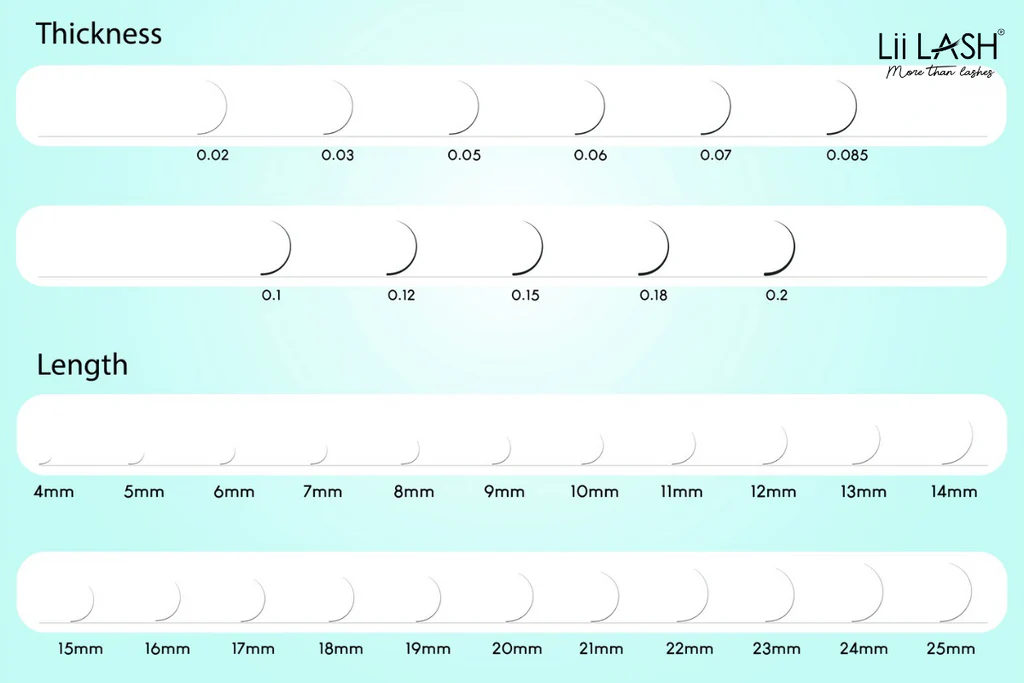
Convert “aesthetic” into measurable parameters
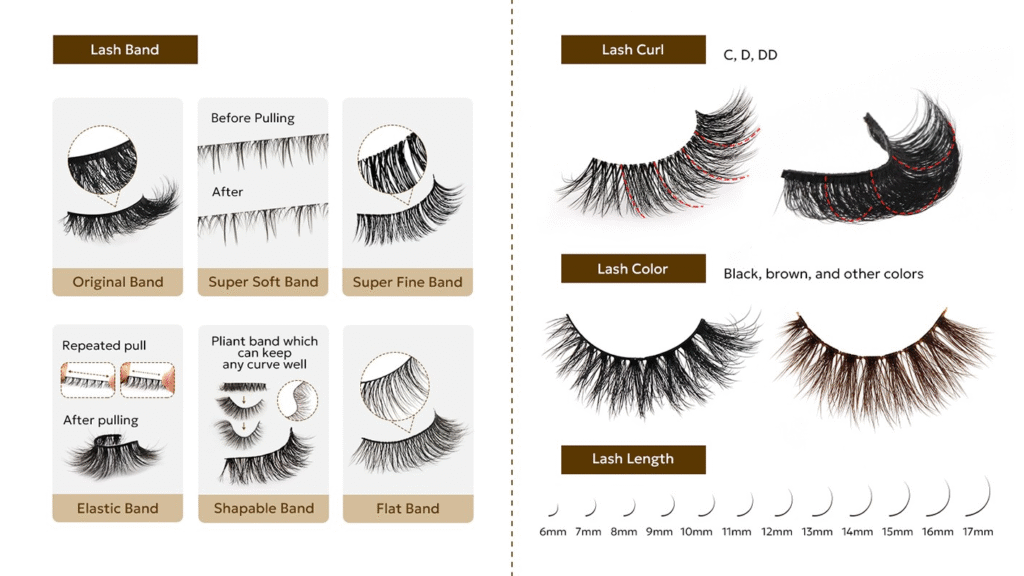
When we help private label customers, we translate design intent into production-ready details: curl, diameter, taper, length mix, and packaging.
Here’s what that looks like in practice:
- Diameter tolerance: “0.05” isn’t just a number—it’s whether the fiber is consistent enough to fan predictably.
- Curl retention: you want a curl that holds after storage and shipping, not just fresh from production.
- Taper + tip quality: “soft and airy” usually means a smoother taper and less blunt cut.
Example: converting “soft & airy” into a spec you can manufacture
When a buyer says “soft & airy,” we translate that into measurable choices: lighter diameter, cleaner taper, consistent curl, and a base that doesn’t feel rigid at the lash line. We then write it as a spec sheet: curl type, diameter range, length map, and acceptable defect limits (e.g., what % of lashes can be slightly off-curl before the tray fails QC).
What you can do today: ask any manufacturer for their internal tolerance ranges (not just the nominal spec). If they can’t answer, that’s a signal.
Step 2: Evaluate material science basics (because “premium” is not a material)
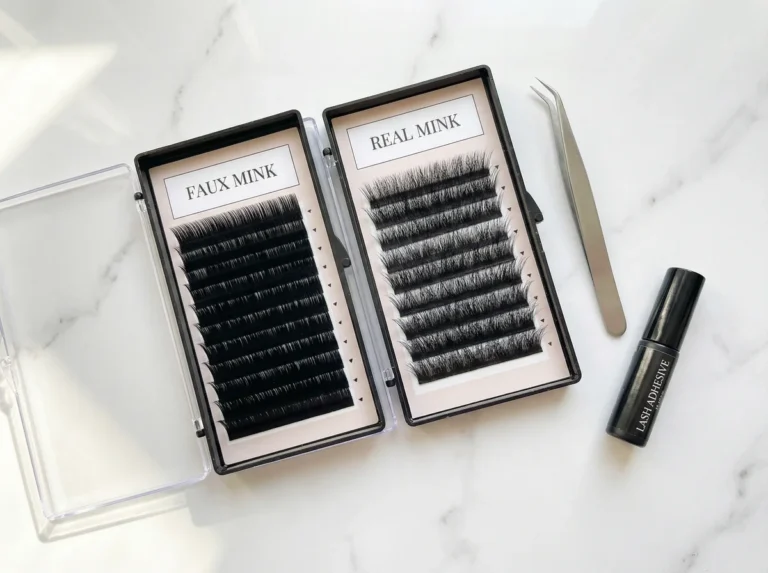
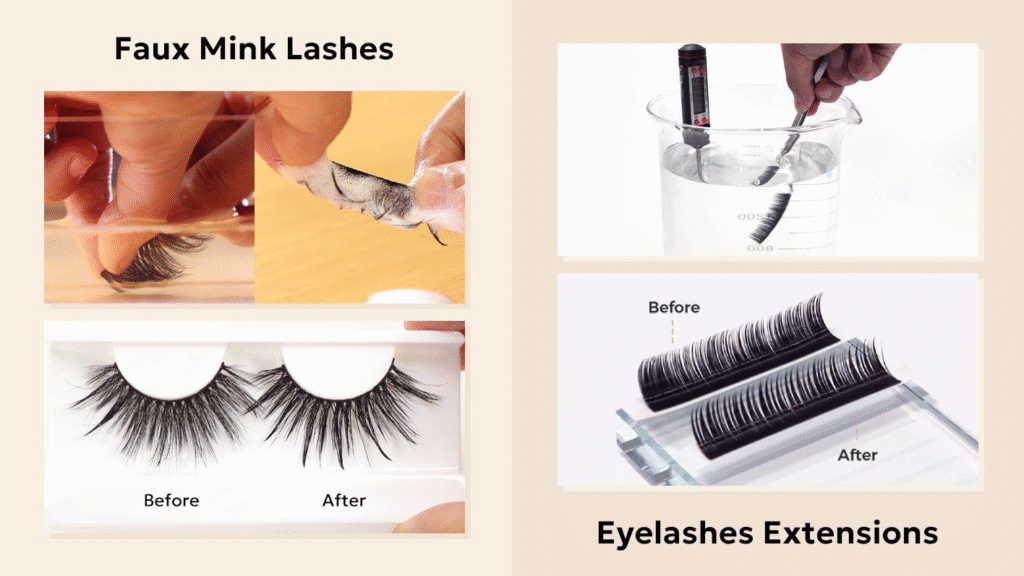
Most lash fibers are synthetic polymers engineered for softness, spring, and curl stability. Some factories (including us) use Korean PBT for its balance of softness and curl retention. Lashvee
But material quality isn’t just what they claim—it’s how they control it.
What “better fiber” usually means in real life
A well-controlled fiber tends to show:
- smoother surface feel (less “scratchy” lash line),
- consistent curl and rebound,
- consistent diameter and taper.
What you can do today: when reviewing samples, do a “three-touch test”:
- pinch the lash base lightly (does it feel rigid or resilient?),
- fan or flex it repeatedly (does it deform easily?),
- compare two trays of the same style (do they behave the same?).
If you can’t tell by touch, that’s okay—your reorder will tell you later. The goal is to reduce surprises before you scale.
Step 3: Adhesives are where “science-based” matters most
If you’re sourcing lash glue or bundling adhesive with lashes, your manufacturer (or supplier chain) needs tighter controls than many brands expect.
- Cyanoacrylate-based glues are commonly used for extensions; medical experts warn they may contain irritants and may emit formaldehyde, causing adverse reactions in some people.
- A published case report documented allergic contact dermatitis linked to ethyl 2-cyanoacrylate, identified via patch testing.
- A dermatology study investigated formaldehyde presence in eyelash glues marketed as “formaldehyde-free,” showing why brands should verify claims with testing rather than labels alone.
What a responsible manufacturer/supplier should provide (minimum)
For adhesives, we recommend asking for:
- SDS (Safety Data Sheet)
- COA (Certificate of Analysis) per batch (or per lot of raw materials)
- Ingredient disclosure appropriate for your market
- Stability and storage guidance (temperature, humidity, shelf life)
- Complaint and adverse event handling process
What you can do today: if a supplier says “it’s safe, everyone uses it,” ask for documentation. If they refuse, treat it as a hard “no.”
A clear safety note (for both B2B and B2C readers)
We can share best practices and research, but we can’t diagnose allergies or eye conditions. If someone experiences redness, swelling, pain, vision changes, or persistent irritation after using lashes or extensions, they should stop use and seek medical advice promptly (ideally from an eye care professional).
And a quick, practical note: keep lash products away from children and pets—if a pet ingests adhesive or lash materials, contact a veterinarian.
Step 4: Look for GMP and quality systems that reduce “batch roulette”
When buyers say “I just need a reliable manufacturer,” what they usually need is process control.
ISO 22716 (Cosmetics GMP) is a strong signal for serious operations
ISO 22716 provides guidelines for the production, control, storage, and shipment of cosmetic products.
And the EU’s Cosmetics Regulation states that cosmetic products placed on the market should be produced according to good manufacturing practice.
Even if your lash product isn’t classified as a “cosmetic product” in every market, the mindset matters: controlled environments, traceability, documentation, training, and hygiene.
At LashVee, we publicly list multiple management and GMP-related certifications (including ISO 22716 for cosmetics GMP).
What GMP changes day-to-day (what we look for beyond certificates)
A certificate matters less than the behaviors behind it: documented cleaning routines, training records, traceable batches, controlled storage, and a defined process for handling nonconforming product. In practice, we ask factories to show how they label batches, how they store materials, and what happens when QC finds a defect trend.our quality system and certifications
What you can do today: ask a manufacturer:
- Which GMP/QMS framework do you follow?
- Can you show an audit certificate and explain how it changes day-to-day operations?
If they only show a badge and can’t explain procedures, the badge isn’t helping you.
FDA perspective: GMP reduces adulteration and misbranding risk
The FDA’s GMP guidance emphasizes that rigorous adherence to GMP minimizes the risk of adulteration or misbranding of cosmetics, and provides inspection-style checklists for self-evaluation.
What you can do today: even if you’re not in the U.S., use the FDA-style checklist approach: walk through receiving, production, packaging, storage, and labeling like an inspector would.
Step 5: Don’t skip microbiology and cleanliness—especially for eye-area products
Even when a product seems “dry,” contamination can occur through handling, storage, or packaging steps.
ISO 17516 provides microbiological limits guidance and is used to assess the microbiological quality of cosmetics, noting that some low-risk products may not require microbiological testing.
For lashes and accessories, what matters is risk-based thinking:
- Is there water involved in the process?
- Are materials handled by many people?
- Is the product used near mucous membranes (eyes)?
What you can do today: ask the manufacturer to explain:
- how they prevent contamination (workstation cleaning, handling rules, storage),
- whether they do microbiology testing for relevant product types,
- how they isolate and trace a problem batch.
You’re not looking for perfection—you’re looking for a system.
Step 6: The “sample-to-bulk gap” is the most expensive surprise in lashes
In real sourcing life, the most painful story goes like this:
“The samples were amazing. The bulk arrived… and the curl felt different, the fans weren’t opening, and the base looked thicker.”
That gap happens when:
- samples are made on a different line than bulk,
- raw material lots change without change control,
- production tolerances are loose,
- QC relies on “eyeballing.”
How we recommend you test samples (even if you’re not technical)
For lash brands / wholesalers
- Order two sample rounds, not one (ideally from different production windows).
- Ask for batch identification on samples and confirm they will also batch-mark bulk.
- Create a simple “golden sample” binder: photos + notes on curl, softness, pickup feel, and tray consistency.
For lash artists (B2C, small B2B)
- Test on a mannequin or a consistent model routine.
- Track “what changed” when a tray feels off: humidity, pickup technique, adhesive, or the tray itself.
- If the manufacturer can’t help you troubleshoot with specifics, they’re not a partner.
What you can do today: build a one-page QC sheet with 8 checkboxes (curl, diameter feel, taper, base thickness, fan opening, stickiness on strip, shedding, packaging integrity). You’ll catch drift early.
Step 7: Compliance and accountability are part of “the right manufacturer”
Regulatory expectations are rising globally. In the U.S., the FDA describes MoCRA as the most significant expansion of FDA’s authority to regulate cosmetics since 1938 and outlines new requirements like adverse event reporting, facility registration, and safety substantiation recordkeeping.
Even if you don’t sell in the U.S. today, manufacturers who take accountability seriously tend to:
- document materials and batches,
- respond to issues quickly,
- support audits and market expansion without panic.
What you can do today: ask your manufacturer:
- “If we get a complaint, what data can you provide within 48 hours?”
If the answer is vague, that’s a risk.
Step 8: Ethics and sustainability—verify, don’t just believe
Sustainability and cruelty-free claims matter more every year. But in manufacturing, the key is traceable proof: documented materials, audited claims, and transparent sourcing practices.
On our side, we talk openly about recyclable/biodegradable packaging options and cruelty-free commitments, and we list certification and audit frameworks we follow.
What you can do today: for any factory claiming “eco-friendly” or “cruelty-free,” ask:
- What exactly is the fiber material?
- What exactly is recyclable in the packaging?
- Which third-party certification supports the claim?
If they can’t define it, they can’t control it.
Red flags we’d treat as “walk away”
If you see any of these, pause the relationship:
- They won’t provide documentation (SDS/COA/testing/audit proof).
- They promise “hypoallergenic” as a guarantee (no responsible supplier can guarantee zero reactions for all users).
- They can’t explain their QC method beyond “we check it.”
- They won’t label batches or support traceability.
- Their answers change depending on who you talk to.
What you can do today: if you’re unsure, run a “clarity test” email: ask the same 5 technical questions twice, one week apart. A stable manufacturer gives stable answers.
A practical 30-minute manufacturer evaluation script (steal this)
If we had to compress the entire selection process into one short call, we’d ask:
- “What materials do you use for this lash style, and what are your tolerance ranges?”
- “What quality system do you follow (ISO 9001 / ISO 22716 / internal GMP), and what does it change daily?”
- “How do you ensure batch-to-batch consistency for curl, diameter, and taper?”
- “If there’s a complaint, how fast can you trace the batch and share records?”
- “Can we do two sample rounds from different production times before bulk?”
What you can do today: copy those questions into a template, and score each manufacturer 1–5 on clarity and proof—not charm.
Key takeaways
- Define your spec in real-world terms (who wears it, how long, what problems it must solve), then translate it into measurable parameters.
- Demand proof, not promises: GMP/QMS behavior is more important than marketing claims.
- Treat adhesives as a higher-risk category and require SDS/COA/testing support; allergic reactions and irritant exposure are well-documented concerns.
- Close the sample-to-bulk gap with repeat sampling, a simple QC sheet, and batch traceability.
- Build for the market you want next, not just the market you have now—compliance expectations are increasing (e.g., under MoCRA in the U.S.).
References (APA)
European Parliament & Council of the European Union. (2009). Regulation (EC) No 1223/2009 of the European Parliament and of the Council on cosmetic products. EUR-Lex.
Han, J., Xie, Z., Zhu, X., Ruan, W., Lin, M., Xu, Z., Miao, L., Zhong, J., Lu, F., & Hu, L. (2024). The effects of eyelash extensions on the ocular surface. Contact Lens and Anterior Eye, 47(2), 102109. https://doi.org/10.1016/j.clae.2023.102109
International Organization for Standardization. (2007). ISO 22716:2007 Cosmetics — Good Manufacturing Practices (GMP) — Guidelines on Good Manufacturing Practices. ISO.
International Organization for Standardization. (2014). ISO 17516:2014 Cosmetics — Microbiology — Microbiological limits. ISO.
U.S. Food and Drug Administration. (n.d.). Good Manufacturing Practice (GMP) guidelines/inspection checklist for cosmetics. Retrieved January 5, 2026.
U.S. Food and Drug Administration. (2025). Modernization of Cosmetics Regulation Act of 2022 (MoCRA). (Content current as of December 29, 2025).
Yoshikawa, Y., et al. (Year not specified in citation metadata). A case of contact dermatitis caused by eyelash extension glue. Journal of Environmental Dermatology and Cutaneous Allergology. (J-STAGE).
University of Miami Health System. (2022, July 5). The health risks of eyelash extensions. UHealth Collective.