
Launching a lash line sounds simple until you hit the first real sourcing question: do we build our own product (OEM), or start from a manufacturer’s proven designs (ODM)? Both routes can create beautiful lashes—and both can be private label. But they lead to different outcomes in timeline, cost, consistency, and how defensible your best-seller is.
At Lashvee, we translate a brand’s “softer and more lifted” into specs you can produce repeatedly. Because lashes sit right next to the eye, we also think in practical science terms: material behavior, hygiene controls, and what tends to trigger irritation.
In short: OEM is about controlling variables; ODM is about choosing a proven set of variables quickly. If you want the fastest route to clarity, start here based on your goal: (1) build a signature lash → see our [OEM/ODM Manufacturing Services] page, or (2) launch fast with proven styles → see [Request Samples].
What’s the difference between OEM and ODM lashes?
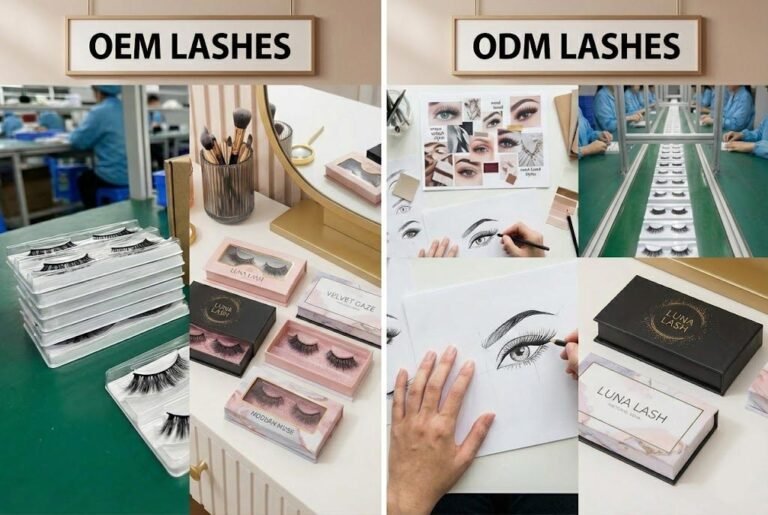
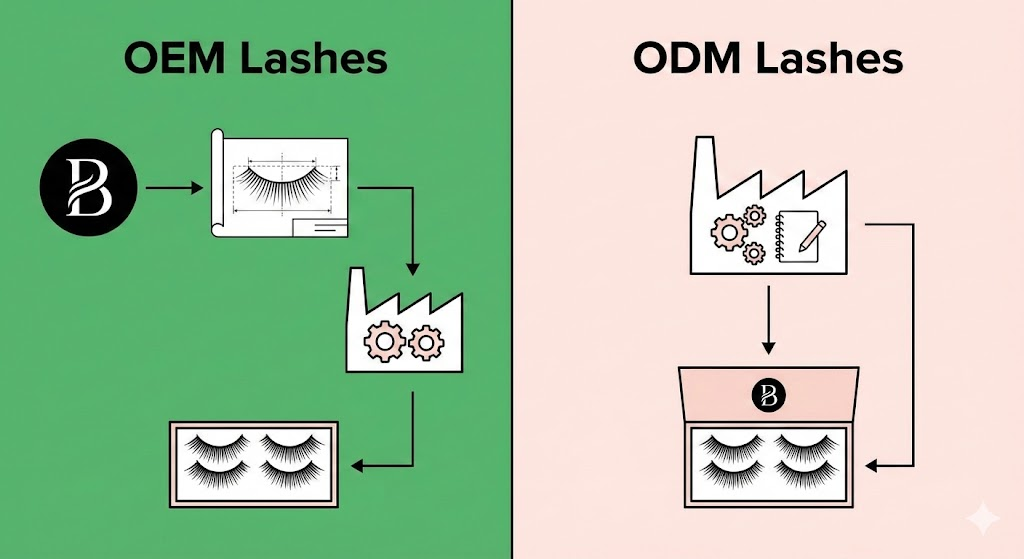
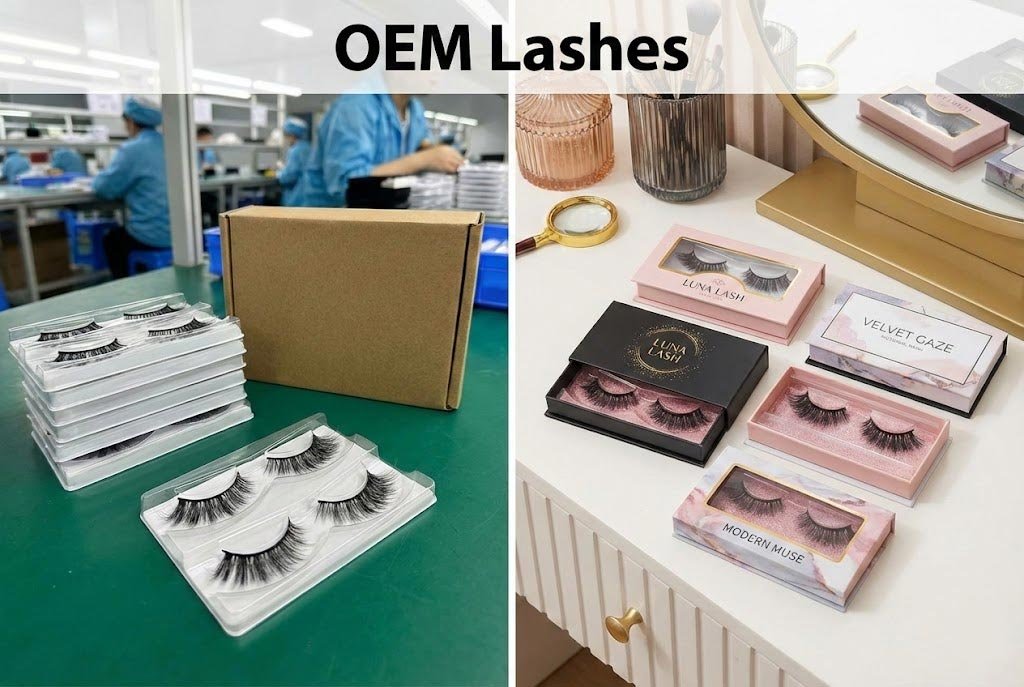
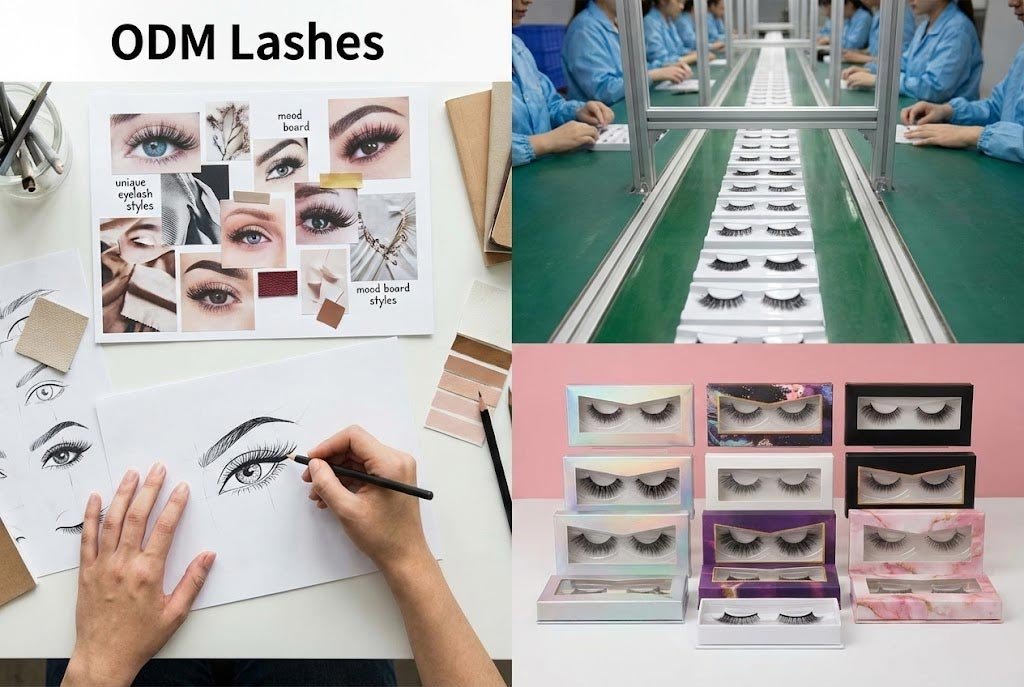
OEM lashes are manufactured to your brand’s specifications (style, curl map, fiber feel, band design, packaging). ODM lashes start from the factory’s pre-developed styles—you choose a proven design and brand it. In practice: OEM = maximum control and defensibility, while ODM = faster launch and easier testing.
If you only remember one rule:
- Choose OEM when consistency + signature results are your business model.
- Choose ODM when speed + variety + market testing are your business model.
OEM vs ODM lashes comparison (quick table)
| Decision factor | OEM lashes | ODM lashes |
|---|---|---|
| Starting point | You define the spec | You pick from factory designs |
| Customization | Deep (materials, band, mapping, packaging) | Light–moderate (logo/box + small tweaks) |
| Speed to launch | Slower (sampling & spec lock) | Faster (production-ready styles) |
| Upfront investment | Higher (development + tooling/packaging) | Lower (less R&D time) |
| Unit cost (long-term) | Often improves at scale | Often stable, depends on catalog pricing |
| MOQ drivers | Custom materials/packaging increase MOQs | Catalog styles often allow lower MOQs |
| Differentiation | Stronger (harder to copy) | Weaker unless exclusivity is negotiated |
| Best for | Signature best-sellers, salons, reorders | Trend drops, new brands, broad assortments |
Our quick decision checklist (7 questions)
- Do you need a signature lash customers reorder for months? → OEM
- Are you launching fast for a seasonal promo or new menu? → ODM
- Will product inconsistency create refunds or lost salon trust? → OEM
- Are you still learning what your audience buys? → ODM
- Do you need exclusivity (hard to copy)? → OEM (or strict ODM contract terms)
- Is your budget better spent on packaging + marketing first? → ODM
- Do you want to claim “engineered comfort/consistency” with tighter specs? → OEM
OEM vs ODM lashes: deeper definitions and lash-specific examples
OEM lashes (Original Equipment Manufacturer)
With OEM, you (and we, as your manufacturer partner) define the product specifications, and the factory produces to that spec. In lashes, a spec isn’t just “wispy.” It can include:
- curl and length map
- fiber feel/finish
- band type and thickness
- packaging protection
What you can do today: pick your “hero lash” (the one you’d keep even if you cut the whole line). Write down what makes it special in plain words: “thin band,” “soft spikes,” “light on the lid,” “holds a C curl after a full day.” That list becomes your OEM starting brief.
If you’re ready to turn that brief into a production spec (curl map, band options, packaging protection), our team breaks down the workflow step by step here: [OEM/ODM Manufacturing Services].
ODM lashes (Original Design Manufacturer)
With ODM, the manufacturer already has production-ready lash styles (and often packaging formats). You choose from the library and brand it—usually with options for logo, box design, and light style tweaks.
What you can do today: make a “must-have vs nice-to-have” list. ODM works best when your must-haves are clear (e.g., “thin band, natural, 10–14 mm range”) and your timeline is tight (e.g., a seasonal launch or a new salon menu).
OEM vs ODM vs Private Label Lashes: they’re related, but not the same
We see this confusion constantly, so we’ll simplify it:
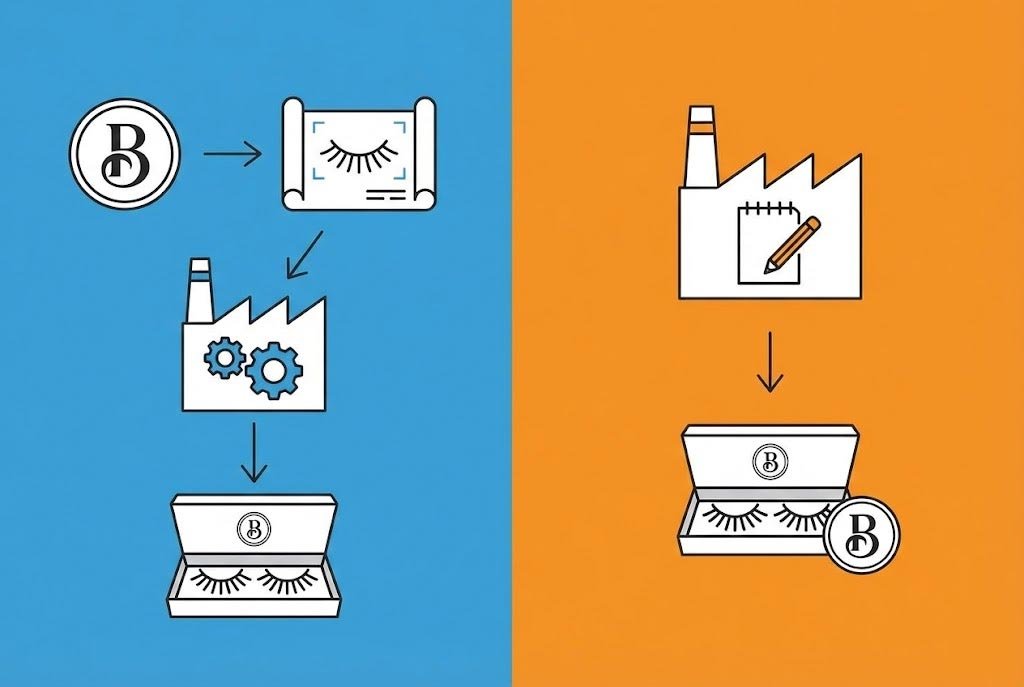
- OEM / ODM describes how the lash product is developed and manufactured (custom spec vs factory design).
- Private label describes how the product is branded and sold (your logo, your packaging, your positioning).
That means you can have:
- ODM + private label: you pick an existing lash style, we customize the box and brand it as yours.
- OEM + private label: you define your own lash spec, and it’s manufactured and branded for your line.
What to do today: look at your packaging plan. If your brand is still testing names, colors, and positioning, ODM + private label often makes sense first. If your brand is already known for a signature look, OEM + private label creates a product customers can’t easily replace.
Quick examples (so you can self-identify)
- You’re likely ODM-first if you want 10 styles fast to cover “natural → glam,” and you’ll refine later.
- You’re likely OEM-first if your customers ask for the same look repeatedly and you need it consistent for reorders.
MOQ, lead time, and cost: what really changes between OEM and ODM lashes
When people compare OEM vs ODM, they usually think they’re choosing a lash style. In reality, they’re choosing a manufacturing workflow—and that workflow affects MOQ, timing, and budget.
MOQ (Minimum Order Quantity): what drives it
MOQ isn’t one fixed number. It’s the factory’s way of protecting efficiency—setting a minimum so a production run makes business sense.
MOQ usually increases when:
- you want custom packaging (especially unique box structures, trays, inserts)
- you request non-standard lash specs (special band construction, unusual style mapping, uncommon materials)
- you require exclusivity (because the factory can’t resell that design easily)
MOQ is usually easier (lower or more flexible) when:
- you choose a standard ODM lash style
- you keep packaging simple at first (one box, one insert, clear labeling)
- you launch with fewer SKUs (so you don’t split your order too thin)
What to do today: decide which part must be custom on day one. If you can keep either the lash or the packaging standard at launch, MOQ pressure usually drops.
Lead time: why OEM typically takes longer
Think of lead time as two different clocks:
- Sampling clock (getting the product exactly right)
- Production clock (making the approved version at scale)
OEM tends to add time because the sampling clock is longer—you may need multiple rounds to translate “soft” and “weightless” into measurable specs.
ODM tends to be faster because the base style already behaves predictably in production.
What to do today: choose your timeline anchor:
- If you have a fixed launch date (holiday, salon menu update), ODM often protects that deadline.
- If you’re building a hero product for long-term reorder revenue, OEM’s extra sampling time can pay for itself.
Cost: setup costs vs unit costs (and where brands get surprised)
Most lash projects have two cost types:
- Setup costs: samples, custom packaging design, molds/tools (if relevant), additional QC requirements
- Unit costs: cost per pair/tray once production is running
OEM often increases setup costs (more development + testing) but can improve long-run consistency and reduce returns.
ODM often reduces setup costs but may limit differentiation unless you add value through packaging, education, and bundles.
What to do today: build a simple “launch budget” with three lines:
- Product development (sampling rounds)
- Packaging (box + insert + protection)
- First production run (your initial inventory)
If that feels heavy, start with ODM + private label, gather real sales data, then upgrade your best-seller to OEM.
A realistic hybrid strategy (what we see work most often)
If you want both speed and defensibility, the most practical plan is:
- Launch with ODM to test which styles actually sell
- Convert the top 1–2 winners into OEM (your signature spec + tighter QC)
- Keep trend styles as ODM so you can rotate quickly without overinvesting
What to do today: label your planned SKUs as either:
- Core (must reorder) → candidate for OEM
- Seasonal/trend (nice-to-have) → keep as ODM
The science behind “premium feel” (and why it affects returns)
When people say “premium,” they’re often describing measurable physical properties. Knowing these helps you decide whether you need OEM-level control or an ODM shortcut.
Fiber behavior: softness, spring, and curl memory
Most modern synthetic lashes are made from thermoplastic fibers (often polyester-family materials such as PBT), because they can be heat-set into stable curls and recover shape after wear. “Softer” usually means finer diameter, better tapering, and a smoother surface finish—less friction against the lid.
If you’d like a quick breakdown of fiber options, softness cues, and what impacts curl memory in real wear, we keep a plain-English guide here: [Lash Materials Guide].
Try this: compare two samples by brushing them across the back of your hand. The one that feels smoother usually has better tapering/finishing. If your brand promise is “weightless comfort,” this is a variable worth controlling (often pointing toward OEM).
Band engineering: comfort and corner lift
For strip lashes, the band is the interface with skin. A thicker band can be easier to apply but may feel stiff or lift at corners; a thin band can disappear visually but requires tighter manufacturing tolerance.
Try this: do a simple bend-and-return test. Bend the band into a U-shape, release, and watch how it returns. A good band springs back without warping—often a practical predictor of corner fit.
Adhesives and finishes: the “sensitizer” conversation
Adhesives are where most sensitivity concerns live. In professional extension settings, cyanoacrylates are common and are known sensitizers; case reports and reviews describe eyelid dermatitis related to ethyl 2-cyanoacrylate and other acrylates (Symanzik et al., 2022; Yamaguchi et al., 2017). Research also suggests eyelash extensions can cause short-term ocular surface changes in some users (Han et al., 2023).
What this means for brands: we don’t diagnose, but we do recommend you build a clear safety script: if someone has significant redness, swelling, pain, discharge, or any vision changes, they should stop use and seek medical care from an eye-care professional.
OEM lashes: when control and repeatability are the priority
OEM is usually the right choice when your brand is anchored on a signature result—especially if you sell through salons, rely on consistent reorders, or plan to tell a “designed for comfort” story with evidence.
Where OEM shines
- Repeatability across batches
When specs are locked, quality control can be measured (band thickness, curl profile, fiber behavior). That reduces the “why does this reorder feel different?” problem. - Real differentiation
If competitors can find a similar lash in a public catalog, your best-seller is easier to copy. OEM makes it easier to build a style that’s truly yours. - Better risk management
OEM forces documentation: what changed, when, and why. That’s not glamorous, but it prevents silent material swaps that can create inconsistent wear.
For fast launches, we recommend choosing a small test set first—here’s how to request a curated set based on your target look and price point: [Request Samples].
The tradeoffs you should plan for
- Sampling rounds (you’re buying clarity): you may need a few iterations to translate “softer” into a measurable spec.
- Upfront cost: custom packaging, development, and testing add cost, but often reduce returns and reputational risk later.
- More decisions: OEM rewards teams willing to think about details.
Practical shortcut: a hybrid line is common. OEM one hero SKU (the one you’ll defend for years), and use ODM for trend styles you rotate.
ODM lashes: when speed, variety, and market testing matter most
ODM is how many brands build momentum quickly—especially early on. It’s not “less professional.” It’s a different strategy: validate demand first, then invest deeper where it counts.
Where ODM shines
- Fast time-to-market
You’re starting from production-ready designs, which often means fewer technical surprises during scale-up. - Lower development risk
A style that has been produced many times usually has known yield rates and stable manufacturing behavior. - Easy assortment building
You can cover natural → glam quickly, learn what reorders, and use real sales data to decide what deserves OEM investment.
The tradeoffs you should manage
- Differentiation is harder: another brand may sell a similar base style.
- Control is partial: deep structural changes often push you into OEM.
- Exclusivity must be negotiated: if you need “only us,” put it in the contract.
Brand-building tip: if the lash itself isn’t unique, make the system unique—application education, aftercare inserts, bundles, and packaging UX. Those are harder to copy and often drive loyalty.
Quality and safety: what we ask for in any OEM or ODM project
No matter which model you choose, we recommend treating lashes like what they are: cosmetic products used near sensitive tissue. “Quality” is a mix of performance, hygiene, and documentation.
1. Ask about GMP, not just pretty factory photos
Cosmetics Good Manufacturing Practices frameworks like ISO 22716 describe expectations for production, storage, and shipment controls. The goal is simple: clean process + trained staff + documented procedures = fewer surprises.
Ask this: “Do you follow ISO 22716 (or an equivalent cosmetics GMP system)? What does your incoming material inspection include?”
2. Ask how they control contamination and traceability
The FDA flags cosmetics for microbiological contamination and maintains import alert programs for products that meet detention criteria. While lashes are not as contamination-prone as water-based creams, accessories and adhesives still deserve documentation.
Request a basic dossier:
- raw material COA (certificate of analysis) for key components
- finished-goods test reports (especially for adhesives)
- batch numbers + retention samples (traceability)
3. Run simple, repeatable performance tests on samples
You don’t need a lab to screen suppliers; you need consistency. We recommend a one-page scorecard and two independent testers.
Three easy tests:
- Humidity curl check: steam exposure (bathroom after a hot shower) vs a dry control.
- Band integrity: apply with your intended adhesive, then check corner lift and warping.
- Shedding screen: brush 20 times with a clean spoolie and count loose fibers.
Safety note (because this product sits next to the eye): Even the best OEM/ODM sourcing can’t eliminate individual sensitivity. If a customer experiences significant redness, swelling, burning, pain, discharge, or any vision changes, they should stop use immediately and seek evaluation from an eye-care professional. For brands, we recommend including a short “stop-use” script in your packaging insert and customer support macros so your team can respond consistently and responsibly.

A decision guide we use with clients: 7 questions
- Is your business a signature look or a wide assortment?
Signature → OEM. Wide assortment/seasonal drops → ODM (or hybrid). - How costly is inconsistency for you?
High (salons, retail programs, subscriptions) → lean OEM + QC. - What’s your timeline?
Weeks → ODM. Months with long-term payoff → OEM. - Where is your differentiation?
Product engineering → OEM. Community/service/content → ODM. - Do you need exclusivity?
Easier with OEM. Possible with ODM, but contract-dependent. - What order volumes are realistic?
Lower, flexible volumes often fit ODM. Stable higher volumes support OEM economics. - What claims do you want to make responsibly?
If you want “engineered comfort” or “consistent curl,” OEM gives you clearer specs to test.
Common paths we see:
- New brand testing demand → ODM now, OEM later for the best seller.
- Salon with a signature mapping → OEM hero style + matching trays.
- Distributor covering many tastes → ODM assortment + OEM for the top reorder SKU.
How we do OEM/ODM at Lashvee (and how you can copy the method)
On our website, we describe Lashvee as a professional eyelash manufacturer supporting OEM and private label wholesale, with custom styles and factory-direct production support. We also emphasize a data-driven approach to consistency.
Here’s the method we recommend—whether you work with us or any supplier:
Step 1: Define the wear experience
Give two real customer stories (e.g., “12-hour shift comfort” vs “weekend glam”). This quickly clarifies band choice, density, and packaging protection.
Step 2: Choose a model and lock the risk points
- ODM: pick proven styles; focus customization on packaging UX, bundles, and education.
- OEM: iterate samples until the spec is clear, then document it so reorders stay consistent.
Step 3: Approve with a scorecard, not vibes
Run the same three sample tests every time, and keep notes. Over a few rounds, you’ll see patterns—strong suppliers get more consistent, not just “prettier.”
To make this easy, we’ve laid out our full workflow (sampling → spec confirmation → packaging → production → QC → shipping) here: [OEM/ODM Manufacturing Services].
Step 4: Build your safety and support script
Near-eye products deserve clear guidance. We recommend an insert and a customer-service script that encourages people to stop use and seek medical care if symptoms are significant.
Key takeaways
- OEM lashes fit brands that need deep control, repeatability, and long-term differentiation.
- ODM lashes fit brands that need speed, variety, and a low-risk way to validate demand.
- “Science-based” in lashes means controlling variables: materials, band behavior, hygiene controls, and repeatable testing.
- A hybrid strategy (OEM for the hero SKU, ODM for rotating trends) is often the most practical path.
Quick FAQ (People Also Ask)
Is ODM the same as private label lashes?
Not exactly. Private label describes branding (your logo/packaging). OEM/ODM describes how the product is developed. You can private label an ODM style (fastest), or private label an OEM style (most customized).
Is OEM always higher quality than ODM?
No—OEM is about control, not automatic superiority. A great ODM style can perform beautifully because it’s been produced many times. OEM becomes valuable when you need repeatability, customization, and a defensible hero SKU.
What affects MOQ and lead time for OEM/ODM lashes?
The biggest drivers are custom packaging, custom materials, and how many sampling rounds it takes to lock a spec. ODM tends to be faster because the production line already “knows” the design; OEM takes longer because we’re building and documenting your exact variables.
References (APA)
Han, J., Xie, Z., Zhu, X., Ruan, W., Lin, M., Xu, Z., Miao, L., Zhong, J., Lu, F., & Hu, L. (2023). The effects of eyelash extensions on the ocular surface. Contact Lens and Anterior Eye, 46(6), 102109. https://doi.org/10.1016/j.clae.2023.102109
International Organization for Standardization. (2007). ISO 22716:2007 Cosmetics—Good Manufacturing Practices (GMP)—Guidelines on good manufacturing practices. https://www.iso.org/standard/36437.html
Symanzik, C., Weinert, P., Babić, Ž., Hallmann, S., Havmose, M. S., Johansen, J. D., & Uter, W. (2022). Allergic contact dermatitis caused by 2-hydroxyethyl methacrylate and ethyl cyanoacrylate contained in cosmetic glues among hairdressers and beauticians who perform nail treatments and eyelash extension as well as hair extension applications: A systematic review. Contact Dermatitis, 86(6), 480–492. https://doi.org/10.1111/cod.14056
U.S. Food and Drug Administration. (n.d.). Eye cosmetic safety. https://www.fda.gov/cosmetics/cosmetic-products/eye-cosmetic-safety
U.S. Food and Drug Administration. (n.d.). Import Alert 53-17: Detention without physical examination of cosmetics due to microbiological contamination. https://www.accessdata.fda.gov/CMS_IA/importalert_136.html
Yamaguchi, A., Shimizu, T., & Tanei, R. (2017). A case of contact dermatitis caused by eyelash extension glue. Nihon Hifu Meneki Arerugy Gakkai Zasshi (Japanese Journal of Dermatoallergology and Contact Dermatitis), 11(4), 316–318.