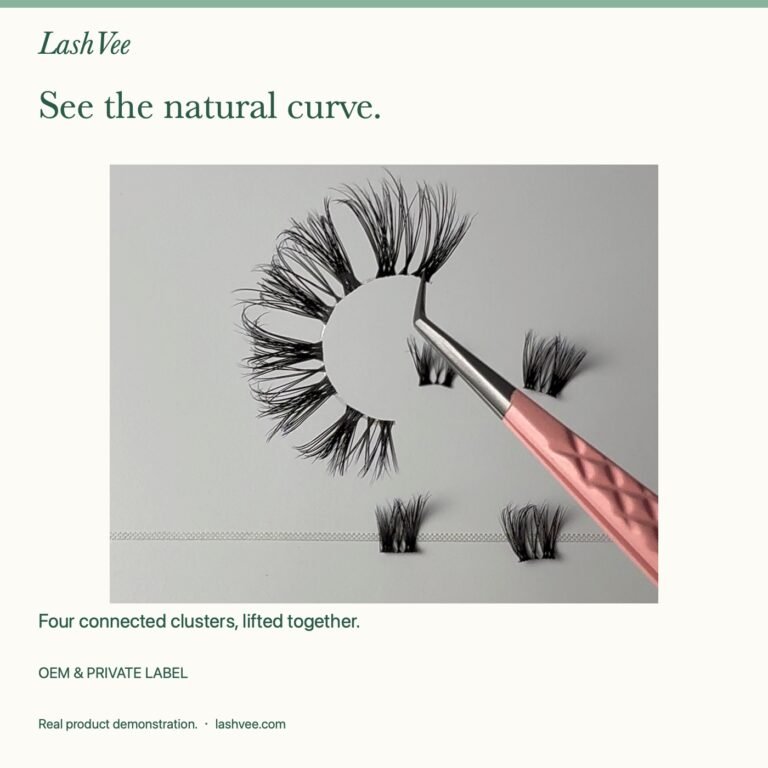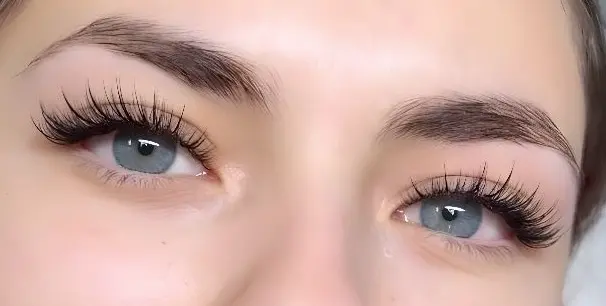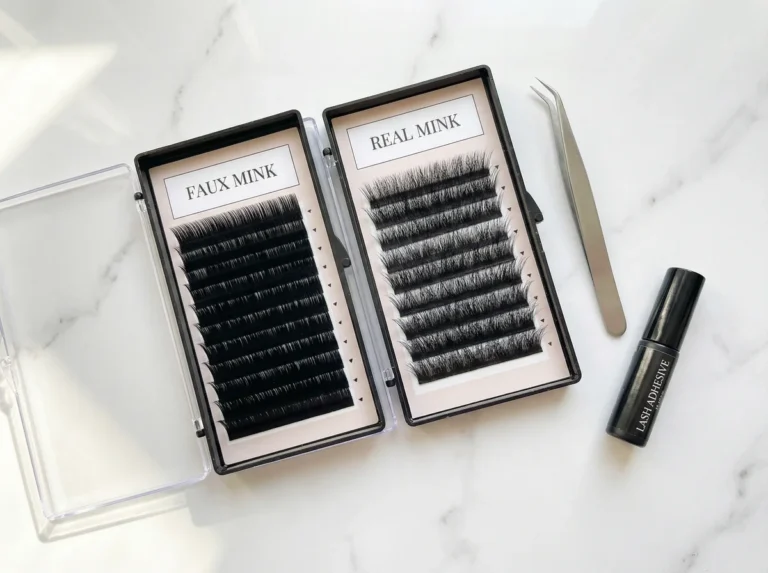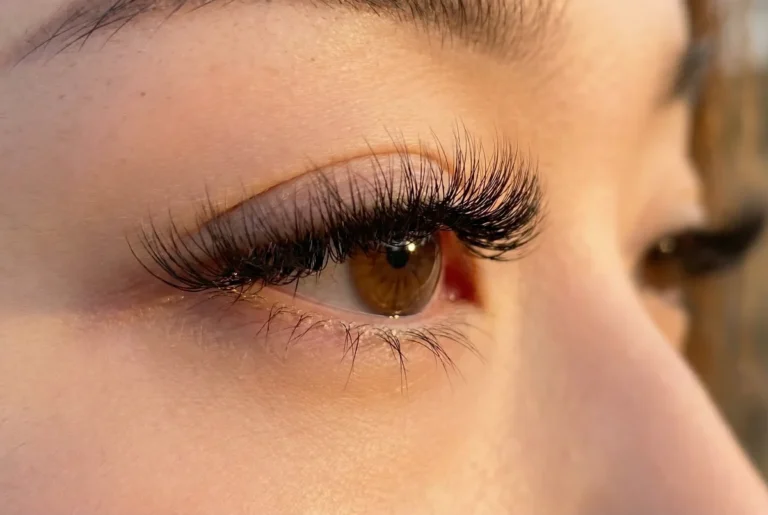

If you search “what are eyelashes made of?”, you’ll find a lot of vague answers (“silk”, “mink”, “synthetic”). The reality is more specific: most modern false lashes and lash extensions are made from engineered polymer fibres (commonly PBT), while some styles still use human hair or animal fur—though the fur category has been shrinking as major retailers and brands move away from mink.
This guide breaks down what lash fibres, bands, and adhesives are typically made from, why certain materials behave the way they do, and how to evaluate a lash product like a professional buyer.
The short answer: the three “material layers” of false lashes
When people ask what lashes are “made of,” they often mean the fibre—but a lash product usually has three relevant material layers:
- The lash fibre (what looks like “hair”)
- The band / base (what holds fibres together)
- The adhesive system (strip lash glue or extension glue + remover)
Most quality issues and most safety complaints come from #2 and #3 as much as #1—especially around the eye area, where irritation is more likely.
Synthetic fibres: why most lashes are really PBT (and why that eyelash material matters)
What is PBT?
PBT (polybutylene terephthalate) is a thermoplastic polyester used widely as an engineering polymer. In lash manufacturing, fibres can be produced, drawn to specific diameters, and then heat-set to hold curl and shape.
Why PBT dominates strip lashes and extensions
In practical terms, PBT is popular because it is:
- Shape-stable after heat-setting (curl consistency matters for C/D/CC/L curls and for mixed-length “wispy” maps)
- Process-friendly for mass production (consistent diameter, predictable behaviour in cutting/stacking)
- Flexible and durable (helps reduce mid-wear deformation and shedding when manufactured well)
This is why many “faux mink” and “silk” lashes are still fundamentally PBT—the label often describes the finish (matte vs glossy, taper style, softness) rather than a different polymer.
What PBT changes in real-world wear
If you’re comparing two lash products with similar styling, PBT-related differences usually show up as:
- Curl retention after steam/heat exposure
- Tip taper quality (natural vs blunt ends)
- Fibre rebound (does it bounce back after compression in packaging?)
- Consistency across batches (critical for wholesale buyers)
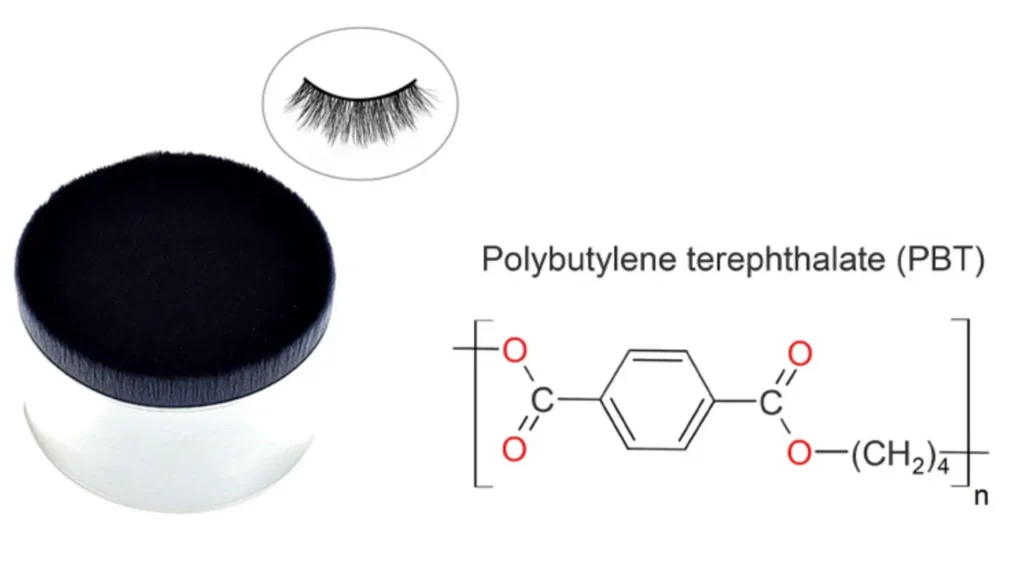
Synthetic fibres: why most lashes are really PBT
“Silk lashes” and “faux mink lashes”: what these names usually mean (and what to ask)
In the lash market, “silk” and “faux mink” are frequently trade descriptions, not strict fibre compositions. Many suppliers use these names for PBT lashes with different surface treatments and tapers.
Common usage in the industry
- “Silk” often implies: slightly thicker fibre diameter, a smoother sheen, a darker finish (but not always)
- “Faux mink” often implies: softer feel, more matte finish, finer taper, lighter appearance
The buyer’s checklist (the questions that get you real answers)
Instead of accepting “silk/faux mink” as a material statement, ask:
- What is the fibre polymer (PBT, PET, nylon blend, other)?
- What is the diameter range (e.g., 0.03–0.07 for volume fans; 0.10–0.20 for classics—varies by supplier system)?
- How is the curl set (heat-set, chemical treatment, hybrid process)?
- What finish is used (matte coating, glossy extrusion, dye process)?
- Are there batch records for curl consistency and fibre shedding?
Natural hair lashes: human hair and why it’s less common for premium consistency
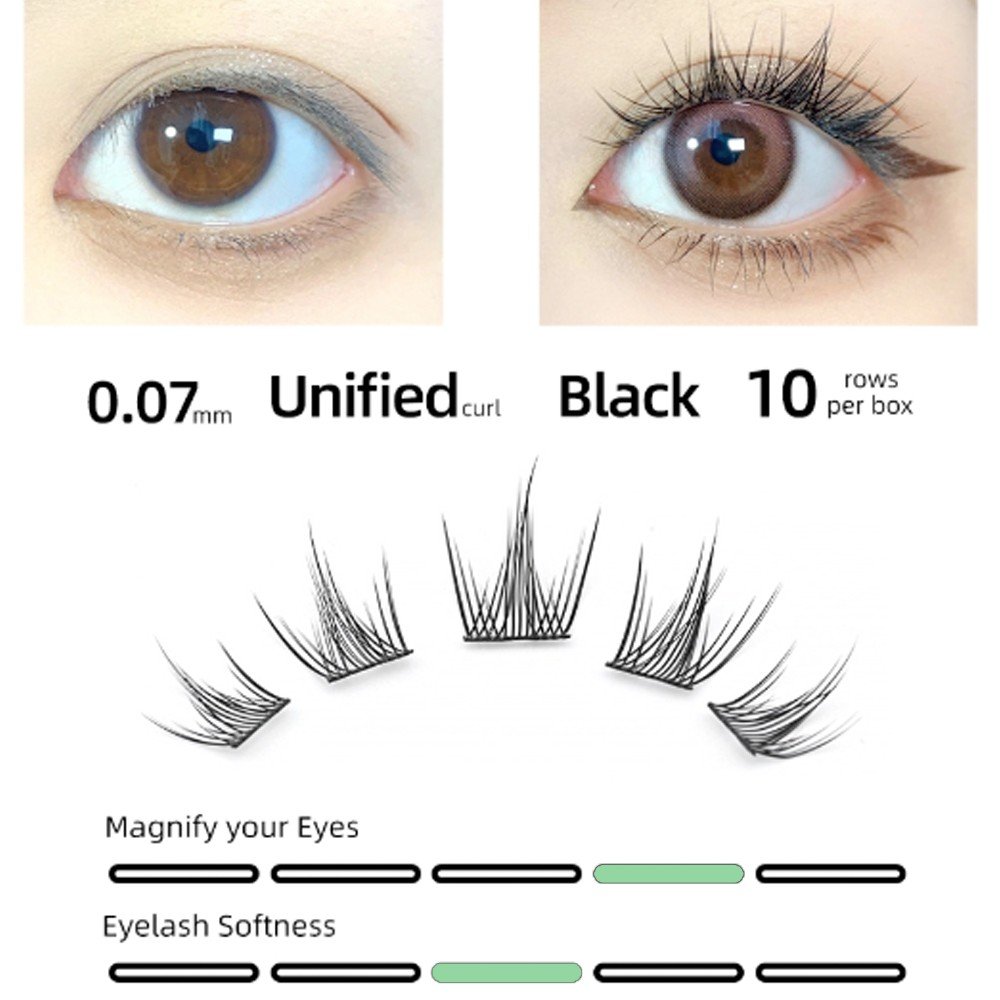
Some false eyelashes are made from human hair (or hair-like natural fibres). Historically, human hair lashes existed before modern synthetic manufacturing became dominant. Today, many brands prefer synthetics because they are easier to standardise.
Practical pros/cons for buyers
Pros
- Can look very natural in certain styles
- Some users like the “real hair” marketing narrative
Cons
- Harder to standardise diameter, taper, and curl consistency
- More variability across batches
- Requires careful hygiene and supply chain controls
If you are buying for professional resale, you’ll want clear documentation for processing and sanitation claims—not just “100% human hair” on a box.
Animal fur lashes (mink): what they are, and why the market moved away
“Mink lashes” traditionally refer to lashes made from mink fur. Concerns about animal welfare and supply chain transparency drove many beauty retailers and brands to phase them out or go “mink-free.”
For buyers, the key point is: even when a supplier claims “cruelty-free mink,” it can be hard to verify sourcing in a way that meets modern retailer standards—so synthetics increasingly replace fur in “luxury” positioning.
The lash band: cotton thread, clear bands, and what “thin band” really means
Even with excellent fibre, the band determines comfort, stability, and how “invisible” a strip looks.
Common band constructions
- Cotton thread / woven band: flexible, often comfortable; can hide glue well
- Clear band (polymer film): visually discreet; may feel stiffer depending on thickness
- Hand-made vs machine-made bonding: can affect glue penetration, bond strength, and durability (especially for very thin bands)
When a listing says “thin band,” you should still verify:
- band thickness (in mm)
- stiffness / rebound (subjective, but can be QC-tested)
- whether fibres are knotted, heat-fused, or adhesively bonded
Adhesives: what lash glues are made of (and why sensitivity happens)
This is where safety and compliance questions concentrate. The U.S. FDA notes that false eyelashes and eyelash extensions (and their adhesives) are cosmetic products and highlights the risk of irritation/allergic reaction around the delicate eye area.
Strip lash glue vs extension glue
- Strip lash adhesives are typically designed for skin contact and removability.
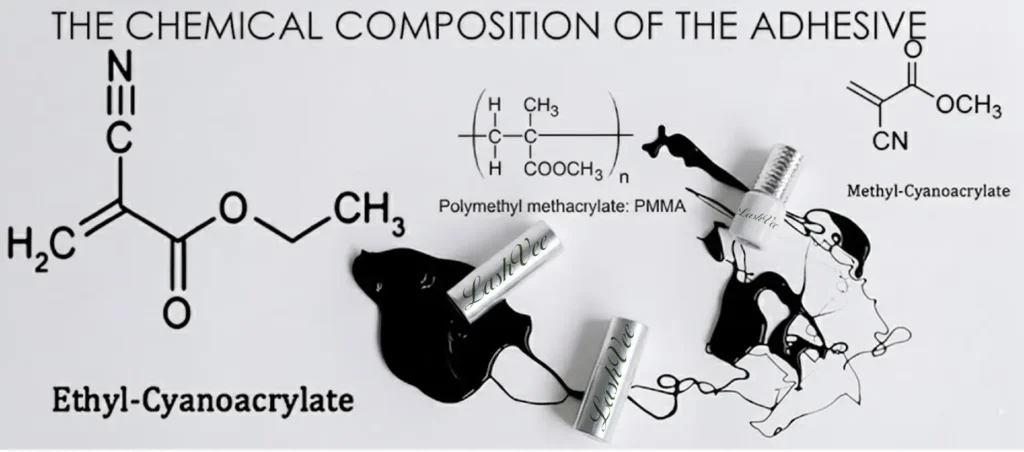
- Professional extension adhesives are commonly cyanoacrylate-based, curing rapidly with moisture.
What research and clinical literature highlight
Medical literature discussing eyelid cosmetic enhancements repeatedly points to cyanoacrylate-based adhesives and associated risks (irritation, contact dermatitis, ocular surface issues), especially when products are misused or fumes/exposure are high.
This doesn’t mean “all glue is dangerous”—it means buyers should take adhesive chemistry seriously:
- require ingredient transparency where applicable
- ensure ventilation guidance for professional use
- use patch-test guidance and clear warnings for sensitive users
How to read cosmetic labels for lash products (INCI, EU rules, and what’s realistic)
If you sell into regulated markets, you will encounter ingredient naming rules.
EU: ingredient naming and CosIng
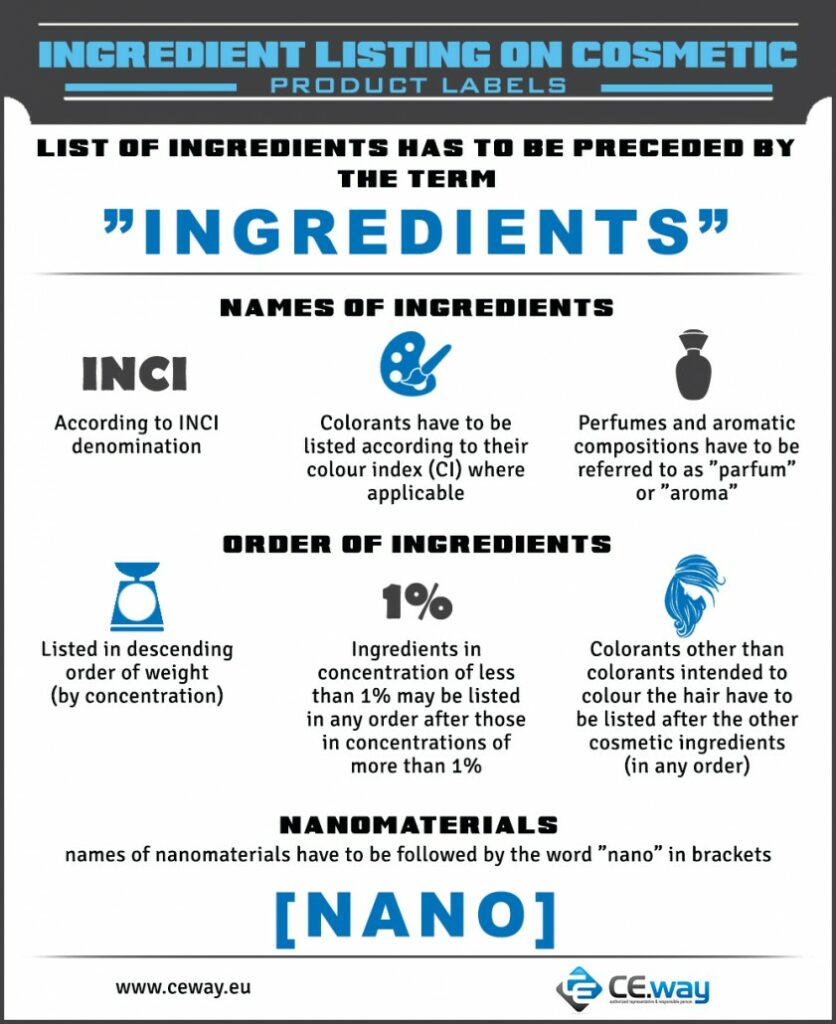
In the EU, cosmetic products must include an ingredient list using recognised nomenclature (INCI). The European Commission’s CosIng database supports ingredient naming and references the Cosmetics Regulation framework.
A practical note about “borderline” products (like some glues)
Regulatory classification can get nuanced for products whose main purpose is “adhesion.” The EU has an evolving “borderline” approach in guidance materials.
For brand owners and distributors, the operational takeaway is simple: treat lashes + glue + remover as a system, and make sure each component has documentation appropriate to its market (labeling, safety file, testing, claims substantiation).
What quality control should look like for lash materials (what professional buyers check)
If you’re sourcing wholesale, “material” is only meaningful if it is controlled.
Core QC points that connect to materials
- Fibre diameter and taper consistency (visual + measurement sampling)
- Curl stability testing (humidity/steam exposure, packaging compression recovery)
- Band bonding strength (peel/shear checks; especially for ultra-thin bands)
- Shedding and deformation rate (handling simulation)
- Cleanliness controls (dust, loose fibres, odor checks)
GMP signals buyers recognise
For cosmetics-adjacent products, many manufacturers align with ISO 22716 guidance for cosmetic Good Manufacturing Practices (GMP). It’s widely referenced as a GMP framework for production, control, storage, and shipment.

Safety and comfort: what actually causes irritation (it’s not always the lash fibre)
Most lash fibres (including PBT) are relatively inert in normal use; discomfort more often comes from:
- Adhesive ingredients or fumes (especially cyanoacrylates in extensions)
- Latex sensitivity (some glues)
- Mechanical irritation (sharp band edge, poor trimming, stiff clear band)
- Poor hygiene / reuse without cleaning (build-up at the lash line)
For content credibility, it’s worth stating clearly: if irritation occurs, users should stop use and seek medical advice—FDA provides channels for reporting cosmetic-related complaints.
Sustainability and ethics: what claims can be verified
“Sustainable lashes” is a tricky claim unless it is backed by evidence. What is usually verifiable:
- Mink-free / vegan fibre (if fibre is confirmed synthetic and no animal-derived processing aids are used)
- Packaging choices (paperboard, FSC options, reduced plastic—if documented)
- Process controls (waste management, batch traceability—internal systems)
What is often not verifiable without deeper auditing:
- “cruelty-free mink” supply chain claims (high skepticism in the market)
Summary Table of Eyelash Material Comparison
| Material Type | Actual Composition | Key Characteristics | Industry Notes |
|---|---|---|---|
| Synthetic (PBT) | Polybutylene Terephthalate | Heat-set curl, consistent diameter, durable | Most modern strip lashes & extensions |
| Faux Mink | PBT (treated) | Matte finish, fine taper, soft look | Marketing term, not animal fur |
| Silk Lashes | PBT (different finish) | Slight sheen, thicker fiber | “Silk” describes texture, not material |
| Human Hair | Natural human hair | Natural movement, variable curl | Less consistent batch to batch |
| Mink Fur | Animal fur | Lightweight, soft | Largely phased out (ethics & sourcing) |
Reference list
Brambilla, E., et al. (2020). Exposure to nail and false eyelash glue: A case series study. https://pmc.ncbi.nlm.nih.gov/articles/PMC7345203/

European Commission. (n.d.). CosIng – Cosmetic ingredient database. https://single-market-economy.ec.europa.eu/sectors/cosmetics/cosmetic-ingredient-database_en

European Commission. (n.d.). CosIng – Glossary of ingredients (INCI naming reference). https://single-market-economy.ec.europa.eu/sectors/cosmetics/cosmetic-ingredient-database/cosing-glossary-ingredients_en

European Union. (2009). Regulation (EC) No 1223/2009 on cosmetic products. https://health.ec.europa.eu/system/files/2016-11/cosmetic_1223_2009_regulation_en_0.pdf

Food and Drug Administration. (2022). Eye cosmetic safety. https://www.fda.gov/cosmetics/cosmetic-products/eye-cosmetic-safety

Food and Drug Administration. (2025). How to report a cosmetic product related complaint. https://www.fda.gov/cosmetics/cosmetics-compliance-enforcement/how-report-cosmetic-product-related-complaint

Lindström, I., et al. (2013). Occupational asthma and rhinitis caused by cyanoacrylate-based glues in eyelash extension work. *Occupational Medicine*. https://pubmed.ncbi.nlm.nih.gov/23553564/

Masud, M., et al. (2019). Eyelid cosmetic enhancements and their associated ocular adverse effects. *Clinical Optometry*. https://pmc.ncbi.nlm.nih.gov/articles/PMC6592309/

Moshirfar, M., et al. (2018). Chemical conjunctivitis and diffuse lamellar keratitis after eyelash extension removal. *Clinical Ophthalmology*. https://pmc.ncbi.nlm.nih.gov/articles/PMC6098230/

Pesonen, M., et al. (2012). Occupational allergic contact dermatitis caused by eyelash extension glues. *Contact Dermatitis, 67*(5), 307–308. https://pubmed.ncbi.nlm.nih.gov/23039004/

ScienceDirect Topics. (n.d.). Polybutylene terephthalate (PBT) – overview. https://www.sciencedirect.com/topics/medicine-and-dentistry/polybutylene-terephthalate

International Organization for Standardization. (2007). ISO 22716:2007 Cosmetics—Good Manufacturing Practices (GMP)—Guidelines on GMP. https://www.iso.org/standard/36437.html

Allure. (2020). Velour will no longer make mink lashes. https://www.allure.com/story/velour-stop-making-mink-false-lashes